- 250 pages
- English
- ePUB (mobile friendly)
- Available on iOS & Android
eBook - ePub
About this book
The Chinese Consumer Market examines the changing consumer business environment in China and offers predictions about the evolution of the Chinese consumer market in the different sectors as well as the likely strategic implications for global consumer oriented companies.
- The first book is in English made by Chinese researchers with a Chinese viewpoint of developments
- Provides the management implications in different sectors of the Chinese economy
- Predicts future trends
Information
1
Chinese consumer trends
Introduction
The Chinese consumer market is huge and offers enormous potential opportunities. China has been the world’s leading producer of many industrial materials such as steel, copper, aluminium, cement and coal for several years. As a resource consumer, China surpassed Japan as the globe’s second largest importer of petroleum in 2005 and as the world’s second largest auto market in 2006, with total sales of 7.2 million vehicles and a production level of 7.3 million. In 2007, China also became the world’s top producer of merchant ships. Simply phrased, China is an economic superpower.
China’s rise as an economic superpower is likely to pose both opportunities and challenges for the world trading system. The rapid increase in consumer income is making China a huge market for a variety of goods and services, and its abundant low-cost labour is leading multinational corporations to shift their export-oriented, labour-intensive manufacturing facilities to the country. Meanwhile, developed and developing nations are concerned that China’s FDI is coming at the expense of FDI in their own countries and that they have not only lost domestic manufacturing jobs to China, but also have to face the economic pressures of pitting their products against cheaper Chinese products.
Chinese consumers are in the midst of an economic boom and a lifestyle revolution. The Chinese have emerged from prolonged global isolation and lack of consumer choice to becoming the world’s fastest growing economy. From affluent urban youths to mobile professionals to the rural elite, consumers are hungry for creative products and services to satisfy their emotional, intellectual and social needs (Figure 1.1).
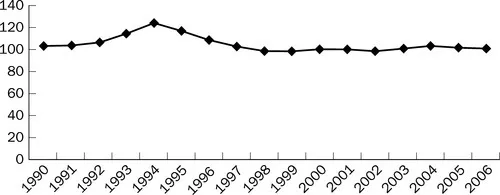
Figure 1.1 Consumer price index in China Source: China Statistical Yearbook, 2007.
Several things will, or may, happen in the near future that will hasten the development of this huge consumer market. These include increased foreign interest in China’s retail sector; possible revaluation of the Chinese currency; the Chinese government’s efforts to shift the sources of economic growth from investment and exports towards consumer spending and the accelerated reform of China’s banking system, which will result in a bigger and more efficient market for consumer credit.
In China, consumption is currently only 50 per cent of its gross domestic product (GDP), which is way below the 65 per cent norm in most major economies. Put another way, 20 per cent of the world’s population accounts for only about 3 per cent of total global consumption. The potential of the Chinese consumer could well be one of the greatest opportunities for the global economy in the 21st century.
When doing business in China, it is important to understand traditional Chinese culture and consumption behaviour.
Chinese traditional culture and its values
Culture is of critical relevance to marketers in China because successful strategies cannot be developed without taking into account the specific features of the regional culture. Relationships and group orientation are deeply rooted in the culture that permeates all aspects of Chinese society. Confucianism, Taoism and Buddhism have shaped Chinese traditional cultures (Zheng, 1997), as these three doctrines were an important part of daily life in old China and are so even today.
Confucianism and its core beliefs
Confucianism, which developed from the teachings of Confucius or Kung-fu-tzu, was the most influential Chinese religion. It was the state religion from the start of the Han Dynasty in 202 BC to the end of the imperial epoch in 1911. Confucius, a Chinese scholar and political figure, lived during feudal times (over 2,000 years ago). He established an ethical and moral system that governs all relationships: father and son, ruler and ruled, husband and wife, elder brother and younger brother and between friends.
Confucianism views the family as the basic unit of society. Certain reciprocal relationships and responsibilities must be observed to preserve harmony. A specific hierarchy is pragmatic, and Confucianism places the greatest importance on rank and age in all interactions. Saving face and not causing shame to another are important. Since the family is the core unit, all the actions of an individual reflect on the family when the virtues of kindness, righteousness, propriety, intelligence and faithfulness are practised (Table 1.1).
Table 1.1
Confucianism and core beliefs
| Confucian doctrine | Essential beliefs |
| Five ethical elements | The relationships between father and son; ruler and ruled; husband and wife; elder brother and younger brother; and friends. |
| Six virtues of humanity | Ren: benevolence, humaneness toward others – the highest Confucian virtue Li: includes ritual, propriety, etiquette, etc. Xiao: love within the family: love of parents for their children and of children for their parents Yi: righteousness Xin: honesty and trustworthiness Cheng: loyalty to the state, etc. |
| Sacred texts | The Si Shu or Four Books The Wu Jing or Five Classics |
Confucianism is the philosophy of living rather than a religion and may guide one’s life while one practices other religions, such as Taoism and Buddhism, without contradiction.
Taoism
Taoism is the most important strain of Chinese thought after Confucianism through the ages. Although almost entirely different from Confucianism, it is not contradictory. The Tao does not concern with affairs of the state, mundane or quotidian matters of administration, or elaborate rituals; rather, it encourages avoiding public duty to search for a vision of the transcendental world of the spirit (Table 1.2).
Table 1.2
The way of Taoism
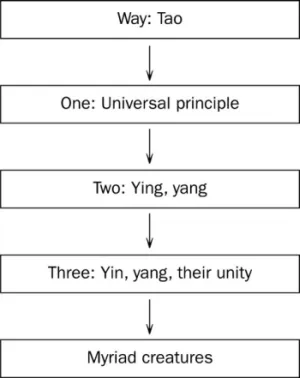
Taoism is based on the idea that behind all material things and all the change in the world lies one fundamental, universal principle: the way of Tao, which is the interplay between five elements (i.e. metal, wood, water, fire and earth), and the interdependence between the macrocosm and the microcosm (e.g. man’s relation to the universe). This principle gives rise to all existence and governs everything – all change and all life. The purpose of human beings is then to live life according to the Tao, which requires passivity, calmness and non-strife, known by Taoists as ‘Wu Wei’ (Table 1.3).
Table 1.3
Taoism and core beliefs
| Taoism doctrine | Core beliefs |
| Eternality | The ineffable, eternal, creative reality is the source and end of all things. |
| Principle of Wu Wei | The Taoist prefers a life of total inactivity. It is rather a life of no purposeful action. |
| Moral wisdom | ‘Manifest the simple’, ‘embrace the primitive, reduce selfishness, have few desires’. |
| Harmony between human beings and nature | The Tao is in harmony with one’s original nature. An individual in harmony with the Tao comprehends the course of nature’s constant change and does not fear the rhythm of life and death. |
| Immortality | Achieving immortality: dietary regimens, breath control and meditation, sexual disciplines, alchemy, the use of magical talismans and the search for healthy, vitality, long life, etc. |
| Sacred Texts | Tao-De-Ging (The Way of Power) |
When Yin and Yang embrace each other, they reveal that they are not a world that can be divided into black and white, but black in white and white in black, forming a unity (Figure 1.2).
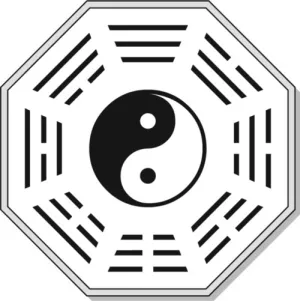
Figure 1.2 Yin: dark, moist, feminine and Yang: bright, dry, masculine
Taoism is not a religion; it is a philosophy – a way of looking at life and a way of thinking about things. Taoists believe that if one looks at life and thinks about things in the right way, then one will be much happier.
Buddhism
Buddhism, though introduced to China from India between 58 and 76 AD, began to flourish only in the third century. It evolved around the teachings of Siddhartha Gautama, or Buddha, a contemporary of Confucius.
Buddhism believes that desire is the source of all pain and that pain can be overcome by suppressing desire through meditation.
The main Buddhist values are love, wisdom, goodness, calmness and self-control. Buddhists believe that people should try to end suffering; all things should be seen as having no self or essential nature. Nothing should be seen as literally existing or ‘standing apart’ from all other things in self-sustained independence. On the contrary, all things should be seen as arising interdependently and as ultimately empty of any permanently abiding essence. In an...
Table of contents
- Cover image
- Title page
- Table of Contents
- Copyright page
- About the author
- 1: Chinese consumer trends
- 2: The Chinese automobile market
- 3: The cosmetic sector in China
- 4: Chinese Internet consumer behaviour
- 5: The Chinese mobile value-added services market
- 6: The Chinese media market
- 7: The Chinese 3G market
- 8: The Chinese wine market
- 9: The Chinese real estate market
- 10: The Chinese pharmaceutical products market
- 11: The Chinese tourism market
- Conclusion
- Abbreviations
- Index
Trusted by 375,005 students
Access to over 1.5 million titles for a fair monthly price.
Study more efficiently using our study tools.
Frequently asked questions
Yes, you can cancel anytime from the Subscription tab in your account settings on the Perlego website. Your subscription will stay active until the end of your current billing period. Learn how to cancel your subscription
No, books cannot be downloaded as external files, such as PDFs, for use outside of Perlego. However, you can download books within the Perlego app for offline reading on mobile or tablet. Learn how to download books offline
Perlego offers two plans: Essential and Complete
- Essential is ideal for learners and professionals who enjoy exploring a wide range of subjects. Access the Essential Library with 800,000+ trusted titles and best-sellers across business, personal growth, and the humanities. Includes unlimited reading time and Standard Read Aloud voice.
- Complete: Perfect for advanced learners and researchers needing full, unrestricted access. Unlock 1.5M+ books across hundreds of subjects, including academic and specialized titles. The Complete Plan also includes advanced features like Premium Read Aloud and Research Assistant.
We are an online textbook subscription service, where you can get access to an entire online library for less than the price of a single book per month. With over 1.5 million books across 990+ topics, we’ve got you covered! Learn about our mission
Look out for the read-aloud symbol on your next book to see if you can listen to it. The read-aloud tool reads text aloud for you, highlighting the text as it is being read. You can pause it, speed it up and slow it down. Learn more about Read Aloud
Yes! You can use the Perlego app on both iOS and Android devices to read anytime, anywhere — even offline. Perfect for commutes or when you’re on the go.
Please note we cannot support devices running on iOS 13 and Android 7 or earlier. Learn more about using the app
Please note we cannot support devices running on iOS 13 and Android 7 or earlier. Learn more about using the app
Yes, you can access The Chinese Consumer Market by Lei Tang in PDF and/or ePUB format, as well as other popular books in Business & Marketing. We have over 1.5 million books available in our catalogue for you to explore.