- 646 pages
- English
- ePUB (mobile friendly)
- Available on iOS & Android
eBook - ePub
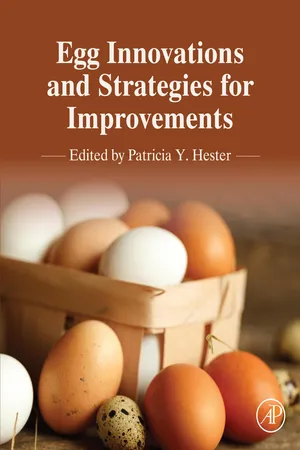
Egg Innovations and Strategies for Improvements
About this book
Egg Innovations and Strategies for Improvements examines the production of eggs from their development to human consumption. Chapters also address consumer acceptance, quality control, regulatory aspects, cost and risk analyses, and research trends.
Eggs are a rich source of macro- and micronutrients which are consumed not only by themselves, but also within the matrix of food products, such as pastas, cakes, and pastries. A wholesome, versatile food with a balanced array of essential nutrients, eggs are a stable of the human diet. Emerging strategies entail improvements to the composition of eggs via fortification or biological enrichment of hen's feed with polyunsaturated fatty acids, antioxidants, vitamins, or minerals. Conversely, eggs can be a source of food-borne disease or pollutants that can have effects on not only human health, but also egg production and commercial viability.
Written by an international team of experts, the book presents a unique overview of the biology and science of egg production, nutrient profiling, disease, and modes for increasing their production and quality. Designed for poultry and food scientists, technologists, microbiologists, and workers in public health and the food and egg industries, the book is valuable as an industrial reference and as a resource in academic libraries.
- Focuses on the production and food science aspects of eggs
- Includes a broad range of microbial contaminants, their risks, and prevention, as well as non-microbial contaminant risks
- Presents analytical techniques for practical application
Information
Section X
Microbial or Parasitic Contaminants
Chapter 48: Salmonella and Impact on Egg Production
Chapter 49: Colibacillosis and Its Impact on Egg Production
Chapter 50: Mycoplasmosis in Egg Laying Flocks
Chapter 51: Avian Influenza Virus and Newcastle Disease Virus
Chapter 52: Infectious Bronchitis
Chapter 53: Coccidiosis in Egg Laying Poultry
Chapter 54: Mycotoxin Impact on Egg Production
Chapter 55: Parasites in Laying Hen Housing Systems
Chapter 48
Salmonella and Impact on Egg Production
Richard K. Gast
Deana R. Jones United States Department of Agriculture, Agricultural Research Service, Egg Safety and Quality Research Unit, Athens, GA, United States
Abstract
There is a strong association between the incidence of human illness and the prevalence of Salmonella in commercial egg-producing poultry. Although most egg-associated disease is attributed to Salmonella Enteritidis, other serovars are sometimes implicated. Deposition of S. Enteritidis within the edible contents of eggs results from colonization of reproductive tissues in infected hens. Environmental conditions influence opportunities for Salmonella introduction, transmission, and persistence in laying flocks. Environmental influences are shaped by the various housing systems used in egg production. Substantial public and private resources have been invested in comprehensive S. Enteritidis testing and risk reduction programs for egg-laying chickens. A strategy involving multiple interventions throughout the egg production cycle is recommended as the most effective approach for controlling S. Enteritidis. Controlling temperature is critical for restricting Salmonella growth inside eggs.
Keywords
environmental contamination
systemic infection
risk reduction
egg production
egg processing
flock testing
egg culturing
housing system
Introduction: Salmonella Enteritidis and the egg industry
History and evolution of a public health and economic problem: The costs associated with human salmonellosis in the United States have been estimated as high as $11 billion each year (Scharff, 2012). Very little overall progress was documented in reducing the incidence of human Salmonella infections in the first decade of the present century, during which the incidence of infections with Salmonella enterica subspecies enterica serovar Enteritidis (Salmonella Enteritidis) infections increased by 44% (Chai et al., 2012). A dramatic international increase in the prevalence of S. enteritidis infections, first reported in the 1980s, is mostly attributed to the consumption of contaminated eggs (Braden, 2006). Both retrospective epidemiologic analyses and active disease surveillance efforts demonstrate an ongoing strong association between the incidence of human salmonellosis and the prevalence of S. Enteritidis in commercial egg-producing poultry flocks (Havelaar et al., 2013).
Significance of S. Enteritidis to the egg industry—risk analysis: The critically important relationship between environmental reservoirs of S. Enteritidis and infections of egg-producing chickens has been widely documented (Dewaele et al., 2012). Environmental conditions can directly affect opportunities for S. Enteritidis introduction, transmission, and persistence in laying flocks. The persistence of S. Enteritidis in poultry housing facilities generates opportunities...
Table of contents
- Cover
- Title page
- Table of Contents
- Copyright
- Dedication
- Contributors
- Section I: Introduction
- Section II: Management and Housing
- Section III: Food Safety
- Section IV: Composition of Eggs
- Section V: Use of Eggs
- Section VI: Improving Production
- Section VII: Improving Composition
- Section VIII: Preserving Eggs
- Section IX: Adverse Nonmicrobial Contaminants
- Section X: Microbial or Parasitic Contaminants
- Index
Trusted by 375,005 students
Access to over 1.5 million titles for a fair monthly price.
Study more efficiently using our study tools.
Frequently asked questions
Yes, you can cancel anytime from the Subscription tab in your account settings on the Perlego website. Your subscription will stay active until the end of your current billing period. Learn how to cancel your subscription
No, books cannot be downloaded as external files, such as PDFs, for use outside of Perlego. However, you can download books within the Perlego app for offline reading on mobile or tablet. Learn how to download books offline
Perlego offers two plans: Essential and Complete
- Essential is ideal for learners and professionals who enjoy exploring a wide range of subjects. Access the Essential Library with 800,000+ trusted titles and best-sellers across business, personal growth, and the humanities. Includes unlimited reading time and Standard Read Aloud voice.
- Complete: Perfect for advanced learners and researchers needing full, unrestricted access. Unlock 1.5M+ books across hundreds of subjects, including academic and specialized titles. The Complete Plan also includes advanced features like Premium Read Aloud and Research Assistant.
We are an online textbook subscription service, where you can get access to an entire online library for less than the price of a single book per month. With over 1.5 million books across 990+ topics, we’ve got you covered! Learn about our mission
Look out for the read-aloud symbol on your next book to see if you can listen to it. The read-aloud tool reads text aloud for you, highlighting the text as it is being read. You can pause it, speed it up and slow it down. Learn more about Read Aloud
Yes! You can use the Perlego app on both iOS and Android devices to read anytime, anywhere — even offline. Perfect for commutes or when you’re on the go.
Please note we cannot support devices running on iOS 13 and Android 7 or earlier. Learn more about using the app
Please note we cannot support devices running on iOS 13 and Android 7 or earlier. Learn more about using the app
Yes, you can access Egg Innovations and Strategies for Improvements by Patricia Hester in PDF and/or ePUB format, as well as other popular books in Technology & Engineering & Food Science. We have over 1.5 million books available in our catalogue for you to explore.