eBook - ePub
Encapsulation Technologies and Delivery Systems for Food Ingredients and Nutraceuticals
- 640 pages
- English
- ePUB (mobile friendly)
- Available on iOS & Android
eBook - ePub
Encapsulation Technologies and Delivery Systems for Food Ingredients and Nutraceuticals
About this book
Improved technologies for the encapsulation, protection, release and enhanced bioavailability of food ingredients and nutraceutical components are vital to the development of future foods. Encapsulation technologies and delivery systems for food ingredients and nutraceuticals provides a comprehensive guide to current and emerging techniques.Part one provides an overview of key requirements for food ingredient and nutraceutical delivery systems, discussing challenges in system development and analysis of interaction with the human gastrointestinal tract. Processing technologies for encapsulation and delivery systems are the focus of part two. Spray drying, cooling and chilling are reviewed alongside coextrusion, fluid bed microencapsulation, microencapsulation methods based on biopolymer phase separation, and gelation phenomena in aqueous media. Part three goes on to investigate physicochemical approaches to the production of encapsulation and delivery systems, including the use of micelles and microemulsions, polymeric amphiphiles, liposomes, colloidal emulsions, organogels and hydrogels. Finally, part four reviews characterization and applications of delivery systems, providing industry perspectives on flavour, fish oil, iron micronutrient and probiotic delivery systems.With its distinguished editors and international team of expert contributors, Encapsulation technologies and delivery systems for food ingredients and nutraceuticals is an authoritative guide for both industry and academic researchers interested in encapsulation and controlled release systems.
- Provides a comprehensive guide to current and emerging techniques in encapsulation technologies and delivery systems
- Chapters in part one provide an overview of key requirements for food ingredient and nutraceutical delivery systems, while part two discusses processing technologies for encapsulation and delivery systems
- Later sections investigate physicochemical approaches to the production of encapsulation and delivery systems and review characterization and applications of delivery systems
Information
Subtopic
Scienze dell'alimentazionePart I
Requirements for food ingredient and nutraceutical delivery systems
1
Requirements for food ingredient and nutraceutical delivery systems
D.J. McClements, University of Massachusetts, USA
Abstract:
A wide variety of colloidal delivery systems are available for utilization in the food industry to encapsulate, protect, and release nutraceutical components. The challenge for the food and beverage manufacturer is to decide which system is the most appropriate delivery system for a particular application, which is based on factors such as physicochemical properties, labelling and legal requirements, and economic factors. This chapter provides an overview of: the terminology used to refer to delivery systems; the different kinds of release mechanisms; the active components that can be encapsulated; and the materials and methods that can be used to fabricate delivery systems. In addition, it highlights the importance of carefully controlling particle characteristics (such as composition, charge, and size) to produce particular physicochemical and functional properties (such as optical, rheological, stability, and release).
Key words
nutraceuticals
delivery systems
emulsions
nanoemulsions
hydrogel particles
controlled release
1.1 Introduction
There are many food components that cannot simply be incorporated into foods in their regular form, and must first be encapsulated in some kind of delivery system before they can be successfully introduced into a food matrix, including lipids (e.g., flavors, antimicrobials, ω-3 fatty acids, conjugated linoleic acid (CLA), carotenoids, vitamins A and D, phytosterols), proteins (e.g., peptides), carbohydrates (e.g., prebiotics, dietary fibers) and minerals (e.g., calcium, iron, selenium). For example, ω-3 oils cannot simply be mixed with water and a beverage base to form a fortified beverage product because the oil is immiscible with water and will rapidly separate. Instead, the ω − 3 oil must first be converted into emulsified droplets that will remain as a stable dispersion within the final product. There are a number of reasons why food components are encapsulated: so that they can be successfully incorporated into the food matrix without adversely affecting the quality attributes; so as to protect them against chemical, physical or biological degradation; so as to mask off-flavors; so as to deliver them to a particular site-of-action where they exhibit their activity; to improve storage, handling and utilization; to extend their shelf life. The purpose of this chapter is to provide some background information about the terminology and concepts used to describe delivery systems, and then to highlight some of the most important requirements of delivery systems intended for use with food ingredients and nutraceuticals.
1.1.1 Terminology
We begin by providing an overview of some of the terminology that is frequently used to describe the properties of delivery systems in the context of food systems:
• Active component – The active component is the food ingredient or nutraceutical that is to be encapsulated within the delivery system. An active component may vary in its molecular characteristics (e.g., molecular weight, structure, polarity, charge, physical state, density, and rheology) and in its functional attributes (e.g., antimicrobial, flavor, color, nutraceutical, enzyme, and pro-biotic).
• Encapsulation – The process of entrapping a specific component (the “active”) within some kind of matrix (the “encapsulant”). The matrix may be made up of one or multiple components (such as proteins, polysaccharides, surfactants, lipids, water and/or minerals), and it may have either a simple (homogeneous) or complex (heterogeneous) structure (Fig. 1.1), depending on the materials and procedures used to fabricate it.
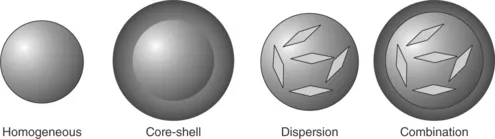
Fig. 1.1 Example Of Different Kinds Of Structural Organization Possible Within Delivery System Particles.
• Delivery – The process of carrying an encapsulated component to the required site of action, which may be the surface of a bacteria, or the human mouth, nose, stomach, small intestine or colon. Once an active component has been encapsulated it usually has to be retained by the delivery system for a certain period under specific environmental conditions before it is released. A “delivery system” is a system designed to encapsulate, deliver and release one or more active components
• Controlled release – The process of releasing an encapsulated component with a specific concentration-time profile at the site of action. The release process may follow a number of different profiles, including:

The nature of the delivery system selected for a particular application depends on the unique molecular characteristics and functional requirements of the active component and food matrix under consideration.
1.1.2 Release mechanisms
An active component may be released from the matrix surrounding it by a variety of different physicochemical mechanisms (Fig. 1.2):
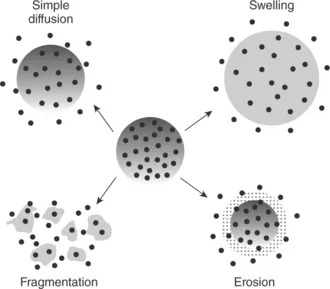
Fig. 1.2 A delivery system may release an encapsulated component through a variety of different mechanisms.
• Diffusion: the active component may move through and out of the matrix by diffusion. The rate at which the active component is released will then depend on the size, shape, structure and composition of the particle, the translation diffusion coefficient through the various components in the matrix, and the concentration gradient between the interior of the particle and the surrounding medium.
• Fragmentation: the active component may be released when the matrix material is physically disrupted, e.g. by applying shear forces. The rate of release will then depend on the fracture properties of the particle, such as the applied stress when fracture occurs, as well as the size and shape of the fragments formed. The active component may still diffuse out of the fragments, but it will be released quicker because of the increased surface area and decreased diffusion path.
• Erosion: the active component may be released from the matrix by erosion of the outer layer of the matrix, e.g. by physical, chemical or enzymatic degradation. The release rate will then depend on the rate at which erosion occurs, which will depend on the composition and structure of the outer layers of the matrix, as well as the magnitude and duration of the factor responsible for erosion (e.g., shear force, acid strength, enzyme type and concentration).
• Swelling: the active component may be released from a matrix material when it absorbs solvent and swells. For example, an active component could be encapsulated within a solid particle or within a biopolymer particle with a pore size small enough to prevent it from moving. Once the particle absorbs solvent molecules, it swells, and the active component can then diffuse out. Conversely, an active component can be loaded into a matrix by swelling an empty particle first, then mixing it with active component, then changing the environmental conditions so that the particle shrinks and traps the active. In this case, the rate of release of the active component will depend on the swelling rate, and the time taken for the compounds to diffuse through the swollen matrix.
1.2 Active components and the need for encapsulation
In this section, we provide a brief overview of some of the most important active components, their physicochemical characteristics, and the reasons why they need to be encapsulated and delivered. More detailed discussions of certain active components are provided in later chapters in this book. Active components may be isolated and purified from natural sources, or they may be chemically synthesized. This is an important consideration for food manufacturers when selecting appropriate active compounds, as consumers usually prefer natural rather than synthetic ingredients in foods. In general, the active components used in foods vary greatly in their molecular, physicochemical, and biological properties. At the molecular level, they can be characterized by their atomic composition, their molecular weight, their three-dimensional structure, their flexibility, their polarity, and their electrical charge. At the physicochemical level, they can be characterized by properties suc...
Table of contents
- Cover image
- Title page
- Table of Contents
- Copyright
- Contributor contact details
- Woodhead Publishing Series in Food Science, Technology and Nutrition
- Preface
- Part I: Requirements for food ingredient and nutraceutical delivery systems
- Part II: Processing technology approaches to produce encapsulation and delivery systems
- Part III: Physicochemical approaches to produce encapsulation and delivery systems
- Part IV: Characterization and applications of delivery systems
- Index
Trusted by 375,005 students
Access to over 1.5 million titles for a fair monthly price.
Study more efficiently using our study tools.
Frequently asked questions
Yes, you can cancel anytime from the Subscription tab in your account settings on the Perlego website. Your subscription will stay active until the end of your current billing period. Learn how to cancel your subscription
No, books cannot be downloaded as external files, such as PDFs, for use outside of Perlego. However, you can download books within the Perlego app for offline reading on mobile or tablet. Learn how to download books offline
Perlego offers two plans: Essential and Complete
- Essential is ideal for learners and professionals who enjoy exploring a wide range of subjects. Access the Essential Library with 800,000+ trusted titles and best-sellers across business, personal growth, and the humanities. Includes unlimited reading time and Standard Read Aloud voice.
- Complete: Perfect for advanced learners and researchers needing full, unrestricted access. Unlock 1.5M+ books across hundreds of subjects, including academic and specialized titles. The Complete Plan also includes advanced features like Premium Read Aloud and Research Assistant.
We are an online textbook subscription service, where you can get access to an entire online library for less than the price of a single book per month. With over 1.5 million books across 990+ topics, we’ve got you covered! Learn about our mission
Look out for the read-aloud symbol on your next book to see if you can listen to it. The read-aloud tool reads text aloud for you, highlighting the text as it is being read. You can pause it, speed it up and slow it down. Learn more about Read Aloud
Yes! You can use the Perlego app on both iOS and Android devices to read anytime, anywhere — even offline. Perfect for commutes or when you’re on the go.
Please note we cannot support devices running on iOS 13 and Android 7 or earlier. Learn more about using the app
Please note we cannot support devices running on iOS 13 and Android 7 or earlier. Learn more about using the app
Yes, you can access Encapsulation Technologies and Delivery Systems for Food Ingredients and Nutraceuticals by Nissim Garti,D. Julian McClements in PDF and/or ePUB format, as well as other popular books in Tecnologia e ingegneria & Scienze dell'alimentazione. We have over 1.5 million books available in our catalogue for you to explore.