- 408 pages
- English
- ePUB (mobile friendly)
- Available on iOS & Android
eBook - ePub
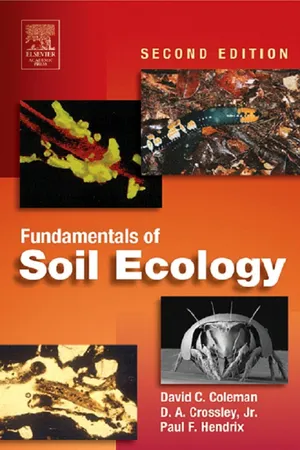
Fundamentals of Soil Ecology
About this book
This fully revised and expanded edition of Fundamentals of Soil Ecology continues its holistic approach to soil biology and ecosystem function. Students and ecosystem researchers will gain a greater understanding of the central roles that soils play in ecosystem development and function. The authors emphasize the increasing importance of soils as the organizing center for all terrestrial ecosystems and provide an overview of theory and practice of soil ecology, both from an ecosystem and evolutionary biology point of view. This volume contains updated and greatly expanded coverage of all belowground biota (roots, microbes and fauna) and methods to identify and determine its distribution and abundance. New chapters are provided on soil biodiversity and its relationship to ecosystem processes, suggested laboratory and field methods to measure biota and their activities in ecosystems..
- Contains over 60% new material and 150 more pages
- Includes new chapters on soil biodiversity and its relationship to ecosystem function
- Outlines suggested laboratory and field methods
- Incorporates new pedagogical features
- Combines theoretical and practical approaches
Information
1 Historical Overview of Soils and the Fitness of the Soil Environment
THE HISTORICAL BACKGROUND OF SOIL ECOLOGY
The “roots” of human understanding of soil biology and ecology can be traced into antiquity and probably even beyond the written word. We can only imagine hunter–gatherer societies attuned to life cycles of plant roots, fungi, and soil animals important to their diets, their welfare or their cultures, and particularly to environmental conditions favorable to such organisms. Indeed, early agriculture must certainly have developed, at least in part, from a practical knowledge of soils and their physical and biological characteristics.
Soil is so fundamental to human life that it has been reflected for millennia in our languages. The Hebrew word for soil is adama, from which comes the name Adam—the first man of the Semitic religions. The word “human” itself has its roots in the Latin humus, the organic matter in soil (Hillel, 1991). Early civilizations had obvious relationships with soils. The Mesopotamian region encompasses present-day Iraq and Kuwait, occupying the valley of the Euphrates and Tigris rivers from their origin as they come out from the high tablelands and mountains of present-day Armenia to their mouth at the Persian Gulf. It had one of the earliest recorded civilizations, the Sumerian, dating from about 3300 years BCE (Hillel, 1991). An inventory taken in the time of the early Caliphates showed 12,500,000 acres (nearly 5,100,000 hectares) under cultivation in the southern half of Mesopotamia (Whitney, 1925). With many centuries of irrigation, this so-called “hydraulic civilization” was plagued with problems of siltation and salinization, which was written about at the time of King Hammurabi (1760 BCE) (Hillel, 1991). An impressive sequence of civilizations waxed and waned over the millennia: Sumerian, Akkadian, Babylonian, and Assyrian, as cultivation shifted from the lower to central and upper regions of Mesopotamia. Siltation and salinization continue to beset present-day civilizations that practice extensive irrigation.
To the east of Mesopotamia, past the deserts of southern Iran and of Baluchistan, lies the Indus River Valley. Another irrigation-based civilization developed here, probably under the influence of the Mesopotamian civilization. The Indus River civilization probably encompassed a total land area far exceeding that of either Sumeria or Egypt; little is known about it. No written records have been discovered, but its fate, like that of the Sumerian, succumbed to environmental degradation, exacerbated by the extensive deforestation which occurred to provide fuel to bake the bricks used in construction (Hillel, 1991). The bricks in Mesopotamian cities were sun-baked, similar to the adobe style of construction used in the desert of the southwestern United States.
In contrast, the Egyptian civilization persisted more or less in place, as a result of the annual floods of the Nile River, which renewed soil fertility in vast areas along the river’s length as it flowed northward. Over the millennia, from one to three million people lived along the Nile, and produced enough grain to export wheat and barley to many countries around the Mediterranean rim. Now that the population is some 30 times greater, it must import some foodstuffs and is economically in questionable condition, in spite of the vast areas being irrigated with water from the Aswan high dam.
The ancient Chinese concept of fundamental elements included earth, air, fire, water, and moon. In the Yao dynasty from 2357 to 2261 BCE, the first attempt was made at soil classification surveying. The Emperor established nine classes of soils in as many provinces of China, with a taxation system based upon this system. These classes included the yellow and mellow soils of Young Chow (Shensi and Kansu); the red, clayey, and rich soils of Su Chow (Shantung, Kiangsu, and Anhwei); the whitish, rich salty soils of Tsing Chow (Shantung); the mellow, rich, dark and thin soils of Yu Chow (Honan); the whitish and mellow soils of Ki Chow (Chili and Shansi); the black and rich soils of Yen Chow (Chili and Shantung); the greenish and light soils of Liang Chow (Szechuan and Shensi); and the miry soils of King Chow (Hunan and Hupeh) and Yang Chow (Kiangsu) (Whitney, 1925). This system reflects a sophisticated knowledge within early Chinese civilization of soils and their relationship with plant growth. Interestingly, in recognition of the importance of biological activity in soils, the ancient Chinese termed earthworms as “angels of the soil” (Blakemore, 2002).
The Greeks believed there were four basic elements: earth, air, fire, and water; and Aristotle, understanding the role of earthworms in organic matter decomposition, considered earthworms to be the “intestines of the earth” (Edwards and Lofty, 1977). The Greeks and Romans also had a clear differentiation of the productive capacities of different types of soils. They referred to good soils as “fat,” and soils of lower quality as “lean” (Whitney, 1925). For the Roman writers, “humus” referred to soil or earth. Virgil (79–19 BC), in his Georgics, named the loamy soil pinguis humus and used the words humus, solum, or terra more or less interchangeably for the notions of soil and earth. Columella in the first century AD noted, “wheat needs two feet of good humus“ (Feller, 1997; italics added).
The word humus seems to have entered the European scientific vocabulary in the 18th century. Thus in Diderot and d’Alembert’s Encyclopaedia (vol. 8) in 1765: “Humus, natural history, this Latin word is often borrowed by naturalists (even into French) and denotes the mould, the earth of the garden, the earth formed by plant decomposition. It refers to the brown or darkish earth on the surface of the ground. Refer to the mould or vegetable mould” (translation in Feller, 1997).
By the beginning of the 19th century, the leading authorities with a biological view of soils were Leeuwenhoek, Linnaeus, and other pre-Darwinians, and then Darwin himself (1837, 1881), who “fathered” the modern era. Müller (1879, 1887), cited in Feller (1997), laid the groundwork for the present-day scientific bases of the different forms of humus, and even included a general survey of soil genetic processes in cold and temperate climates. Müller developed terms for the three humus types—Mull, Mor, and Mullartiger Torf—the latter equivalent to Moder. Mull is mould and Torf is peat in Danish. Thus Mullartiger Torf is mould peat in Danish, and it is viewed as an intermediate form between the two extremes (see Feller, 1997, for more details on the history of these fascinating substances).
The first scientific view of soils as natural bodies that develop under the influence of climate and biological activity acting on geological substrates arose in Russia with the work of Dokuchaev and his followers (Zonn and Eroshkina, 1996; Feller, 1997) and in Europe with Müller’s (1887) descriptions of soil horizon development (Tandarich et al., 2002). The ecological basis of the Russian tradition is clear in the words of Glinka (1927; cited in Jenny, 1941), a disciple of Dokuchaev, whose view of soil included “… not only a natural body with definite properties, but also its geographical position and surroundings, i.e., climate, vegetation, and animal life.” This Russian perspective predates the formal statement of the ecosystem concept by several decades (Tansley, 1935).
During this early period of theoretical development across the Atlantic, soil science in the United States was more concerned with practical matters of agriculture, such as soil productivity and crop growth (Tandarich et al., 2002) and, later, on restoration of soils badly degraded f...
Table of contents
- Cover Image
- Title page
- Copyright
- Preface to the Second Edition
- Preface to the First Edition
- Table of Contents
- Chapter 1: Historical Overview of Soils and the Fitness of the Soil Environment
- Chapter 2: Primary Production Processes in Soils: Roots and Rhizosphere Associates
- Chapter 3: Secondary Production: Activities of Heterotrophic Organisms—Microbes
- Chapter 4: Secondary Production: Activities of Heterotrophic Organisms—The Soil Fauna
- Chapter 5: Decomposition and Nutrient Cycling
- Chapter 6: Soil Food Webs: Detritivory and Microbivory in Soils
- Chapter 7: Soil Biodiversity and Linkages to Soil Processes
- Chapter 8: Future Developments in Soil Ecology
- Chapter 9: Laboratory and Field Exercises in Soil Ecology
- References
- Index
Trusted by 375,005 students
Access to over 1.5 million titles for a fair monthly price.
Study more efficiently using our study tools.
Frequently asked questions
Yes, you can cancel anytime from the Subscription tab in your account settings on the Perlego website. Your subscription will stay active until the end of your current billing period. Learn how to cancel your subscription
No, books cannot be downloaded as external files, such as PDFs, for use outside of Perlego. However, you can download books within the Perlego app for offline reading on mobile or tablet. Learn how to download books offline
Perlego offers two plans: Essential and Complete
- Essential is ideal for learners and professionals who enjoy exploring a wide range of subjects. Access the Essential Library with 800,000+ trusted titles and best-sellers across business, personal growth, and the humanities. Includes unlimited reading time and Standard Read Aloud voice.
- Complete: Perfect for advanced learners and researchers needing full, unrestricted access. Unlock 1.5M+ books across hundreds of subjects, including academic and specialized titles. The Complete Plan also includes advanced features like Premium Read Aloud and Research Assistant.
We are an online textbook subscription service, where you can get access to an entire online library for less than the price of a single book per month. With over 1.5 million books across 990+ topics, we’ve got you covered! Learn about our mission
Look out for the read-aloud symbol on your next book to see if you can listen to it. The read-aloud tool reads text aloud for you, highlighting the text as it is being read. You can pause it, speed it up and slow it down. Learn more about Read Aloud
Yes! You can use the Perlego app on both iOS and Android devices to read anytime, anywhere — even offline. Perfect for commutes or when you’re on the go.
Please note we cannot support devices running on iOS 13 and Android 7 or earlier. Learn more about using the app
Please note we cannot support devices running on iOS 13 and Android 7 or earlier. Learn more about using the app
Yes, you can access Fundamentals of Soil Ecology by David C. Coleman,D. A. Crossley Jr.,D. A. Crossley, Jr. in PDF and/or ePUB format, as well as other popular books in Biological Sciences & Ecology. We have over 1.5 million books available in our catalogue for you to explore.