- 856 pages
- English
- ePUB (mobile friendly)
- Available on iOS & Android
eBook - ePub
Mechanical Design Engineering Handbook
About this book
Mechanical Design Engineering Handbook is a straight-talking and forward-thinking reference covering the design, specification, selection, use and integration of machine elements fundamental to a wide range of engineering applications.
Develop or refresh your mechanical design skills in the areas of bearings, shafts, gears, seals, belts and chains, clutches and brakes, springs, fasteners, pneumatics and hydraulics, amongst other core mechanical elements, and dip in for principles, data and calculations as needed to inform and evaluate your on-the-job decisions.
Covering the full spectrum of common mechanical and machine components that act as building blocks in the design of mechanical devices, Mechanical Design Engineering Handbook also includes worked design scenarios and essential background on design methodology to help you get started with a problem and repeat selection processes with successful results time and time again.
This practical handbook will make an ideal shelf reference for those working in mechanical design across a variety of industries and a valuable learning resource for advanced students undertaking engineering design modules and projects as part of broader mechanical, aerospace, automotive and manufacturing programs.
- Clear, concise text explains key component technology, with step-by-step procedures, fully worked design scenarios, component images and cross-sectional line drawings all incorporated for ease of understanding
- Provides essential data, equations and interactive ancillaries, including calculation spreadsheets, to inform decision making, design evaluation and incorporation of components into overall designs
- Design procedures and methods covered include references to national and international standards where appropriate
Information
Subtopic
Ingegneria meccanicaChapter 1
Design
Abstract
The aims of this book are to present an overview of the design process and to introduce the technology and selection of a number of specific machine elements that are fundamental to a wide range of mechanical engineering design applications. This chapter introduces the design process from an inventor's perspective, and double diamond, to more formal models such as “total design” and stage- or phase-gate reviews.
Keywords
Design; Engineering; Function; Gate; Optimization; Process; Stage; Technology; Total
Chapter Outline
1.1 Introduction
1.2 The Design Process
1.2.1 Case Study
1.3 Total Design
1.3.1 Market
1.3.2 Specification
1.3.3 Conceptual Design
1.3.4 Detailed Design
1.3.5 Manufacturing
1.3.6 Marketing/Sales
1.3.7 Total Design Information Flows and Activities
1.4 Systematic Design
1.5 Double Diamond
1.6 Conceive, Design, Implement, Operate (CDIO)
1.7 Design for Six Sigma
1.8 Design Optimization
1.9 Stage-Gate Process
1.10 The Technology Base
1.11 Conclusions
References
Further Reading
Nomenclature
1.1 Introduction
The term “design” is popularly used to refer to an object's a esthetic appearance, with specific reference to its form or outward appearance as well as its function. For example, we often refer to designer clothes, design icons, and beautiful cars, examples of which are given in Figures 1.1 and 1.2. In these examples, the products fulfill a range of requirements with regard to visual impact, i.e. something that appeals to our visual perception, and technical function, both of which are important in defining so-called “good design.”

Figure 1.1 Piaggio's Vespa, which was launched in 1946. The Vespa was an early example of monocoque construction where the skin and frame are combined as a single construction to provide appropriate rigidity and mounting for the vehicle's components and riders.

Figure 1.2 The Audi TT, which was originally launched in 1998 and is a contender for the most attractive sports car of the twentieth century. Figure courtesy of Audi.
The word “design” is used as both a noun and a verb, and it carries a wide range of context-sensitive meanings and associations. As stated by George Cox in the Cox Review (Cox, 2005), “Design is what links creativity and innovation. It shapes ideas to become practical and attractive propositions for users or customers. Design may be described as creativity deployed to a specific end.” In essence design can be considered to be the process of conceiving, developing, and realizing products, artifacts, processes, systems, services, and experiences with the aim of fulfilling identified or perceived needs or desires typically working within defined or negotiated constraints. This process may draw upon and synthesize principles, knowledge, methods skills, and tools from a broad spectrum of disciplines depending on the nature of the design initiative and activity.
The word design comes from the Latin “designare,” which means to designate or mark out. Design can be taken to mean all the processes of conception, invention, visualization, calculation, refinement, and specification of details that determine the form of a product. Design generally begins with either a need or a requirement or, alternatively, an idea. It ends with a set of drawings or computer representations and other information that enables a product to be manufactured and utilized.
Design can be regarded as “the total activity necessary to provide a product or process to meet a market need.” This definition comes from the SEED (Sharing Experience in Engineering Design) organization, which is now the DESIG (Design Education Special Interest Group of the Design Society) (see Pugh, 1990).
According to a Royal Academy of Engineering pamphlet, engineering can be defined as,
The discipline, art and profession of acquiring and applying scientific, mathematical, economic, social and practical knowledge to design and build structures, machines, devices, systems, materials and processes that safely realize solutions to the needs of society.
This definition is not attributed to a single individual, and the Accreditation Board for Engineering and Technology (ABET, 2011), the Institution of Mechanical Engineers, and the National Academy of Engineering (2004) all have similar definitions for engineering where scientific and mathematic principles are applied to design, develop, and deliver artifacts, products, and systems to realize a societal, commercial, or organization requirement or opportunity.
The terms “engineering design” and “design engineering” are often used interchangeably. The inclusion of the word engineering in both suggests that they involve the application of scientific and mathematical knowledge and principles. It may be useful to think of “engineering design” in connection with “engineering science” as the strand of engineering that is concerned with application, designing, manufacturing, and building. Design engineering suggests a process in which engineering (scientific and mathematical) approaches are applied in the realization of activities that began with a design concept or proposal. However, such distinctions remain subtle and subject to context.
1.2 The Design Process
Design processes abound and have been widely documented, with many design schools, design consultancies, and engineering corporations developing their own brand of approaches (e.g. see Clarkson and Eckert, 2005). Commonly cited methods include the educational approach CDIO (conceive, develop, implement, operate), total design, double diamond, six sigma, MDO (multiobjective design optimization), and gated reviews. Design processes can be broadly categorized as activity-based, involving generation, analysis, and evaluation, and stage-based, involving distinct phases of, for example, task clarification and conceptual design. It is also widely recognized that experienced practitioners approach design in a different manner to novice designers (e.g. see Ahmed et al., 2003).
From your own experience, you probably know that design can consist of examining a design need and working on the problem by means of sketches, models, brainstorming, calculations as necessary, development of styling as appropriate, making sure the product fits together and can be manufactured, and calculation of the costs. The process of design can be represented schematically to levels of increasing formality and complexity. Figure 1.3 represents the traditional approach associated with lone inventors. This model comprises the generation of the “bright idea,” drawings and calculations giving form or shape to the idea, judgment of the design, and reevaluation if necessary, resulting in the generation of the end product. The process of evaluation and reworking an idea is common in design and is represented in the model by the iteration arrow taking the design activity back a step so that the design can be improved. Figure 1.4 illustrates the possible results from this process for a helmet providing peripheral and reverse vision.
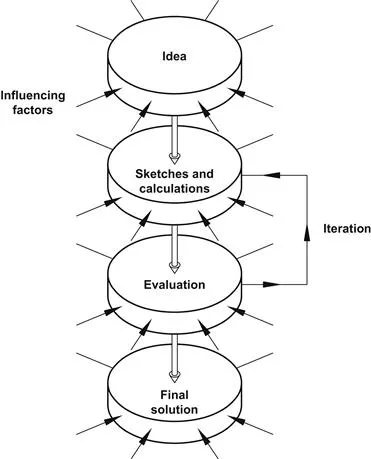
Figure 1.3 The traditional and familiar “inventor's” approach to design.
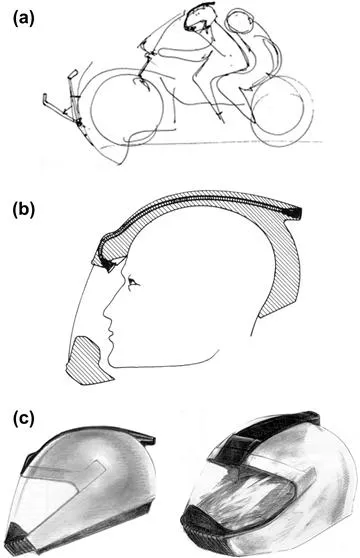
Figure 1.4 Panoramic helmet by Alberto Meda and Denis Santachiara. (a) The need: to be able to view behind you. (b) The idea: An optical link using fiber optics and lenses. (c) Practical sketches showing the concept. Source...
Table of contents
- Cover image
- Title page
- Table of Contents
- Copyright
- Preface
- Acknowledgments
- About the Author
- Chapter 1. Design
- Chapter 2. Specification
- Chapter 3. Ideation
- Chapter 4. Machine Elements
- Chapter 5. Journal Bearings
- Chapter 6. Rolling Element Bearings
- Chapter 7. Shafts
- Chapter 8. Gears
- Chapter 9. Spur and Helical Gear Stressing
- Chapter 10. Bevel Gears
- Chapter 11. Worm Gears
- Chapter 12. Belt and Chain Drives
- Chapter 13. Clutches and Brakes
- Chapter 14. Seals
- Chapter 15. Springs
- Chapter 16. Fastening and Power Screws
- Chapter 17. Wire Rope
- Chapter 18. Pneumatics and Hydraulics
- Chapter 19. Engineering Tolerancing
- Index
Trusted by 375,005 students
Access to over 1.5 million titles for a fair monthly price.
Study more efficiently using our study tools.
Frequently asked questions
Yes, you can cancel anytime from the Subscription tab in your account settings on the Perlego website. Your subscription will stay active until the end of your current billing period. Learn how to cancel your subscription
No, books cannot be downloaded as external files, such as PDFs, for use outside of Perlego. However, you can download books within the Perlego app for offline reading on mobile or tablet. Learn how to download books offline
We are an online textbook subscription service, where you can get access to an entire online library for less than the price of a single book per month. With over 1.5 million books across 990+ topics, we’ve got you covered! Learn about our mission
Look out for the read-aloud symbol on your next book to see if you can listen to it. The read-aloud tool reads text aloud for you, highlighting the text as it is being read. You can pause it, speed it up and slow it down. Learn more about Read Aloud
Yes! You can use the Perlego app on both iOS and Android devices to read anytime, anywhere — even offline. Perfect for commutes or when you’re on the go.
Please note we cannot support devices running on iOS 13 and Android 7 or earlier. Learn more about using the app
Please note we cannot support devices running on iOS 13 and Android 7 or earlier. Learn more about using the app
Yes, you can access Mechanical Design Engineering Handbook by Peter Childs,Peter R. N. Childs in PDF and/or ePUB format, as well as other popular books in Tecnologia e ingegneria & Ingegneria meccanica. We have over 1.5 million books available in our catalogue for you to explore.