![]()
PART I
Around the House and Garden
![]()
1
APPLE AT MY CORE
Our human notion of garbage as old, unusable, or unwanted material does not exist in nature. Instead, living organisms pass the essential materials for life to others in a relay race with no end. Death is not final; it’s just a transitory state for what ecologists call organic matter. Let’s observe the reincarnation of something you might consider garbage—an apple core discarded in your backyard. Although the word organic is often used these days to refer to healthier food choices, in biology and chemistry it means something quite different. In fact, organic simply means material that is living, or once was. Much of our kitchen waste slowly disintegrates into its organic components: molecules containing carbon and hydrogen (see the boxed definitions at the end of this chapter). The rest of our household waste is made up of inorganic molecules composed of other elements such as nitrogen, phosphorus, or iron. Many of these products of disintegration become nutrients essential for the growth of primary producers, which in most ecosystems are more simply called plants. Primary producers are at the base of all food chains because by using nutrients, sunlight, and water they produce new life that other organisms depend on.
In decomposition, complex waste material (like the core of an apple) is converted into simpler forms that are returned to the food chain. Many hardworking organisms—perhaps not surprisingly called decomposers—carry it out. Without decomposers, every plant or animal that has died since the beginning of life on Earth would accumulate around us, leaving no room for new life. In addition to filling the planet with waste, each death would sequester more of the nutrients surviving organisms need for growth, eventually leading to the extinction of all life as they are used up.
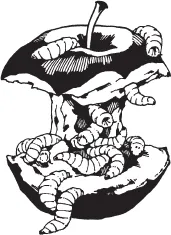
Organic matter starts decomposing as soon as the living organism stops protecting itself from decomposer attacks, usually on the death of the organism or one of its parts. When an apple is picked the tree can no longer protect it, and decomposition starts (we keep fruit in the refrigerator to slow down the decomposers). Let’s see what happens to the apple core you throw on your backyard compost heap.
PHASE 1: DECOMPOSITION
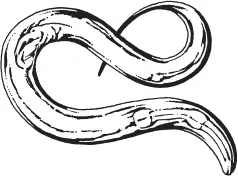
The first organisms to attack the apple core are the macroscopic decomposers. These include invertebrates (animals without spinal cords), such as millipedes, fly larvae (maggots), and earthworms, that cut the core into smaller bits. Then smaller organisms, like protozoans and tiny worms called nematodes, take over breaking apart the garbage as these bigger decomposers leave.
Decomposing organisms feed on waste such as apple cores to fuel their metabolism—the same reason we eat. Metabolism produces carbon dioxide (CO2) through cellular respiration. In this way these initial decomposers produce both CO2 (a gas) and solid waste products. This solid excrement is rapidly colonized by microscopic decomposers such as bacteria and fungi that complete the work of deconstruction, creating humus, soil high in nutrients and therefore useful for plant growth.
The decomposers haven’t yet finished with your apple core. Some proteins, sugars, cellulose, and lignin remain in the humus. These large, complex molecules bind up the nutrients the primary producers need. Once again the bacteria and fungi work to break these molecules into their simpler constituent molecules and elements. An important example of this conversion from complex to simple molecules is the decomposition of proteins found in dead plants and animals. Proteins are very large molecules made up of amino acids rich in nitrogen (N). Within the humus, nitrogen is still unusable for plants, since it is caught up in proteins. Decomposers convert these into smaller molecules: urea, ammonia (NH4+), and nitrites (NO2), and finally the form plants most prefer, the nitrates (NO3). Even though N is the most abundant molecule in the air we breathe (78 percent), plants can take up only the forms found in the soil, so microscopic decomposers are essential in degrading proteins into forms of nitrogen that plants can use to make more proteins.
At this point your apple core has completely disintegrated, transformed into its basic constituents of CO2 and inorganic nutrients like nitrogen. Now it’s ready for the next step.
PHASE 2: RECONSTRUCTION
The element at the base of all life on Earth is carbon (C). In plants we find it principally as cellulose and lignin, the major components of wood, pulp, and bark. Carbon is found mostly in animals’ tissues, including fat.
All living organisms need carbon for growth, maintenance, and reproduction. Plants take C directly from the air and convert it to other molecules (using light energy) through photosynthesis. Animals take in C by eating organic matter like plants or other animals, then convert it into energy by cellular respiration (the same process the decomposers use to keep growing).
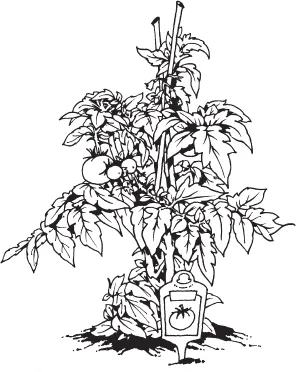
This is the final step in the reincarnation of the apple core, now converted into minuscule molecules of CO2 and nutrients so that plants in the garden can take it up. If you feed your growing vegetables with compost, parts of the apple will become part of your body when you eat those magnificent home-grown tomatoes and cucumbers.
The number of atoms on Earth has remained more or less the same since the planet was formed. Because they are constantly recycled, some of the atoms in your body may have once belonged to Jurassic dinosaurs, while others might have spent time in the body of Plato or Mozart. Then again, maybe your atoms were part of their forgotten neighbors, so let’s not get carried away.
Alice Parkes
Try this experiment. Take six to ten seeds from the same plant species (ideally, all from the same package from your local garden center). Beans or peas are easy to grow and measure. Grow half the seeds in pots with potting soil and the other half in a mixture of half potting soil, half compost. Treat your pots the same in every other way (light, water, temperature). And don’t forget to water!
Measure the stems every day for a few weeks and record the figures in a notebook. From these measurements you should be able to estimate growth rates; a simple way is to plot size against time on a graph. If you are patient you may even see seeds forming. Is there any difference in growth rate or number of seeds in plants grown in regular soil and those supplemented with compost? Why?
SOME DEFINITIONS
Organic matter: Material made up of molecules that contain at least both carbon and hydrogen atoms.
Inorganic matter: Material made up of any other types of atoms (elements).
Decomposers: Consumers that reduce complex organic matter to simple molecules using oxygen and producing carbon dioxide gas (e.g., many insects, bacteria, and fungi).
Nutrients: Elements other than carbon and oxygen that are essential for life (N, P, K, Ca, Mg, S, Si, Cl, Fe, B, Mn, Na, Zn, Cu, Ni, Mo).
Primary producers: Organisms that grow by using solar energy (sunlight), water, carbon dioxide, and nutrients (e.g., trees, aquatic plants, algae).
Macroscopic: Visible to the naked eye (larger than 0.02 inch [0.5 mm]).
Microscopic: Not visible without special lenses (smaller than 0.02 inch [0.5 mm]).
Humus: Decomposed organic matter.
Respiration: Oxidization of organic matter using oxygen, releasing carbon dioxide and heat.
![]()
2
ARBOREAL AQUEDUCTS
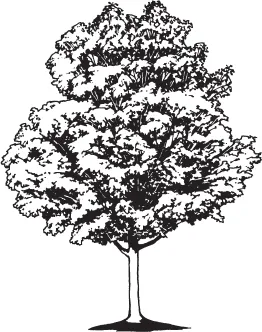
It’s noon on a sunny summer day. The thermometer reads 90°F (32°C), and not a drop of rain has fallen in weeks. Heat shimmers above the parked cars. The grass in your yard is turning brown, yet the magnificent maple in your front yard doesn’t seem to be suffering. Now that you consider it, all the trees on your block seem immune to the drought and still sport very green foliage. The secret lies in the way trees transport water up those tall trunks, from the roots to the leaves.
All organisms need water to survive, and trees are far from an exception. So why do they remain green while the grass turns brown? What adaptations did trees evolve to allow them to colonize all parts of the planet, from arid deserts to barren mountains to muddy swamps? Don’t forget that for many living organisms, too much water is as much of a problem as too little. Scientists were long baffled about how trees survive in such a wide variety of humidity levels.
Without water, there would be no life on Earth, or at least not the kind we know. Certainly there would be no trees. As they grow, trees go through a series of complex physiological processes including germination, photosynthesis, growth, and absorption of nutrients from the soil, and they all take lots of water. In a single summer, a large maple tree transports up to 53 gallons (200 L) of water every hour from its roots to its uppermost leaves.
How do trees pump all this water from the soil to the impressive heights where their leaves are found? For some trees the task seems downright impossible: consider Australian eucalyptus or the California sequoias, which must pump water up 500 feet (150 m).
MODULAR TUBES
Trees constitute a complex network of natural aqueducts. Just like municipal waterworks, arboreal aqueducts must constantly adapt flow to the amount demanded by the end users—in this case, the leaves.
Trees take water from the soil using their smallest roots, called root hairs, but some very small fungi (mycorrhizae) that colonize root hairs do most of this work. Mycorrhizae are indispensable to the survival of most trees: the minuscule filaments (hyphae) of the fungi vastly improve the tree’s ability to absorb water and nutrients. The hyphae reach into and exploit resources from a much larger volume of soil than could the roots alone, while remaining attached to the tree’s root hairs. In fact, the roots, root hairs, and mycorrhizae occupy as much volume as all of the tree’s foliage. This extended root system gives trees a major advantage over lawn grasses, whose roots are often confined to the top 4 inches (10 cm) of soil.
After being picked up by the roots, water continues to travel through the plant by small vessels in the sapwood: mainly living tissue directly under the bark that makes up the outer 2 to 6 inches (5–15 cm) of the trunk. Acting like a sponge, sapwood moves water toward the leaves. In contrast, heartwood is the dead tissue in the middle of the trunk that holds the tree up. At the summit, the sapwood divides and makes its way into each branch and twig to irrigate every leaf, so even the most remote receives the water it needs—most of the time.
THE SECRET PUMP
Now that we better understand the route water takes through the tree, we can look at what makes it move. At one time researchers thought tree roots pushed water from the soil up to the leaves using “root pressure.” But they quickly learned that if such a mechanism existed, it could not raise water higher than 10 feet (3 m)—certainly not high enough to reach the tops of most trees. To see how the process works, we need to understand what leaves do.
Leaves transpire. Lots. Plant transpiration is much like human perspiration. The foliage of a single tree produces enough water in a day to fill at least ten bathtubs, without expending metabolic energy, owing to a pressure differential between the atmosphere and the inside of microscopic pores (stomates) found on the underside of every leaf. During the day, each leaf dissipates heat by evaporating the water in its cells, creating water vapor within the leaf. Because it is under pressure, this vapor seeks to escape whenever the leaf opens its stomates, as it must do to capture carbon dioxide (CO2) in the air for photosynthesis. So a leaf picks up CO2 while releasing water vapor. This simple transfer of water from the leaf to the atmosphere, evapotranspiration, causes a chain reaction: to fill the vacuum created by ...