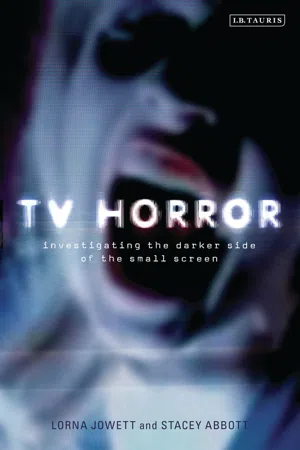
Horror is a universally popular, pervasive TV genre, with shows like True Blood, Being Human, The Walking Dead and American Horror Story making a bloody splash across our television screens. This complete, utterly accessible, sometimes scary new book is the definitive work on TV horror. It shows how this most adaptable of genres has continued to be a part of the broadcast landscape, unsettling audiences and pushing the boundaries of acceptability. The authors demonstrate how TV Horror continues to provoke and terrify audiences by bringing the monstrous and the supernatural into the home, whether through adaptations of Stephen King and classic horror novels, or by reworking the gothic and surrealism in Twin Peaks and Carnivale. They uncover horror in mainstream television from procedural dramas to children's television and, through close analysis of landmark TV auteurs including Rod Serling, Nigel Kneale, Dan Curtis and Stephen Moffat, together with case studies of such shows as Dark Shadows, Dexter, Pushing Daisies, Torchwood, and Supernatural, they explore its evolution on television.
This book is a must-have for those studying TV Genre as well as for anyone with a taste for the gruesome and the macabre.
- 288 pages
- English
- ePUB (mobile friendly)
- Available on iOS & Android
eBook - ePub
About this book
Information
1. | The TV in TV Horror |
Production and Broadcast Contexts |
Our Doctor Who is very, very, very Saturday night.
(Russell T. Davies, quoted in Hills 2010 (a): 117)
By describing the reinvented Doctor Who as ‘very, very, very Saturday night’ showrunner Russell T. Davies acknowledges the context in which the show is produced, scheduled and marketed by the BBC as mainstream entertainment, despite its horror and science fiction roots. Similarly, in the commentary for the Angel episode ‘Billy’ (3.6), writers Tim Minear and Jeffrey Bell explain how they were forced to re-edit a scene in which Lilah Morgan, a series regular, is repeatedly struck by one of her colleagues, as it was deemed too violent. Rather than emphasize the repeated blows, the scene concludes with her being strangled. This decision is a good example of the censorship restrictions that affect the day-to-day production of a horror series. These contexts, however, are not fixed but fluid, evolving with changes in the television industry, and with social and political changes. This opening chapter, therefore, addresses how television production and broadcast contexts in the UK and the USA, including scheduling, censorship and the expansion of cable and satellite channels, have impacted upon the horror genre on television. Through these discussions we establish criteria for developing a new understanding of televisual horror.
TV scholars have tended to categorize television production history into three broad periods, sometimes referred to as TVI (roughly 1950–1975), TVII (1975–1990s) and TVIII (1990s–present). Shifts in industry and technology mean that television production takes on distinctive characteristics in the different eras, according to the opportunities and limitations of the period. How audiences consume television also changes according to these industrial and historical shifts (see, for example, Reeves, Rodgers and Epstein). In this chapter we aim to show how horror has been prominent on TV in the USA and the UK in all three eras, however it might be disguised or labelled. As Matt Hills notes, horror on TV is often ‘generically nominated in ways that render horror relatively invisible’, such as Twin Peaks being called postmodern drama (2005a: 112). The horror genre is frequently considered to be in bad taste or to be excessively violent and this is one reason there has been little consideration of TV horror, since TV itself is assumed to be a mainstream medium that cannot sustain the graphic nature (visual or thematic) of horror’s subject matter. Moreover, it is assumed that the ‘limitations’ of the small screen mean TV does not have the capacity to render horror effectively (see Hills 2005a: 111). However, as Brigid Cherry points out, horror has never been a well-defined genre: ‘It is not simply that there is a range of conventions that offers some degree of variation on a coherent, formulaic theme …, but that this genre is marked by a sheer diversity of conventions, plots and styles’ (2009: 2). Thus it seems natural that horror has adapted itself to television conventions, plots and styles and thus proved highly successful.
TVI (1950–1975)
In this era, TV’s restricted number of channels are seen to have a mainstream address. While some programming raised questions about what was appropriate to air on a broadcast medium this did not prevent experimentation with the genre as TV writers and producers sought to expand the limits of what television could do. In fact, as Lez Cooke points out, some writers welcomed the mainstream address of TV, since it afforded an opportunity to reach a mass audience, unlike theatre (2003: 77). It is also a truism that during this era ‘serious’ social issues were often negotiated through fantasy genres such as science fiction and horror, with the single play drama a natural home for this kind of thought-provoking content. While an ethos of public service broadcasting informed UK television production on the BBC, more commercial concerns drive the US television industry. In both countries, the popularity of programming dealing with the uncanny and horror is apparent in shows from the seminal Quatermass, to anthology shows like One Step Beyond, Alfred Hitchcock Presents and The Twilight Zone, to daytime soap opera Dark Shadows, to gothic sitcoms like The Addams Family. Stephen Gallagher, screenwriter, director and novelist, observes that the 1950s and 1960s were ‘awash’ with science fiction and horror TV (quoted in Hills 2005a: 117). Some of these TV horror programmes were milestones in TV history (Quatermass was ‘the earliest film to be adapted from television,’ Pirie 2008: 23) or flagship productions, used to promote aspects of their channels and TV itself. Miles Booy points out that Doctor Who was ‘consistently used by the BBC, just as historical serials were, to promote the imagination and skills of their design and costume departments’ (2010: 189) and many people still associate the radiophonic workshop with Doctor Who.
As both Catherine Johnson and Helen Wheatley have acknowledged, this was a period of experimentation as writers and producers sought to overcome the technological limitations associated with both television production and broadcast, and explore the narrative and aesthetic possibilities of this new medium (Johnson 2005; Wheatley 2006). TV horror played a significant role in this development. Nigel Kneale, writer of the Quatermass serials, points out that the cameras used to make The Quatermass Experiment in 1953 were cumbersome, primitive equipment dating from 1936, which meant that ‘you couldn’t easily cut from one camera to another in those days, and cameras had great difficulty in following moving characters’ (quoted in Newman and Petley 1998: 35). As Johnson notes, however, these seeming limitations were utilized by producer Rudolph Cartier to generate suspense and horror when he chose to move the actor rather than the camera in a climactic end to the first episode. In this sequence the surviving astronaut from the first manned flight into space collapses and falls toward ‘the camera so that his face momentarily fills the screen, revealing a mere glimpse of the terror in his expression before the image fades to a blur’ (2005: 26). Similarly, in the climax of the serial, Quatermass confronts the giant alien creature in Westminster Abbey, an effect that could not be achieved in the same shot but was accomplished by inter-cutting between close-ups of the alien and Quatermass, overlaid by the sound of the ‘alien’s rustling tendrils’ (Johnson: 26), binding the two images together in the same space, enhancing the visible with radio’s ability to construct the illusion of space through sound.
The limitations of domestic technology also raised potential issues regarding the creation of horror. As Cartier explains, the size of the TV screen in the 1950s was between 17 and 21 inches, with only 405 lines of information (compared with over 1,080 lines of information in High Definition television), which meant that while closeups appeared life size, ‘medium shots … show very little facial expression; and long shots can only be used to establish the backgrounds’ (1958: 10). This led to the dominance of the close-up in television (Lury 2005: 28–29). These limitations of the image were once again manipulated to create a horror effect in the Kneale – Cartier collaborations by utilizing the close-up, not to reassure audiences with familiar faces and intimate moments but to unsettle, as when the astronaut falls toward the camera in The Quatermass Experiment. These close-ups were used most effectively in the Kneale/Cartier adaptation of George Orwell’s 1984 (1954). As Cartier explains, Orwell’s exploration of government surveillance through domestic TV screens gained additional impact by being adapted for and broadcast on television, to be viewed ‘in the TV viewer’s own home, where cold eyes stared from the small screen straight at him, casting into the viewers’ heart the same chill that the characters in the play experienced whenever they heard [Big Brother’s] voice coming from their “watching” T.V. screens’ (1958: 10). The intimacy of the domestic television screen is here made threatening.
From these horror single plays and serials through to the horror anthology series of the 1960s and 70s, such as Boris Karloff’s Thriller, Mystery and Imagination and Rod Serling’s Night Gallery, TV horror continued to be affected by, while equally influencing, televisual technological developments as well as the increasing competition between channels or networks. For instance, Wheatley argues that one of the ways that British independent television channel ITV responded to increased competition with the BBC was by producing ‘experimental and innovative’ horror series like Mystery and Imagination ‘which responded to the possibilities of television, showcased new production technologies, and challenged the predominance of naturalistic television drama in the 1960s’ (2003: 80). While some of the gothic narratives of this series rely upon the suggestion of the supernatural, others, such as Patrick Dromgoole’s adaptation Dracula (18 November 1968) engage in the spectacle of the supernatural through experimentation with developing optical and videographic special effects.
The Veil and Boris Karloff’s Thriller, anthology horror series hosted by Karloff in which he introduced, and sometimes appeared in, stand-alone tales of the supernatural, highlight another context that influenced the development of TV horror in this period: the growing relationship between cinema and television. While it is often assumed that television was threatening competition for cinema by encouraging audiences to stay at home, in actuality the two media developed a productive, if cautious, symbiotic relationship. As television schedules expanded, the channels needed to fill hours of programming and Hollywood studios saw an opportunity to sell their back catalogue to television, thus developing a new strand of income. This led, as discussed in the introduction, to a rediscovery of classic horror films on television, making actors like Boris Karloff, Bela Lugosi, Lon Chaney Jr and Peter Lorre household names decades after the heyday of classic horror cinema of the 1930s and 40s. Karloff, Chaney and Lorre play themselves, for example, in the episode ‘Lizard’s Leg and Owlet’s Wing’ of the hit series Route 66 (3 June 1962). In this episode, the actors meet up in a motel on the eponymous route to discuss an offer from a television network to ‘produce and star in the most terrifying stories ever seen on television’. While Karloff attempts to convince Lorre and Chaney that they should embrace a new modern form of horror, the others argue that playing traditional monsters will ‘guarantee our ratings’. The episode follows the actors as they perform a gallery of familiar monsters, including the Hunchback of Notre Dame, the Wolfman, the Mummy and Frankenstein’s monster, in order to ascertain whether these monsters are still scary. The episode concludes with the suggestion that the old ways still work … on television.
This influence from cinematic horror is apparent in both The Veil and Boris Karloff’s Thriller. These shows drew upon Karloff’s reputation as an iconic figure of classic gothic horror. While cinematic horror was moving into a new modern era, represented by Hitchcock’s Psycho and Romero’s Night of the Living Dead, TV horror was, through the influence of classic horror movies on television in this period, embracing gothic monsters. This approach to horror was potentially more appropriate to television given the restrictions upon what could be shown on network TV, at a time when censorship regulations for the cinema were relaxing. The influence of classic horror cinema is further felt in the gothic series Dark Shadows, the literary adaptations of classic gothic novels produced by Dan Curtis (Dracula, Frankenstein, Dr Jekyll and Mr Hyde), as well as those presented on a weekly basis in Mystery and Imagination (Carmilla, Dracula, Uncle Silas).
TVII (1975–1990s)
TVII is a period of transition between the network and the digital eras and, as such, often variously dated, though we have chosen the longest period between TVI and TVIII. Developments in technology changed the way people watched television. Recording technologies meant that watching live broadcast was no longer essential, and also allowed for archiving of favourite episodes or whole series. Having a remote control enabled easy channel surfing, suggesting that programming now had to work harder to retain attention. The dominance of major channels also faced challenges both from pay-channels on cable and satellite and from new networks. In the late 1970s viewership of the ‘big three’ American networks was around 90 per cent (Staiger 2000: 170) but had dwindled to less than 60 per cent by 1991 (171), and by 2002 networks attracted less than 40 per cent of the audience (Hilmes quoted in Pearson 2005: 14).
These changes meant a widespread move away from the notion of broadcasting of programming for the largest audience possible – and towards narrowcasting: ‘niche marketing of specific products to attract different segments of the audience at different times of day’ (Nelson 1997: 236). Thus throughout the 1980s and 90s horror often emerges as a form of ‘quality’ television drama appealing to an upscale audience. Many view this period as enabling greater creativity and diversity. As network TV drew smaller audiences, ‘TV programming gets better’ opined Tom Shales, TV critic for The Washington Post (quoted in Thompson 1997: 44) and Robert J. Thompson argues that ‘In 1981, shows started appearing that would never have made the lineup just a few years earlier’ (1997: 35) because networks took risks to retain their audience. Several programmes held to have ‘changed the face of television’ during this period are TV horror (Twin Peaks and The X-Files) and Johnson argues that The X-Files’ visual approach presented ‘something different from the other networks (horror), in a new way (without “lots of blood”)’ as noted by Glen Morgan (2005: 101).
Sapphire and Steel, coming early in the TVII era (1979–1982), broke new ground, following the eponymous agents as they investigate disruptions of time. Sergio Angelini calls it an ‘unusually thoughtful and troubling experiment in genre-splicing’ (2010: 240) and writer P. J. Hammond speculates, ‘I suppose it made a change from all the social realism dramas that had been around for so long’ (1993, 1996). Originally intended as a children’s drama, Sapphire and Steel stories evolved to contain dark elements, such as ‘violent deaths and disfigurement, attempted suicides, monstrous shape-shifting creatures’ and more (Angelini 2010: 239). Yet the show was broadcast early in the evening, usually at either 7 or 8pm, before the 9pm watershed (the time after which content considered unsuitable for children may be safely aired). ‘I like writing about things that disturb us,’ Hammond admits, ‘It’s not the things you see, it’s the things you don’t see. It’s the old Hitchcockian theory of fear’ (quoted in Edgar 2007) and this suggestive, rather than graphic, approach may have allowed it to air in this time slot. Studio shooting predominated, yet the close-quarters nature of studio filming enhanced ‘the menacing, claustrophobic nature of the stories,’ according to Hammond (1993/1996). This is apparent not only in the eerie, deserted spaces of the large railway station set of Assignment Two, but also in Assignments One, Three and Four, set in an old house, an apartment in a high rise block and a shop with accommodation above respectively. Scenes on staircases or in hallways filled such everyday locations with a sense of the liminal and the uncanny, while the sets added to what Angelini calls the series’ ‘anti-naturalistic style’ (2010: 240).
Sapphire and Steel may be studio-bound, authored drama in the British tradition, but Hammond’s creation looks forward to developments in TVII horror.2 The production company, ABC, invested part of a fairly large budget in stars to carry the show. Joanna Lumley and David McCallum were both recognizable faces from successful series such as The New Avengers and The Man from U.N.C.L.E., yet their new characters were far from the popular action heroes of the network era. Sapphire and Steel remain mysterious, their purpose and origin never overtly explained, and their interactions with humans underscore their own uncanny, inhuman nature. By the end of Assignment Two, Hammond states, ‘viewers were in a position to know exactly what Sapphire and Steel were capable of, and where they could sometimes fail’ (1993, 1996). These characters are fallible and even unsympathetic. Steel, as his name suggests, is cold and has little patience with humans caught up in the assignments. At the end of Assignment Two he sacrifices a human to a strange force in a bargain to stop its activity. Viewers had got to know psychic investigator George Tully over eight episodes, yet after the being takes him both agents leave, apparently without regret for Tully’s death. Ambivalent protagonists and moral grey areas like this feature prominently in subsequent TVII series such as The X-Files and Buffy the Vampire Slayer, culminating in the many TVIII monster protagonists discussed in Chapter 10.
Robin Nelson argues that the ‘drift to series’ in this period, ‘marks a move from an authored, literary tradition of the playwright’ (1997: 26), yet Roberta Pearson points out that in US television the writer-director or writer-producer was becoming the new ‘author’ of TV (see also Chapter 5). ‘Writers, agents and UPN’s target demographic of younger viewers were said to be attracted not just by Buffy but by Joss Whedon’s high-profile public (might we even say star?) image’, she argues of Buffy the Vampire Slayer’s move from the WB network to UPN in 2001 (2005: 11). Certainly as Pearson, Johnson and others demonstrate, new US networks built their reputation and profile on key horror TV shows like The X-Files (on Fox) and Buffy. Buffy’s renegotiation of traditional gender roles (male and female), as well as its action and witty dialogue, was ideal for the WB’s profile of 12–34-year-olds, especially its female viewers...
Table of contents
- Cover
- About the Author
- Title Page
- Copyright
- Contents
- List of Illustrations
- Acknowledgements
- Introduction: Horror Begins at Home
- 1. The TV in TV Horror: Production and Broadcast Contexts
- 2. Mainstreaming Horror
- 3. Shaping Horror: From Single Play to Serial Drama
- 4. Adaptation: Translating Horror Tales
- 5. The Horror Auteur
- 6. Revising the Gothic
- 7. The Excess of TV Horror
- 8. Horror, Art and Disruption
- 9. TV as Horror
- 10. The Monster in Our Living Room: From Barnabas Collins to Dexter Morgan
- Conclusion: The Road So Far
- Notes
- Work Cited
- TV and Filmography
Trusted by 375,005 students
Access to over 1.5 million titles for a fair monthly price.
Study more efficiently using our study tools.
Frequently asked questions
Yes, you can cancel anytime from the Subscription tab in your account settings on the Perlego website. Your subscription will stay active until the end of your current billing period. Learn how to cancel your subscription
No, books cannot be downloaded as external files, such as PDFs, for use outside of Perlego. However, you can download books within the Perlego app for offline reading on mobile or tablet. Learn how to download books offline
Perlego offers two plans: Essential and Complete
- Essential is ideal for learners and professionals who enjoy exploring a wide range of subjects. Access the Essential Library with 800,000+ trusted titles and best-sellers across business, personal growth, and the humanities. Includes unlimited reading time and Standard Read Aloud voice.
- Complete: Perfect for advanced learners and researchers needing full, unrestricted access. Unlock 1.5M+ books across hundreds of subjects, including academic and specialized titles. The Complete Plan also includes advanced features like Premium Read Aloud and Research Assistant.
We are an online textbook subscription service, where you can get access to an entire online library for less than the price of a single book per month. With over 1.5 million books across 990+ topics, we’ve got you covered! Learn about our mission
Look out for the read-aloud symbol on your next book to see if you can listen to it. The read-aloud tool reads text aloud for you, highlighting the text as it is being read. You can pause it, speed it up and slow it down. Learn more about Read Aloud
Yes! You can use the Perlego app on both iOS and Android devices to read anytime, anywhere — even offline. Perfect for commutes or when you’re on the go.
Please note we cannot support devices running on iOS 13 and Android 7 or earlier. Learn more about using the app
Please note we cannot support devices running on iOS 13 and Android 7 or earlier. Learn more about using the app
Yes, you can access TV Horror by Lorna Jowett,Stacey Abbott in PDF and/or ePUB format, as well as other popular books in Media & Performing Arts & Television History & Criticism. We have over 1.5 million books available in our catalogue for you to explore.