This important new contribution to studies on authorship and film explores the ways in which shared and disputed opinions on aesthetic quality, originality and authorial essence have shaped receptions of Lynch's films. It is also the first book to approach David Lynch as a figure composed through language, history and text. Tracing the development of Lynch's career from cult obscurity with Eraserhead, to star auteur through the release of Blue Velvet, and TV phenomenon Twin Peaks, Antony Todd examines how his idiosyncratic style introduced the term 'Lynchian' to the colloquial speech of new Hollywood and helped establish Lynch as the leading light among contemporary American auteurs. Todd explores contemporary manners and attitudes for artistic reputation building, and the standards by which Lynch's reputation was dismantled following the release of Wild at Heart and Twin Peaks: Fire Walk with Me, only to be reassembled once more through films such as Lost Highway, Mulholland Dr. and INLAND EMPIRE.
In its account of the experiences at play in the encounter between ephemera, text and reader, this book reveals how authors function for pleasure in the modern filmgoer's everyday consumption of films.
eBook - ePub
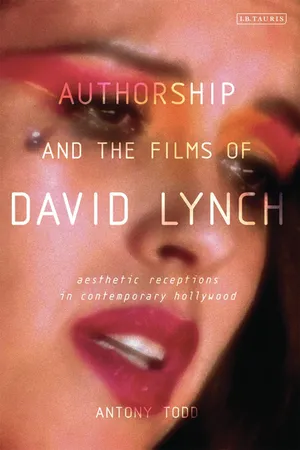
Authorship and the Films of David Lynch
Aesthetic Receptions in Contemporary Hollywood
- 224 pages
- English
- ePUB (mobile friendly)
- Available on iOS & Android
eBook - ePub
About this book
Information
CHAPTER 1
Towards a Textual Historicity
It is my intention that the chapters in this book will develop in the manner of a causal narrative. However, the methodology I have applied throughout brings together
historically disparate paradigms that merit some careful negotiation. So it is to this task that we must turn in the first instance through this shorter chapter. In its rudiment, my approach brings
together a contextual model, much like that applied by Klinger in her study on Douglas Sirk, and an aesthetic reception study method informed by the work of Jauss and Iser. Like Klinger (whose own
research built on the work of Robert Kapsis’s on Hitchcock, Jane Tompkins’s on Hawthorne and Charles Masland’s on Chaplin), my first aim is to offer a case study that investigates
contemporaneous manners for artistic reputation building, and the standards by which those reputations are then dismantled, only, in Lynch’s case, to be reassembled once more. In this regard
I follow Klinger’s lead when she noted that a departure ‘from the idea that works alone reveal the genius of their authors...helps us grasp the dialogic function between artistic
reputations and history – the dynamic circumstances under which an author’s status and the status of her or his works are established, sustained, transformed, unappreciated, or even
vilified’ (Klinger 1994: xiii).
Our first undertaking, then, will be to grasp the story of Lynch’s passage from student filmmaker to the status of auteur proper with the release of Blue Velvet in 1986. Once we
have established this, we will have arrived at the point at which horizons of expectation for future films ‘by David Lynch’ could be more or less agreed upon. We will, in other words,
have set to the task of putting in place the foundations of Lynch’s ‘biographical legend’, a hypothesis attributed initially to Boris Tomashevskii, that dates back to the early
twentieth century and the literary studies conducted in the name of Russian Formalism. In his essay ‘Literature and biography’, Tomashevskii in some ways anticipated French
structuralism by placing analytical emphasis on the texts’ formal structures. Where his writing was at variance with modern rebuttals of authorship, however, was in his appreciation for the
public function of the author biography. Speaking of the biography as a ‘literary fact’, Tomashevskii (1971: 47–48) argued that ‘we must remember that creative
literature exists, not for the literary historians, but for readers, and as such, the historian ‘must consider how the poet’s biography operates in the reader’s
consciousness’.
David Bordwell applied Tomashevskii’s concept in his 1988 study of Yasujiro Ozu, Ozu and the Poetics of Cinema. In that book, Bordwell understood the importance of the author
biography in the way it permits ‘works to come into being, as fulfilments of the legend; and to orient perceivers to them’. Bordwell (1988: 5–6) revealed how Ozu’s legend
had been built upon biographical sources that had composed ‘an image [that] easily slides into the notion of Ozu the Zen artist, the simple toiler who turns out to have a deep secret’.
Lynch, too, is a filmmaker concerned with secrets – what is hidden beneath surfaces – although Lynch is rather more likely to be conveyed in biographical literature as an expressionist
and a surrealist; and, as personality, a rebellious eccentric who operates in defiance of the Hollywood system. These are, indeed, the principal characteristics of the horizons of expectation for
films carrying Lynch’s name.
But as I have said already, my field of analysis will look further than the work undertaken by Klinger and other American Reception Studies scholars, most notably at Staiger, who in her preface
to Interpreting Films, expounded the neo-Marxist idea of a ‘materialist historiography’ that promotes ‘contextual factors rather than textual materials or reader
psychologies as most important in illuminating the reader process in interpretation’ (1992: xi–xiv). While I too support the idea that understanding contextual factors is a necessity in
getting to grips with what texts mean, I feel that the structural and thematic properties of poetic texts are of equal importance and must not be relegated as a result of historical imperatives. My
research is not, therefore, intended to be read as a defence, or even a revised theory, of authorship. I am intent, rather, on presenting a history that takes into account the pleasure –
produced through the coming together of various humanist and generic signs – that the authored text brings in the public consumption of post-classical art films.
As a means of attaining our goals, we will call upon some of the precepts of Rezeptionsäesthetik which, having gained recognition in the late 1960s through the research of Jauss and
Iser, established its station initially within the philosophical expansion of twentieth-century literary scholarship: namely poetic formalism and linguistic theory. We know already that under the
theoretical lead of post-structuralism it is usually understood that scholars will pass over the author on the grounds that hermeneutic rights reside with the reader. But through the concept of
Rezeptionsäesthetik, and notably his ‘horizons of expectation’ configuration, Jauss offered us a different perspective of reception; one that is especially helpful for us
given the intrusive nature of modern media systems and the way these systems construct and sustain public perceptions of the modern day auteur.
Unlike the post-structural reading model, where history becomes threatened due to the text’s innumerable interpretive combinations, through the idea of an ‘aesthetic of
reception’ Jauss proposed a critical paradigm that addresses the aesthetic perceptions of formalism while retaining a grounding in historical pragmatism. In his 1970 essay ‘Literary
history as a challenge to literary theory’, Jauss complained that ‘through their one-sidedness’, Marxist and Formalist literary theories had arrived ‘at an aporia’ and
for Jauss, any solution would demand ‘that historical and aesthetic considerations be brought into a new relationship’ (1982: 10). Jauss was partly critical of the Formalist method
because it ‘assumes that the reader has the theoretical understanding of the philologist who can reflect on the artistic devices, already knowing them’, and of the Marxist school since
it ‘candidly equates the spontaneous experience of the reader with the scholarly interest of historical materialism, which would discover relationships between superstructure and basis in the
literary work’. Jauss did not propose any kind of synthesis of the two approaches either, since this would not solve the fundamental dilemma of addressing the reader: the very person
‘for whom the literary work is primarily destined’. He wrote (1982: 18–19):
My attempt to bridge the gap between literature and history, between historical and aesthetic approaches, begins at the point [where] both schools [Marxist and Formalist]
stop. Their methods conceive the literary fact within the closed circle of aesthetics of production and of representation. In doing so, they deprive literature of a dimension that inalienably
belongs to its aesthetic character as well as its social function: the dimension of its reception and influence.
Indeed, Jauss proposed that the analysis of the aesthetic experience could amount to something ‘more than a simple sociology of taste’, if it described:
the reception and the influence of a work within the objectifiable system of expectations that arise for each work in the historical moment of its appearance, from a
pre-understanding of the genre, from the form and themes of already familiar works, and from the opposition between poetic and practical language. (1982: 22)
Through his distinction between poetic and practical language, moreover, Jauss invokes the evaluative dichotomies that have transferred into filmic tradition through the time-honoured standoff
between genre pictures and auteur pictures. Where we can start to identify cracks in the ‘death of the author’ approach, is in the fact that while a given text may be new to the reader
(which would seem to include a text that can be theoretically happened upon, as well as a new text chosen for that which it promises to yield in terms of novelty) that text ‘does not present
itself as something absolutely new in an informational vacuum but predisposes its audience to a very specific kind of reception’. Indeed, Jauss suggests that the encounter with a text
‘awakens memories of that which was already read, brings the reader to a specific emotional attitude, and with its beginning arouses expectations for the “middle and end,” which
can then be maintained intact or altered, reoriented, or even fulfilled ironically in the course of the reading according to a specific set of rules of the genre or type of text’ (1982:
23).
Although Jauss’s proposition stands fundamentally at odds with Barthes’s reading paradigm in that it supports some system for collective interpretive consciousness, his method still
offers the scope to account for different textual strategies and pleasures. We know, however, that Barthes’s writing addresses these ideas much less equivocally and his theory points to an
elementary limitation in Jauss’s model that as historians we are bound to address.
Jauss suggests that the horizon of expectation for a work ‘allows one to determine its artistic character by the kind and the degree of its influence on a presupposed audience’,
while a change in horizons will occur when a text overrides previous expectations ‘through raising newly articulated experiences to the level of consciousness’. Indeed, Jauss proposed
that any new ‘aesthetic distance can be objectified historically along the spectrum of the audience’s reactions and criticism’s judgement (spontaneous success, rejection or shock,
scattered approval, gradual or belated understanding)’ (1982: 25). What is of significance here is the proposition of a presupposed audience – that is for Jauss an audience that carries
out ‘specific instructions in a process of directed perception which can be comprehended according to its constitutive motivations and triggering signals’ (1982: 23) – and the
lack of the potential for discursive reading practices to come to the fore.
We find criticisms of the above in Paul de Man, who queried Jauss’s ‘lack of interest, bordering on outright dismissal’ of the potential ‘“play” of the
signifier’ (Jauss 1982: vii–xxv); in Robert C. Holub (1984: 63), whose misgivings were directed at Jauss’s tendency to ‘universalize novelty’ in ‘determining
aesthetic value’; and in Staiger (1992: 46), who believed that any emphasis on ‘aesthetic horizons’ would be to the ‘practical neglect of discursive, social, political, and
economic contexts’. In taking up these drawbacks, we should acknowledge, firstly, that Jauss’s ideas were a long way removed from the context of a post-classical art cinema. Jauss was
primarily concerned with the mediation of literature between past and present reading horizons (for instance, Flaubert’s Madame Bovary, Feydeau’s Fanny and
Chateaubriand’s Atala) (Jauss 1982: 27). But if we reposition the horizonal model in a modern filmic context I believe we are able to surmount the limitations of its literary
application. There are two prevailing points that warrant our consideration in this respect.
The first of these is the objection put forward by Staiger that takes issue with any emphasis on aesthetic reception on the grounds that it is socially, politically and economically divisive (as
we know, historically the business of aesthetics and poetics has tended to be administrated by a cultural and intellectual elite). Indeed, Jauss was chiefly concerned with horizonal paradigms that
have helped shape literary scholarships. In a filmic situation the same could be argued of auteurism, in the sense that the Cahiers group and their followers set about bestowing the status
of artistic respectability only upon special Hollywood films. But while we would without doubt fall victim to the sort of reading snags Staiger anticipated in applying Jauss to a blanket reception
study of encrypted authors in classical cinema, I believe that Jauss’s ideas can be instructive if we are committed, as I am, to accounting for the sharp ascent of the modern Hollywood auteur
in the public consciousness. Auteurism, in other words, has extended beyond the corral of a scholarly clique into the sphere of public discourse.
My second point relates more explicitly to the detail of the horizonal reading paradigm. It would be nonsensical to suggest that there is consensus on the merits of a given text. Lynch in
particular is seen as something of an acquired taste and judgements on his films are often polarised. Additionally, we might be pressed to qualify the terms of auteurism, since its specificity as a
reading paradigm is historically unstable and it has been subject to its own horizonal transformations. Paisley Livingston’s comment (1997: 132) that ‘it seems to be wrongly taken on
faith that we [...] have a strong, shared understanding of what [the] traditional conception of authorship entails’, would seem to point to a fundamental block in treating auteurism as a
horizonal paradigm. Yet Livingston’s thesis addresses the long succession of scholarly undertakings that have grappled with the philosophical puzzles of cinematic authorship. In the public
sphere, though, there is no such authorship puzzle.
The auteurism I have in mind is identified by Staiger (2003: 30) as the ‘authorship as origin approach’; an approach whereby ‘the author is conceptualized as a free agent,
untroubled philosophically or linguistically – although rational individuals might debate interpretation’. And in the public province, notions of individualism and novelty will sit at
the very forefront of horizons of expectation for determining the value of auteurist texts. Henry Jenkins (through Michel de Certeau) has noted that we are conditioned as schoolchildren to read for
authorial meaning and to ‘successfully understand what the author was trying to say’ (Jenkins 1992: 24). Given such a collective state of affairs, Jauss’s hypothesis seems more
instructive for the goals of this book when he writes (1982: 23) that ‘the question of the subjectivity of the interpretation and of the taste of different readers or levels of readers can be
asked meaningfully only when one has first clarified which transsubjective horizon of understanding conditions the influence of the text’.
At the root of the aesthetic judgement lies what de Man called ‘the enigma of the relationship between the aesthetic and the poetic’ (Jauss 1982: xxv) which, in the filmic realm, is
transferred in the fluctuating altercation between the auteur picture and the genre picture. In Jauss’s terms, an encounter with a new work will bring into play ‘the horizons of
expectation and rules familiar from earlier texts, which are then varied, corrected, altered or even just reproduced’. And, as Jauss reminded us ‘variations and correction determine the
scope, whereas alteration and reproduction determine the borders of the genre-structure’ (1982: 23). The author helps the reader account for the former, of course, but in conducting an
authorial case study we need to consider two overlapping horizons of expectation. The first will be the horizon of expectation for a film by David Lynch; the second is the more general horizon of
expectation for the genre/auteur picture. It is only in the perception of the manner in how these horizons are met that the final judgement is brought about and the degree of the influence of a
given text can be gauged. It is, then, to the construction of Lynch as a marketable author that we turn our attention to begin with.
CHAPTER 2
David Lynch: The Making of a Post-classical Auteur
That Lynch (or, for that matter, any other post-classical auteur) might be considered a ‘free agent’, operating independently of the system, can only ever be hypothetical. The proposition that authorship is manufactured by industry (rather than innate) is hardly new, but it is, all the same, an important point to clarify from the outset of our study. The principle, indeed, that the system and its films are malleable structures, adaptable to the tastes of different audience demographics, offers us the contextual framework we require for a more flexible understanding of the authored text to emerge. In verifying this point, this chapter, routed initially through the work of Staiger (2000) and Hoberman (1991), traces post-classical American art cinema, vis-à-vis Lynch’s biographical legend, back to the American underground movement that flourished during the early-to-mid 1960s. We will begin by establishing, thus, how Lynch found his auteurist niche within, rather than outside, the post-classical system.
In the decade from 1976 to 1986 Lynch directed four feature films, his debut Eraserhead, The Elephant Man (1980), Dune (1984) and Blue Velvet. A concentration on this period allows us to put in place the contextual foundations for this book since it will help us trace Lynch’s career path from comparative authorial anonymity to the full-blown status of auteur and deliver us, thus, to a point at which a horizon of expectation for ‘A Film by David Lynch’ was established. I will concentrate most of my discussion on two of these films – Eraserhead and Blue Velvet – since The Elephant Man and Dune were, at the time of their release, neither promoted nor read as auteur films. A focus upon this period also provides a contextual framework for Lynch as a key figure in the maturity of post-classical American art cinema and will show the manner in which his legend was established through a confluence of promotion, publicity and criticism.
This chapter will also point to the capricious nature of the post-classical system, which adapts according to the demands of a dispersed modern audience demographic. Through the commentaries of Staiger and Hoberman, moreover, I will offer a focused historical illustration of how the Hollywood system has adapted to accommodate elements of modernist and avant-garde cinemas (a locus in which Lynch is situated) that duly set the ground for a more expressive new Hollywood to emerge. At the same time, this chapter will point us towards some of the broader themes of the book, such as how certain authorial assumptions fortify value judgements made upon cinematic artworks.
A signifying feature of an artwork is that it is personal; that the text somehow represents the personality of its author. Indeed, a studied or imagined account of an author’s biography is the defining feature of the author function since, as Michel Foucault observed, the perception of an author’s signature enables the spectator to ‘explain the presence of certain events within a text, as well as their transformations, distortions and various modifications’ (Foucault 1981: 143). It follows, then, that if we are to understand the reception and influence of a particular author’s body of work, we are obliged, at the outset, to establish what horizons of expectation for that author’s films are put into circulation through...
Table of contents
- Cover
- Author biography
- Dedication
- Title page
- Copyright page
- Contents
- List of Illustrations
- Acknowledgements
- Introduction
- 1. Towards a Textual Historicity
- 2. David Lynch: The Making of a Post-classical Auteur
- 3. Meanings and Authorships in Dune
- 4. Critical Theory and ‘Cruel Jokes’: Principles of Ethics and Pleasure, and the Reception of Blue Velvet
- 5. Twin Peaks: The Rise and Fall of a Public Auteur
- 6. Brand Lynch
- 7. Receiving Mulholland Dr.: ‘A Contemporary Film Noir Directed by David Lynch’
- Conclusion
- Notes
- Bibliography
Trusted by 375,005 students
Access to over 1.5 million titles for a fair monthly price.
Study more efficiently using our study tools.
Frequently asked questions
Yes, you can cancel anytime from the Subscription tab in your account settings on the Perlego website. Your subscription will stay active until the end of your current billing period. Learn how to cancel your subscription
No, books cannot be downloaded as external files, such as PDFs, for use outside of Perlego. However, you can download books within the Perlego app for offline reading on mobile or tablet. Learn how to download books offline
Perlego offers two plans: Essential and Complete
- Essential is ideal for learners and professionals who enjoy exploring a wide range of subjects. Access the Essential Library with 800,000+ trusted titles and best-sellers across business, personal growth, and the humanities. Includes unlimited reading time and Standard Read Aloud voice.
- Complete: Perfect for advanced learners and researchers needing full, unrestricted access. Unlock 1.5M+ books across hundreds of subjects, including academic and specialized titles. The Complete Plan also includes advanced features like Premium Read Aloud and Research Assistant.
We are an online textbook subscription service, where you can get access to an entire online library for less than the price of a single book per month. With over 1.5 million books across 990+ topics, we’ve got you covered! Learn about our mission
Look out for the read-aloud symbol on your next book to see if you can listen to it. The read-aloud tool reads text aloud for you, highlighting the text as it is being read. You can pause it, speed it up and slow it down. Learn more about Read Aloud
Yes! You can use the Perlego app on both iOS and Android devices to read anytime, anywhere — even offline. Perfect for commutes or when you’re on the go.
Please note we cannot support devices running on iOS 13 and Android 7 or earlier. Learn more about using the app
Please note we cannot support devices running on iOS 13 and Android 7 or earlier. Learn more about using the app
Yes, you can access Authorship and the Films of David Lynch by Antony Todd in PDF and/or ePUB format, as well as other popular books in Media & Performing Arts & Film Direction & Production. We have over 1.5 million books available in our catalogue for you to explore.