- 312 pages
- English
- ePUB (mobile friendly)
- Available on iOS & Android
eBook - ePub
About this book
This book addresses new applications of omega-3 fatty acids from both plant and marine sources in food supplements and pharmaceuticals and covers three basic areas: structure and function, production and processing, and health effects. The authors review the latest clinical evidence on the impact of consumption of omega-3 polyunsaturated fatty acids on prevalent human diseases such as inflammation-related illnesses in general and cardiovascular illnesses in particular. They also examine technologies to purify marine oils and protect them against oxidation as well as novel techniques for their incorporation into foods.
- Covers the role omega-3 plays in general health and disease and includes several reviews on the latest clinical evidence
- Explains different methods to deliver omega-3 to the consumer, through various methods including food fortification, nutritional supplements, and more
- Considerations for the processing of omega-3 oils to minimize conditions that could destroy the nutrtional properties.
Information
Topic
Physical SciencesSubtopic
Biochemistry in Medicine1
Omega-3 Fatty Acids in Health and Disease
Fereidoon Shahidi, Department of Biochemistry, Memorial University of Newfoundland, St. John’s, Newfoundland, Canada
Introduction
The omega-3 (n-3) fatty acids belong to the family of polyunsaturated fatty acids (PUFAs) with three or more double bonds with the first unsaturation site occurring on the third carbon from the methyl end group. The location of the first unsaturation site dictates the biological activity of the molecules involved. Other double bonds are positioned in a methylene-interrupted manner with respect to the first and subsequent double bonds. Omega-6 fatty acids constitute another family of PUFAs; the first member of this family is linoleic acid (LA, 18:2n-6).
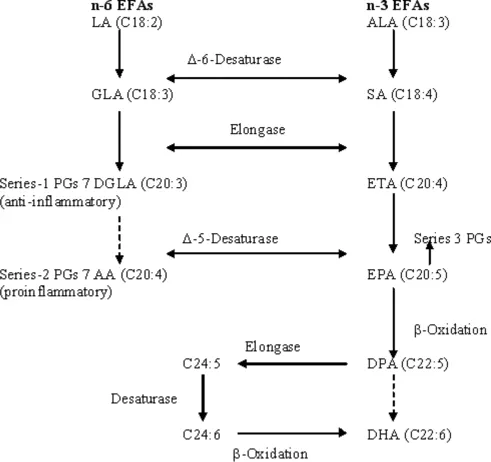
The first member of the omega-3 family and the parent molecule in this series is alpha-linolenic acid (ALA, 18:3n-3), which is abundant in flaxseed oil and is also present in canola, soybean, and walnut oils, among other commodities. Meanwhile, stearidonic acid (18:4n-3) has been detected in viable amounts in several species of algae, fungi, and animal tissues, as well as seeds of Echium (Boraginaceae). It has also been produced in soybean transgenitically. The other important omega-3 fatty acids, namely eicosapentaenoic acid (EPA, 20:5n-3), docosahexaneoic acid (DHA, 22:6n-3), and to a lesser extent, docosapentaenoic acid (DPA, 22:5n-3), are found in high amounts in certain algal species and in marine oils, primarily those from the body of fatty fish species such as herring and mackerel, the liver of lean white fish such as cod and halibut, and the blubber of marine mammals such as whales and seals. These important all cis omega-3 oils may also be recovered from processing by-products of wild catch and aquaculture fisheries (Shahidi, 2007; Zhong et al., 2007). While alpha-linolenic acid may be metabolized in the body via a series of desaturation and elongation reactions (Fig. 1.1), the production of long-chain omega-3 PUFA from ALA is limited and may vary from 1 to 5% (Shahidi & Finley, 2001). This is because conversion of ALA to stearidonic acid (SA, 18:4n-3) via the action of DELTA-6 desaturase is the slowest and thus the rate-determining step. This enzyme may be impaired and its activity reduced owing to aging, disease condition, lifestyle factors, micronutrient deficiency, or to use of certain drugs. Thus, adequate dietary intake of long-chain PUFA is generally recommended to maintain health and reduce disease risk. The fatty acid composition of selected plant, algal, and animal sources of omega-3 fatty acids are summarized in Table 1.A.
Table 1.A
Fatty Acid Composition of Omega-3 Oils.a
| Fatty acid | Flax oil | Menhaden | Cod liver oil | Seal blubber | Algal oil |
| 14:0 | — | 9.4 | 2.7 | 3.7 | 8.7 |
| 16:0 | 5.3 | 16.0 | 12.4 | 6.0 | 22.2 |
| 16:1 | — | 12.8 | 5.0 | 18.0 | — |
| 18:0 | 4.1 | 2.9 | 6.1 | 0.9 | 0.7 |
| 18:1 | 20.2 | 10.4 | 16.3 | 20.1 | 0.7 |
| 18:2 | 12.7 | 2.1 | 3.0 | 1.5 | 0.5 |
| 18:3n-3 | 53.3 | 1.1 | 1.0 | 0.4 | 0 |
| 20:5n-3 | — | 11.4 | 13.2 | 6.4 | 1.4 |
| 22:5n-6 | — | 0.5 | 0 | 4.8 | 16.3 |
| 22:6n-3 | — | 11.3 | 15.4 | 7.6 | 41.1 |
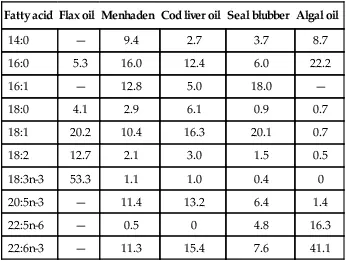
aSeal blubber oil contains 12.2% of 20:1 and 2.0% of 22:1.
Omega-3 Fatty Acids in Food and Daily Intake Requirements
As it was noted, plant sources of omega-3 oils provide ALA, which may promote health. However, the importance of omega-3 fatty acids is often ascribed to the long-chain PUFAs, especially EPA and DHA. The total content of EPA and DHA in various fish varies and depends on the type of fish and their habitat. The proportion of omega-3 fatty acids in fish muscle is higher in fatty fish such as herring, mackerel, and salmon than in lean fish such as cod, flounder, haddock, perch, and halibut (Table 1.B). Meanwhile, shellfish such as crab (0.3%–0.4%), shrimp (0.2%–0.5%), and lobster (0.3%–0.4%) have low levels of omega-3 fatty acids, and mollusks may also contain low levels of omega-3 fatty acids (e.g., squid, scallops, oysters, and mussels, 0.2%–0.6%) or no omega-3 fatty acids (abalone and some species of clam) (Shahidi, 2006; 2007; Barrow & Shahidi, 2008).
Table 1.B
Content (g/100g) of Omega-3 Fatty Acids (EPA + DHA)a in Selected Fish.
| Anchovy | 1.4 | Halibut | 0.2–0.5 |
| Bass | 0.3–0.8 | Herring | 1.3–1.8 |
| Capelin | 1.2 | Mackerel | 0.6–2.2 |
| Catfish | 0.3–0.5 | Perch | 0.2–0.4 |
| Cod | 0.2–0.3 | Salmon | 1.0–1.4 |
| Eel | 0.9 | Trout | 0.6–2.0 |
| Flounder | 0.2 | Tuna | 0.4–1.6 |
| Haddock | 0.2 |
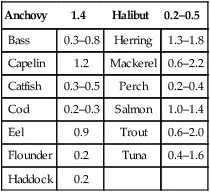
aEPA, eicosapentaenoic acid; DHA, docosahexaenoic acid.
The total recommended daily intake of EPA and DHA is age-dependent. It should be up to 1.5 g for children 1–8 years old, 2.0 g for 9–13 years old, and 2.5 g for 14–18 years old; this value may reach up to 3.0 g/day for adults, depending on the purpose and type of studies conducted. Owing to the oxidizability of such oils, their supplementation with antioxidants such as vitamin E is recommended. However, most suppliers of fish oil capsules generally add vitamin E to their products in order to arrest oxidative processes; this would also address the increasing need of the body on antioxidants because of consumption of highly unsaturated lipids which would otherwise cause oxidative stress. Although manufacturers as well as consumers of dietary supplements may use alpha-tocopherol, mainly d-alpha-tocopherol, manufacturers of omega-3 capsules often use mixed tocopherols from soybean oil-refining deodorizer-distillate, which is rich in gamma-tocopherol, as a source of vitamin E for stabilizing the oil because gamma-tocopherol is a much more effective antioxidant than alpha-tocopherol in vitro and hence it better protects the oil from oxidative deterioration.
In order to take advantage of omega-3 fatty acids, there has been a surge in the retail market in the appearance of fortified foods as well as a myriad of dietary supplements containing omega-3 fatty acids—occasionally ALA, but mainly EPA and DHA (Shahidi, 2006). Although use of such oils has traditionally been restricted owing to their instability and flavor reversion, availability of stabilized products such as microencapsulated and coacervated marine oils have allowed manufacturers to offer a variety of products. These include cereal-based products such as crackers, bars, bread, and pasta; dairy-based products such as milk, yogurt, and specialty dairy-based drinks; and juices, such as orange juice, as well as other commodities. Table 1.C summarizes the types of products in which omega-3 oils may be used for fortification and/or enrichment purposes. In addition, candies, pastries, and other confectionary products containing omega-3 fatty acids have appeared. Furthermore, meat products and even seafoods have been fortified in test markets and in product development. These formulated commodities either use microencapsulated and coacervated marine oils and do not release their content until it reaches the gastrointestinal tract or employ stabilized omega-3 oils by using sophisticated refining techniques and powerful antioxidants.
Table 1.C
Different Classes of Food Products Enriched with Omega-3 Fatty Acids.
| Class | Items |
| Dairy | Milk, yogurt, yogurt-based drinks |
| Grain-based | Bread, cereals, pasta, bars |
| Confectionary | Sweets, candies, bars |
| Spreads | Margarine, butter, spreads |
| Dressings | Salad dressing, mayonnaise, etc. |
| Juices | Orange juice, other fruit juices, etc. |
| Muscle foods | Meat, fish, and poultry products |
| Infant foods | Formula, etc. |
| Eggs | Hen eggs and products thereof |
| Others | Specialty products |
For therapeutic purposes, concentrates of omega-3 fatty acids—for example, up to 75% omega-3 content, or even capsules containing pure omega-3 fatty acids—may be used for certain health conditions. The concentrates may be in the ethyl ester form or as triacylglycerols, reconstituted to appear as natural or true-to-nature. Commercially available concentrates may contain equal amounts of EPA and DHA, or predominantly EPA or DHA, depending on the end use. Procedures used for concentration of omega-3 fatty acids are varied and are beyond the mandate of this brief overview (Shahidi & Wanasundara, 1998).
Omega-3 Fatty Acids in Health and Disease
Marine oils and their omega-3 fatty acids provide the best example of functional food ingredients and nutraceuticals that may serve as a continuum for their perceived and demonstrated health benefits. Thus, they may prevent ailments caused by their deficiency, such as those encountered in the body, and secondly they aid in reducing disease risk, and thirdly they act as therapeutic agents in treating certain diseases or conditions.
A large body of literature provides information about the health benefits of omega-3 fatty acids, mainly those arising from EPA and DHA. EPA and DHA serve as building blocks of cells in vital organs, particularly those with electrical activity such as the brain, the heart, and the eye, and also are important for normal growth and development (Shahidi & Miraliakbari, 2004; 2005). Therefore, adequate intake of omega-3 fatty acids by pregnant and lactating women is encouraged in order to addr...
Table of contents
- Cover image
- Title page
- Table of Contents
- Copyright
- Preface
- Chapter 1: Omega-3 Fatty Acids in Health and Disease
- Chapter 2: Clinical Effects of n-3 PUFA Supplementation in Human Health and Inflammatory Diseases
- Chapter 3: Fish Sources of Various Lipids Including n-3 Polyunsaturated Fatty Acids and Their Dietary Effects
- Chapter 4: Production of Marine Oils
- Chapter 5: Processing of Omega-3 Oils
- Chapter 6: Synthesis and Properties of Structured Lipids with Omega-3s
- Chapter 7: Applications of Omega-3 Fats in Foods
- Chapter 8: Synergistic/Additive Health Effects of Fish Oil and Bio-Active Compounds
- Chapter 9: Docosahexaenoic Acid Containing Phosphatidylcholine Alleviates Obesity-Related Disorders in Obese Rats
- Chapter 10: Health Benefits of Flaxseed
- Chapter 11: Fish Oil and Aggression
- Chapter 12: Effect of Dietary Fish Protein and Fish Oil on Azoxymethane-induced Aberrant Crypt Foci in A/J Mice
- Index
Trusted by 375,005 students
Access to over 1.5 million titles for a fair monthly price.
Study more efficiently using our study tools.
Frequently asked questions
Yes, you can cancel anytime from the Subscription tab in your account settings on the Perlego website. Your subscription will stay active until the end of your current billing period. Learn how to cancel your subscription
No, books cannot be downloaded as external files, such as PDFs, for use outside of Perlego. However, you can download books within the Perlego app for offline reading on mobile or tablet. Learn how to download books offline
Perlego offers two plans: Essential and Complete
- Essential is ideal for learners and professionals who enjoy exploring a wide range of subjects. Access the Essential Library with 800,000+ trusted titles and best-sellers across business, personal growth, and the humanities. Includes unlimited reading time and Standard Read Aloud voice.
- Complete: Perfect for advanced learners and researchers needing full, unrestricted access. Unlock 1.5M+ books across hundreds of subjects, including academic and specialized titles. The Complete Plan also includes advanced features like Premium Read Aloud and Research Assistant.
We are an online textbook subscription service, where you can get access to an entire online library for less than the price of a single book per month. With over 1.5 million books across 990+ topics, we’ve got you covered! Learn about our mission
Look out for the read-aloud symbol on your next book to see if you can listen to it. The read-aloud tool reads text aloud for you, highlighting the text as it is being read. You can pause it, speed it up and slow it down. Learn more about Read Aloud
Yes! You can use the Perlego app on both iOS and Android devices to read anytime, anywhere — even offline. Perfect for commutes or when you’re on the go.
Please note we cannot support devices running on iOS 13 and Android 7 or earlier. Learn more about using the app
Please note we cannot support devices running on iOS 13 and Android 7 or earlier. Learn more about using the app
Yes, you can access Omega-3 Oils by Ernesto Hernandez,Masashi Hosokawa in PDF and/or ePUB format, as well as other popular books in Physical Sciences & Biochemistry in Medicine. We have over 1.5 million books available in our catalogue for you to explore.