Salami: Practical Science and Processing Technology is a one-of-a-kind reference that covers all types of salami products from around the world, including all aspects of salami, such as microbiology, food safety, and research development trends. It provides the latest scientific findings and developments used to describe the production and manufacturing processes that lead to products that are produced efficiently and safe to eat.
The book is a comprehensive resource that combines a scientific and hands-on approach that is useful not only to those in the industry, but also students of meat science. The purpose of the book is to give clear and helpful guidelines to professionals within the meat-processing industry, such as technical, production, operations, process improvement, quality control, and research and development managers.
- Provides food safety summaries at the end of each chapter
- Includes detailed information on the composition and function of raw meat, additives, and technologies
- Presents recipes on how salami is produced by linking theory and science with the process of making salami
- Describes how to avoid faulty products and control food safety, etc.
Most countries interpret the presence of “pork meat” in their respective food standards as meaning “muscle meat including fat and skin” rather than as lean muscle tissue only. This fact can be confusing to the ordinary consumer as most understand lean muscle tissue to be “meat” and do not know that fat and skin are classified as “meat” as well. When other types of meat are described, though, the term meat does not include fat and skin. The amount of lean meat obtained from a carcass is around 35% in cattle, around 45% in pigs, around 38% in veal, and around 35% in lamb. Fat is also part of a balanced human diet, and the presence of fat in meat and meat products has both technological and organoleptic purposes. The relationship between fat consumption and weight gain, though, is currently a topic of interest, as excessive consumption of fat may be a cause of the increased levels of obesity worldwide.
Most countries interpret the presence of “pork meat” in their respective food standards as meaning “muscle meat including fat and skin” rather than as lean muscle tissue only. This fact can be confusing to the ordinary consumer as most understand lean muscle tissue to be “meat” and do not know that fat and skin are classified as “meat” as well. When other types of meat are described, though, the term meat does not include fat and skin. The amount of lean meat obtained from a carcass is around 35% in cattle, around 45% in pigs, around 38% in veal, and around 35% in lamb. Fat is also part of a balanced human diet, and the presence of fat in meat and meat products has both technological and organoleptic purposes. The relationship between fat consumption and weight gain, though, is currently a topic of interest, as excessive consumption of fat may be a cause of the increased levels of obesity worldwide.
The quality of meat and meat products is also a topic of frequent discussion. There is currently no consensus on what the term “quality” really stands for given that “quality” is generally seen as a combination of two major aspects. “Total quality” of meat and meat products includes, on the one hand, characteristics that can be measured, such as microbiological status, tenderness, color, juiciness, shelf life, pH value, pesticide levels, etc. On the other hand, total quality also includes an aspect that is less easy to measure: the consumer’s personal perception of the value of meat and meat products. This perception is different for every individual human being, as external factors such as television advertisements have an influence on this aspect of total quality. The term “quality,” from the consumer’s point of view, could be simply said to mean whether the consumer thinks a product is good value for money, and this judgment will vary from person to person and from product to product.
The study of meat technology evolves around the five major building blocks used to make a meat product: raw materials, additives, the manufacturing technologies applied, food safety, and commercial interests, including all possible interactions between the five. Manufacturing technology combines raw materials and additives with each other to obtain a product of the desired quality within a certain economic framework possibly providing profit to the manufacturer of the product (see Fig. 1.1).
Figure 1.1 Overview on meat technology.
1.2. Amino Acids
Amino acids are the building blocks of proteins. Even though about 190 amino acids are known today, only 20 different amino acids are required by humans to synthesize all necessary proteins. All of these 20 amino acids are α-amino acids given that both functional groups, the “acid” carboxyl group (
COOH), and the “alkaline” amino group (
NH2), are attached to the same carbon atom, the alpha (α)-carbon atom or Cα. This alpha-carbon atom is also referred to as the “chiral center” and glycine, the simplest amino acid, is the only nonchiral amino acid. The rest of the molecule is in most cases the primary portion of the amino acid and determines the identity of the amino acid itself as well as whether the amino acid is polar or nonpolar.
As stated, almost all α-amino acids are chiral, meaning that two arrangements of the same molecule are nonidentical mirror images.
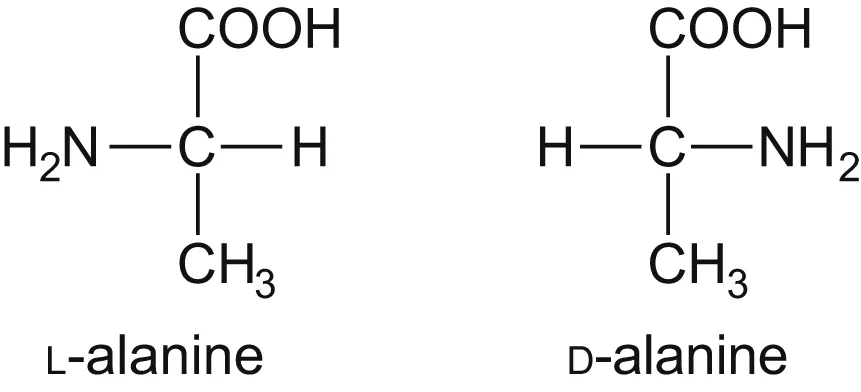
Chiral amino acids exist in two configurations known as L- or D-stereoisomers, which correspond to “left-handed” (L) or “right-handed” (D) three-dimensional shapes. D originates from the Latin word dexter and the NH2 group is on the right hand side of the molecule, while L originates from laevus, meaning “left.” All amino acids found in proteins are L-isomers except for glycine, the simplest amino acid, which is not chiral. Depending on the side chains within the amino acid, neutral, acid, or alkaline amino acids are formed (see Fig. 1.2).
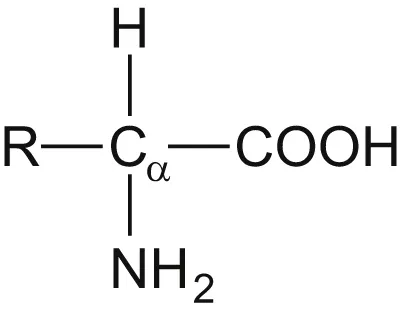
Amino acids exhibit side groups, which can be made of a hydrogen atom or other ring-structured molecules. In turn, those side groups can show different groups such as hydroxyl groups (
OH) and, in conjunction with the carboxyl and amino group of the main structure of the amino acid, these affect the structure of a protein (see Fig. 1.3).
Figure 1.2L- or D-form of the amino acid alanine.
Figure 1.3 Typical configuration of an amino acid; R represents the “rest” of the molecule.
Eight of those 20 amino acids are “essential” and have to be supplied to the human body by consuming food, containing those essential amino acids.
The body cannot synthesize those eight essential amino acids, and if they are not provided to the human body via the intake of food, illness and death may be the consequence. The remaining 12 amino acids can be synthesized by the human body, as long as food consumed provides all elements needed to synthesize those amino acids. Protein-containing food is broken down via digestion into individual amino acids, from which the required body proteins are synthesized.
The eight essential amino acids are:
• Isoleucine
• Threonine
• Leucine
• Valine
• Lysine
• Tryptophane
• Methionine
• Phenylalanine
All other 12 amino acids can be synthesized by the human body itself using nitrogen, which is supplied by consuming food containing nitrogen.
• Alanine
• Asparagine
• Arginine
• Cysteine
• Aspartic acid
• Glutamic acid
• Proline
• Histidine
• Tyrosine
• Glutamine
• Serine
• Glycine
The nutritional value of food is determined by the presence of essential amino acids at their lowest relative concentration. A food might contain seven of the eight essential amino acids at a high concentration but one at only a very low level, and it is the one present at a low level that determines the nutritional value of the food. This is based on the fact that if only this particular type of food were consumed to provide essential amino acids, the one present at the low concentration would be always...
Table of contents
Cover image
Title page
Table of Contents
Copyright
Preface
Acknowledgments
Introduction
Disclaimer
Part I. Meat and Fat
Part II. Additives
Part III. Production Technology
Index
Trusted by 375,005 students
Access to over 1.5 million titles for a fair monthly price.
Study more efficiently using our study tools.
Frequently asked questions
Yes, you can cancel anytime from the Subscription tab in your account settings on the Perlego website. Your subscription will stay active until the end of your current billing period. Learn how to cancel your subscription
No, books cannot be downloaded as external files, such as PDFs, for use outside of Perlego. However, you can download books within the Perlego app for offline reading on mobile or tablet. Learn how to download books offline
Perlego offers two plans: Essential and Complete
Essential is ideal for learners and professionals who enjoy exploring a wide range of subjects. Access the Essential Library with 800,000+ trusted titles and best-sellers across business, personal growth, and the humanities. Includes unlimited reading time and Standard Read Aloud voice.
Complete: Perfect for advanced learners and researchers needing full, unrestricted access. Unlock 1.5M+ books across hundreds of subjects, including academic and specialized titles. The Complete Plan also includes advanced features like Premium Read Aloud and Research Assistant.
Both plans are available with monthly, semester, or annual billing cycles.
We are an online textbook subscription service, where you can get access to an entire online library for less than the price of a single book per month. With over 1.5 million books across 990+ topics, we’ve got you covered! Learn about our mission
Look out for the read-aloud symbol on your next book to see if you can listen to it. The read-aloud tool reads text aloud for you, highlighting the text as it is being read. You can pause it, speed it up and slow it down. Learn more about Read Aloud
Yes! You can use the Perlego app on both iOS and Android devices to read anytime, anywhere — even offline. Perfect for commutes or when you’re on the go. Please note we cannot support devices running on iOS 13 and Android 7 or earlier. Learn more about using the app
Yes, you can access Salami by Gerhard Feiner in PDF and/or ePUB format, as well as other popular books in Technology & Engineering & Food Science. We have over 1.5 million books available in our catalogue for you to explore.