- 576 pages
- English
- ePUB (mobile friendly)
- Available on iOS & Android
eBook - ePub
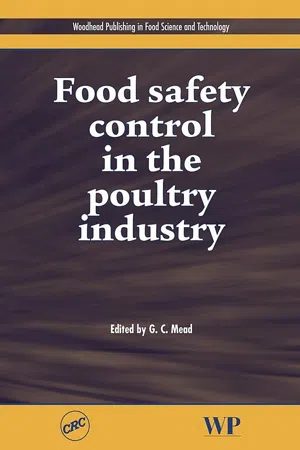
Food Safety Control in the Poultry Industry
About this book
The safety of poultry meat and eggs continues to be a major concern for consumers. As a result, there has been a wealth of research on identifying and controlling hazards at all stages in the supply chain. Food safety control in the poultry industry summarises this research and its implications for all those involved in supplying and marketing poultry products.The book begins by analysing the main hazards affecting poultry meat and eggs, both biological and chemical. It then discusses methods for controlling these hazards at different stages, from the farm through slaughter and carcass processing operations to consumer handling of poultry products. Further chapters review established and emerging techniques for decontaminating eggs or processed carcasses, from physical methods to the use of bacteriophage and bacteriocins.With its distinguished editor and international team of contributors, Food safety control in the poultry industry is a standard reference for both academics and food companies.
- Reviews recent research on identifying and controlling hazards at all stages in the supply chain
- Edited by a leading expert in this hot area with contributions from a worldwide team of experts
- Identify how to meet and excede consumers high expectations in food safety
Information
1
Bacterial infection of eggs
R.K. Gast United States Department of Agriculture, Agricultural Research Service, USA
1.1 Introduction
Although a variety of microbes, including pathogens such as Campylobacter jejuni, Listeria monocytogenes and Yersinia enterocolitica, are occasionally found on egg shells and are capable of surviving or growing in egg contents (Burley and Vadehra, 1989; Board and Fuller, 1994; Stadelman and Cotterill, 1995; Ricke et al., 2001), the history of eggs as a source of human illness has almost exclusively concerned bacteria of the genus Salmonella. Until the late 1960s, human salmonellosis (involving a diversity of serotypes) was commonly attributed to table eggs with cracked or dirty shells or to egg products that had not been heated sufficiently during processing to completely destroy pathogens. In the USA, the 1970 Egg Products Inspection Act prohibited the sale of cracked and dirty table eggs and mandated reliably effective pasteurization standards for liquid egg products, thereby leading to a very dramatic reduction in the frequency with which human illness was linked to eggs in the years that followed. However, by the mid-1980s, a newly-emerging public health issue again focused attention on eggs as a source of Salmonella transmission (St Louis et al., 1988). In this, more recent version of the story of eggs and Salmonella, human illness was associated primarily with clean and intact, Grade A table eggs. Moreover, the vast majority of these disease outbreaks involved a single serotype, S. enterica serovar Enteritidis (S. Enteritidis). An international surge in human S. Enteritidis (SE) infections has been principally connected to contaminated eggs (Angulo and Swerdlow, 1999; van de Giessen et al., 1999; Wall and Ward, 1999). In the USA, approximately 80% of the human SE outbreaks for which a food source could be identified have been attributed to eggs or egg-containing foods (Patrick et al., 2004). Accordingly, developing and implementing effective programmes to diminish the likelihood that consumers will be exposed to contaminated eggs has become an important objective for both government and industry on several continents (Hogue et al., 1997b; Cogan and Humphrey, 2003).
This chapter will explore the causes, characteristics, consequences and control of SE contamination of commercially-produced eggs. Section 1.2 discusses the routes of SE transmission into poultry flocks and into eggs, including the host and bacterial factors that promote the infection of laying hens and how these infections bring about Salmonella deposition inside eggs. Section 1.3 discusses the nature of SE contamination of eggs, including the deposition, survival and multiplication of the pathogen in various locations inside eggs. Section 1.4 discusses and assesses the most promising approaches to achieving sustainable, long-term reductions in egg-associated human illness.
1.2 Routes of transmission of Salmonella into poultry flocks and eggs
1.2.1 External and internal contamination of eggs
Although extensive microbial contamination of egg shells is uncommon at the time of oviposition, avian faecal material and other environmental sources in the laying house can rapidly introduce bacteria onto eggs (Board and Fuller, 1994). Inadequate sanitation in egg processing facilities is another possible cause of shell contamination (Davies and Breslin, 2003a). If not removed during processing, pathogens on the shell surface can be transferred to the edible, liquid portion of the egg, when the shell is broken to release the contents for use or consumption. Moreover, bacteria can also penetrate through shells to reach the contents. The porous shell is not a significant obstacle to bacterial penetration, although the underlying shell membranes are a more effective barrier (Burley and Vadehra, 1989; Ricke et al., 2001). Eggs are routinely washed in some countries to remove pathogens and spoilage organisms from shells, but improper control of temperature during egg washing can lead to a pressure gradient that promotes the movement of microbes through the shell membranes and into the contents (Stadelman and Cotterill, 1995).
Diverse Salmonella serotypes are found on shells, but only SE has been associated with a large number of egg-transmitted, human disease outbreaks in recent decades. A Japanese study reported that SE was the only one of six serotypes tested that was deposited in egg yolks by experimentally-infected hens (Okamura et al., 2001a). Similarly, a study in the UK found SE only inside naturally-contaminated eggs, even though a wide assortment of serotypes was present on the shells of these eggs (Humphrey et al., 1991b). This suggests that some mechanism other than shell contamination is responsible for the current public health problems related to eggs. This other process, often referred to somewhat misleadingly as ‘transovarian transmission’, is the consequence of systemic infection of laying hens with Salmonella that results in deposition of the pathogen inside the contents of developing eggs in the reproductive tract (Timoney et al., 1989; Gast and Beard, 1990a).
1.2.2 Systemic infection of hens and transovarian transmission of Salmonella Enteritidis
Like most other paratyphoid (non-host-adapted) Salmonella serotypes, SE is usually introduced to chickens via the gastrointestinal tract. After oral ingestion from the environment, SE colonizes several regions of the tract, particularly the crop and caeca (Turnbull and Snoeyenbos, 1974). Invasion through mucosal epithelial cells can then lead to systemic dissemination to a wide array of internal organs, including reproductive tissues (Gast and Beard, 1990b; Humphrey et al., 1993). By colonizing the ovary (the site of yolk maturation and release) and the oviduct (the site of albumen secretion around the descending yolk), SE appears to gain access to the contents of eggs (Miyamoto et al., 1997; Okamura et al., 2001a; De Buck et al., 2004). Some investigators have found SE inside pre-ovulatory follicles and in developing eggs removed from the oviducts of infected hens before oviposition (Thiagarajan et al., 1994; Keller et al., 1995). Recent reports have also implicated S. Heidelberg as an egg- transmitted pathogen (Hennessy et al., 2004), and an experimental-infection study documented the ability of some strains of this serotype to colonize reproductive tissues and be deposited inside eggs (Gast et al., 2004).
In experimental infection studies, laying hens have typically produced internally-contaminated eggs for only a few weeks following oral inoculation (Gast and Beard, 1990a; Gast and Holt, 2000a). However, in commercial laying flocks, the patterns of egg contamination over time are far more irregular, as infection spreads gradually through each house. Contamination of eggs with SE seems to be a generally infrequent phenomenon within infected flocks. Two studies of environmentally-positive, commercial laying flocks in the USA have indicated a prevalence of contaminated eggs of less than 0.03% (Kinde et al., 1996; Henzler et al., 1998). The overall incidence of SE contamination of eggs from commercial flocks in the USA has been estimated at around 0.005% (Ebel and Schlosser, 2000). Likewise, egg contamination usually occurs at relatively low frequencies in experimental infection studies, even after the administration of very large oral doses of SE to laying hens (Humphrey et al., 1991a; Gast and Holt, 2001a; Gast et al., 2002).
1.2.3 Sources of introduction of Salmonella Enteritidis into poultry flocks
A recent national survey in the USA indicated that approximately 7% of the commercial laying flocks in that country were environmentally positive for SE (Garber et al., 2003). The leading potential sources that can intro...
Table of contents
- Cover image
- Title page
- Table of Contents
- Copyright page
- Contributor contact details
- Introduction
- 1: Bacterial infection of eggs
- 2: Bacterial contamination of poultry as a risk to human health
- 3: Detecting and controlling veterinary drug residues in poultry
- 4: Modelling risks from antibiotic and other residues in poultry and eggs
- 5: Pathogen populations on poultry farms
- 6: Catching, transporting and lairage of live poultry
- 7: Ensuring the safety of poultry feed
- 8: The effective control of Salmonella in Swedish poultry
- 9: The use of probiotics to control foodborne pathogens in poultry
- 10: The HACCP concept and its application in primary production
- 11: Microbial risk assessment in poultry production and processing
- 12: Techniques for reducing pathogens in eggs
- 13: Improving slaughter and processing technologies
- 14: Refrigeration and the safety of poultry meat
- 15: Sanitation in poultry processing
- 16: HACCP in poultry processing
- 17: On-line physical methods for decontaminating poultry meat
- 18: Microbial treatments to reduce pathogens in poultry meat
- 19: Irradiation of poultry meat
- 20: Rapid detection and enumeration of pathogens on poultry meat
- 21: Modified atmosphere packaging and the safety of poultry meat
- 22: Handling poultry and eggs in the kitchen
- Index
Trusted by 375,005 students
Access to over 1.5 million titles for a fair monthly price.
Study more efficiently using our study tools.
Frequently asked questions
Yes, you can cancel anytime from the Subscription tab in your account settings on the Perlego website. Your subscription will stay active until the end of your current billing period. Learn how to cancel your subscription
No, books cannot be downloaded as external files, such as PDFs, for use outside of Perlego. However, you can download books within the Perlego app for offline reading on mobile or tablet. Learn how to download books offline
Perlego offers two plans: Essential and Complete
- Essential is ideal for learners and professionals who enjoy exploring a wide range of subjects. Access the Essential Library with 800,000+ trusted titles and best-sellers across business, personal growth, and the humanities. Includes unlimited reading time and Standard Read Aloud voice.
- Complete: Perfect for advanced learners and researchers needing full, unrestricted access. Unlock 1.5M+ books across hundreds of subjects, including academic and specialized titles. The Complete Plan also includes advanced features like Premium Read Aloud and Research Assistant.
We are an online textbook subscription service, where you can get access to an entire online library for less than the price of a single book per month. With over 1.5 million books across 990+ topics, we’ve got you covered! Learn about our mission
Look out for the read-aloud symbol on your next book to see if you can listen to it. The read-aloud tool reads text aloud for you, highlighting the text as it is being read. You can pause it, speed it up and slow it down. Learn more about Read Aloud
Yes! You can use the Perlego app on both iOS and Android devices to read anytime, anywhere — even offline. Perfect for commutes or when you’re on the go.
Please note we cannot support devices running on iOS 13 and Android 7 or earlier. Learn more about using the app
Please note we cannot support devices running on iOS 13 and Android 7 or earlier. Learn more about using the app
Yes, you can access Food Safety Control in the Poultry Industry by G.C. Mead in PDF and/or ePUB format, as well as other popular books in Technology & Engineering & Food Science. We have over 1.5 million books available in our catalogue for you to explore.