- 596 pages
- English
- ePUB (mobile friendly)
- Available on iOS & Android
eBook - ePub
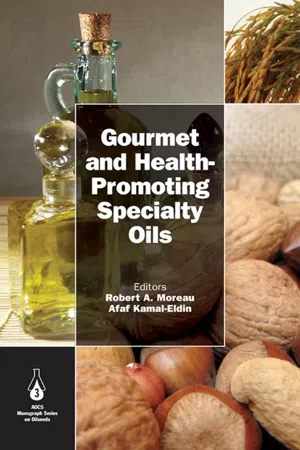
Gourmet and Health-Promoting Specialty Oils
About this book
The third volume in the AOCS PRESS MONOGRAPH SERIES ON OILSEEDS is a unique blend of information focusing on edible oils. These oils contain either unique flavor components that have lead to their being considered "gourmet oils," or contain unique health-promoting chemical components. Each chapter covers processing, edible and non-edible applications, lipids, health benefits, and more related to each type of oil.
- Includes color illustrations of over 20 health-promoting specialty oils
- Comprehensive resource for the chemical and physical properties and extraction and processing methods of these specialty oils
- Describes and and includes the health effects of over 50 different oils from plants, algae, fish, and milk
Information
1
Olive Oil
Diego L. García-González, Ramón Aparicio-Ruiz and Ramón Aparicio, Instituto de la Grasa (CSIC), Padre García Tejero, 4, 41012, Sevilla, Spain
Introduction
The olive tree, one of the oldest known cultivated trees, is the symbol of friendship and peace; it also plays other social and religious roles described in Greek mythology and the Old Testament. More than 1275 autochthonous olive cultivars are identified and characterized (Bartolini et al., 1998) from an ancestor that is still subject to debate, but its origin is dated circa 5000 years ago though controversy also exists about its possible geographical origin in Mesopotamia. Nevertheless, Phoenicians and Greeks were responsible for the spread of the olive tree to Western regions where they traded.
The growth of olive oil cultivation was followed by the development of olive processing. The squeezing of olives in stone mortars, operated by early farmers, was not suitable for the increasing trade of olive oil in the Roman Empire. Romans decisively contributed to technological development with the milling crusher, which expedited the crushing process, and the wooden or iron manually activated screw press. They represented the major revolution in olive processing until Joseph Graham (1795) invented the hydraulic pressing system. The third revolution was in the second half of the twentieth century with the centrifugation system. The cost reduction of fully automated systems, which produce high-quality olive oils, the industrialization of agriculture, and the nutritional benefits of consuming olive oil abruptly increased olive oil demand and hence, olive oil production.
Nowadays, 600 million productive olive trees grow on the Earth and are spread out on 7 million ha, with pedoclimatic conditions such as those prevailing in the Mediterranean countries that account for not less than 97% of world production. The European Union is the major producer and also consumer, and surprisingly the number one exporter and the number two importer. Olive oil is marketed in accordance with the designations of the International Olive Council trade standards (IOC. 2006). Thus, virgin olive oil must be obtained by only mechanical or other physical means under conditions, particularly thermal, which do not lead to alterations in the oil. This oil has not undergone treatment other than washing, decantation, centrifugation, and filtration. Extra-virgin olive oil (EVOO) and virgin olive oil (VOO) are different edible grades of virgin olive oil. Lampante VOO is not fit for consumption and is intended for refining or for technical purposes. Refined olive oil (ROO) is the oil refined by methods that include neutralization, decolorization with bleaching earth, and deodorization. Olive oil is an edible blend of VOO and ROO. Olive–pomace oil is obtained by solvent extraction of the olive milling by-products; its triacylglycerol composition is similar to that of VOO, but some of the nonsaponifiable compounds (e.g., waxes) may differ significantly requiring the oil to be winterized before refining. Olive–pomace oil designation means a mixture refined olive-pomace oil with virgin olive oil. The result is that olive oil is the most controlled edible oil, overseen by numerous chemical standards and regulations (Table 1.1) that protect consumers against false copies.
Table 1.1
Olive Oil Trade Standards.
| Designations | (1) | (2) | (3) | (4) | (5) | (6) | (7) | (8) | (9) | (10) | (11) | (12) | (13) | (14) |
| Extra Virgin Olive Oil | ≤0.05 | ≤0.05 | ≥1000 | ≤4.5 | ≤250 | ≤0.10 | ≤0.2 | B | ≤2.50a | ≤0.22 | ≤0.01 | ≤0.8 | ≤20 | ≤0.2 |
| Virgin Olive Oil | ≤0.05 | ≤0.05 | ≥1000 | ≤4.5 | ≤250 | ≤0.10 | ≤0.2 | B | ≤2.60a | ≤0.25 | ≤0.01 | ≤2.0 | ≤20 | ≤0.2 |
| Ordinary Virgin Olive Oil | ≤0.05 | ≤0.05 | ≥1000 | ≤4.5 | ≤250 | ≤0.10 | ≤0.2 | B | − | ≤0.30a | ≤0.01 | ≤3.3 | ≤20 | ≤0.2 |
| Lampante Virgin Olive Oil | ≤0.10 | ≤0.10 | ≥1000 | ≤4.5a | ≤300a | ≤0.50 | ≤... |
Table of contents
- Cover image
- Title page
- Table of Contents
- Copyright
- Preface
- Introduction
- List of Color Illustrations
- Color Illustrations
- Chapter 1: Olive Oil
- Chapter 2: Avocado Oil
- Chapter 3: Tree Nut Oils
- Chapter 4: Flax, Perilla, and Camelina Seed Oils: α-Linolenic Acid-rich Oils
- Chapter 5: Hempseed Oil
- Chapter 6: Berry Seed and Grapeseed Oils
- Chapter 7: Borage, Evening Primrose, Blackcurrant, and Fungal Oils; γ-Linolenic Acid-rich Oils
- Chapter 8: Sesame Seed Oil
- Chapter 9: Niger Seed Oil
- Chapter 10: Nigella (Black Cumin) Seed Oil
- Chapter 11: Camellia Oil and Tea Oil
- Chapter 12: Pumpkin Seed Oil
- Chapter 13: Wheat Germ Oil
- Chapter 14: Rice Bran Oil
- Chapter 15: Corn Kernel Oil and Corn Fiber Oil
- Chapter 16: Oat Oil
- Chapter 17: Barley Oil
- Chapter 18: Parsley, Carrot, and Onion Seed Oils
- Chapter 19: Algal Oils
- Chapter 20: Fish Oils
- Chapter 21: Butter, Butter Oil, and Ghee
- Contributors
- Index
Trusted by 375,005 students
Access to over 1.5 million titles for a fair monthly price.
Study more efficiently using our study tools.
Frequently asked questions
Yes, you can cancel anytime from the Subscription tab in your account settings on the Perlego website. Your subscription will stay active until the end of your current billing period. Learn how to cancel your subscription
No, books cannot be downloaded as external files, such as PDFs, for use outside of Perlego. However, you can download books within the Perlego app for offline reading on mobile or tablet. Learn how to download books offline
Perlego offers two plans: Essential and Complete
- Essential is ideal for learners and professionals who enjoy exploring a wide range of subjects. Access the Essential Library with 800,000+ trusted titles and best-sellers across business, personal growth, and the humanities. Includes unlimited reading time and Standard Read Aloud voice.
- Complete: Perfect for advanced learners and researchers needing full, unrestricted access. Unlock 1.5M+ books across hundreds of subjects, including academic and specialized titles. The Complete Plan also includes advanced features like Premium Read Aloud and Research Assistant.
We are an online textbook subscription service, where you can get access to an entire online library for less than the price of a single book per month. With over 1.5 million books across 990+ topics, we’ve got you covered! Learn about our mission
Look out for the read-aloud symbol on your next book to see if you can listen to it. The read-aloud tool reads text aloud for you, highlighting the text as it is being read. You can pause it, speed it up and slow it down. Learn more about Read Aloud
Yes! You can use the Perlego app on both iOS and Android devices to read anytime, anywhere — even offline. Perfect for commutes or when you’re on the go.
Please note we cannot support devices running on iOS 13 and Android 7 or earlier. Learn more about using the app
Please note we cannot support devices running on iOS 13 and Android 7 or earlier. Learn more about using the app
Yes, you can access Gourmet and Health-Promoting Specialty Oils by Robert Moreau,Afaf Kamal-Eldin in PDF and/or ePUB format, as well as other popular books in Biological Sciences & Biochemistry in Medicine. We have over 1.5 million books available in our catalogue for you to explore.