eBook - ePub
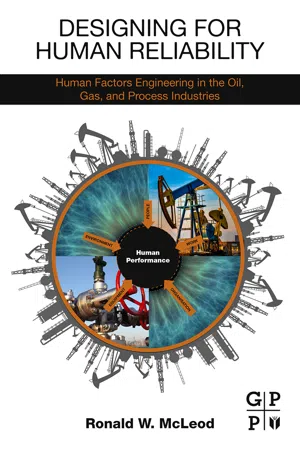
Designing for Human Reliability
Human Factors Engineering in the Oil, Gas, and Process Industries
- 422 pages
- English
- ePUB (mobile friendly)
- Available on iOS & Android
eBook - ePub
Designing for Human Reliability
Human Factors Engineering in the Oil, Gas, and Process Industries
About this book
Industry underestimates the extent to which behaviour at work is influenced by the design of the working environment. Designing for Human Reliability argues that greater awareness of the contribution of design to human error can significantly enhance HSE performance and improve return on investment. Illustrated with many examples, Designing for Human Reliability explores why work systems are designed and implemented such that "design-induced human error" becomes more-or-less inevitable. McLeod demonstrates how well understood psychological processes can lead people to make decisions and to take actions that otherwise seem impossible to understand. Designing for Human Reliability sets out thirteen key elements to deliver the levels of human reliability expected to achieve the return on investment sought when decisions are made to invest in projects. And it demonstrates how investigation of the human contribution to incidents can be improved by focusing on what companies expected and intended when they chose to rely on human performance as a barrier, or control, against incidents.
- Recognise some 'hard truths' of human performance and learn about the importance of applying the principles of Human Factors Engineering on capital projects
- Learn from analysis of real-world incidents how differences between 'fast' and 'slow' styles of thinking can lead to human error in industrial processes
- Learn how controls and barrier against major incidents that rely on human performance can be strengthened throughout the design and development of assets and equipment
Information
1
Introduction
Abstract
This chapter provides an introduction to the main argument of the book—that design-induced human unreliability is a significant factor leading to major incidents and lost production across the oil and gas, process and related industries. Human Factors in the design of work systems is one of three pillars of safety and reliability alongside leadership, culture and behavioral safety, and fitness for work, competence, training and organizational systems. Human factors in design has, to-date, received significantly less attention than the other two pillars. The chapter provides definitions of “human reliability” and “design-induced human unreliability” in terms of organizational expectations and the application of existing Human Factors standards to the design of work systems. The chapter summarizes the structure and content of the book.
Keywords
Human factors
Human and organizational factors
Human factors engineering
Design-induced human unreliability
Human error
Human reliability
There are many causes and contributors to loss of human reliability in safety-critical activities. Table 1.1 summarizes three different views of the range of factors that need to be managed to reduce the potential for human error contributing to major accidents.1 The left-hand column lists some of the Human and Organizational Factors “Key Topics” identified by the UK Health and Safety Executive [2]. These form the basis of the HSE's expectations about the scope of human-related risks that need to be managed at sites that have the potential for major accidents. The middle column contains a proposal for nine “Human Factors Elements” that if not adequately controlled in the design, construction, and operation of marine vessels and offshore installations can have a direct impact on human performance and human error [3]. The third column is a perspective developed during a summit held by the Society of Petroleum Engineers (SPE) in Houston in 2012 [4]. The summit was attended by around 70 experienced managers, engineers and operators (and a few Human Factors specialists) from across the global upstream oil and gas industry. The third column of the table lists the consensus view of the attendees of the scope of issues that need to be managed to provide assurance that risks from “Human Factors” will be adequately controlled in future oil and gas exploration and production operations.
Table 1.1
Perspectives on the range of factors influencing human reliability
| UK HSE Key Topics | HF Elements | SPE White Paper |
| Managing human failure | Fitness for duty | Leadership and culture |
| Procedures | Job aids (manuals, policies. procedures, labels, signage) | Perception of risk and decision making |
| Training and competence | Training | Communication of risk |
| Staffing | Interpersonal communications | Human factors in design |
| Organizational change | Personnel selection criteria | Individual and team capacity |
| Safety critical communications | Establishment of the manpower requirements | Commercial and contractual environment |
| Human factors in design | Environmental control of work and habitability spaces | Collaborative and distributed team working |
| Fatigue and shift work | Workplace design | Workload transition |
| Organizational culture | Management support of, and participation in, HF programs | Assurance of safety critical human activities |
| Maintenance, inspection and testing | Investigation and learning from incidents |
There is, not surprisingly, a lot of consistency across these three perspectives. The differences reflect the nature of the operations and priorities, as well as the organizational experience, commercial and contractual responsibilities and contexts represented. For example, the SPE list reflects the complex and dynamic contractual environment in oil and gas exploration activities, as well as the recent knowledge gained from the investigation into the 2010 loss of the Deepwater Horizon drilling platform in the Gulf of Mexico.
Although the range of factors contributing to the loss of reliability is undoubtedly large, this book focuses on one identified by all three organizations (among many others), that has to date received significantly less attention than it justifies: human factors in design. That is, the influence the design of technological systems and the working environment has on the ability of people to behave and perform safely and reliably without putting their health and safety at risk.
The contribution of human performance to major accidents is widely recognized and has been investigated and studied in great depth. Investigations into major accidents regularly conclude, usually among many human and organizational factors, that issues related to the design of the work environment and/or equipment interfaces contributed to the loss of human reliability. They frequently identify inadequate attention having been paid to the needs of the people who are expected to monitor, inspect, operate or maintain equipment when facilities and equipment were designed: i.e., the errors were, to at least some extent, “design-induced.” Many, perhaps the great majority, would not have happened if the engineers, designers, manufacturers and construction teams involved in the design and implementation of the assets had complied with what has been widely recognized for many years as good practice in Human Factors Engineering (HFE).
The argument that design-induced human error is a significant contributor to major industrial accidents should not be news to anybody who takes an interest in safety. It is, however, surprising that so little progress has yet been made in learning those lessons and routinely designing facilities in such a way that the incidence of design-induced human error is substantially lower than it actually is.
The same lack of attention to Human Factors in design that leads to the losses associated with major accidents is also behind the large number of daily operational incidents and mishaps that cause assets to fail to operate at their intended rates of production. No one gets hurt, nothing gets spilled, and, often, nothing gets reported. But the asset has lost production, and each time, across the business, investors have lost a little more of the potential return on their investment. The nature of the errors involved is virtually the same whether the outcome is a health, safety or environmental incident or a loss of production.
This book makes two claims: First, the amount of return on investment being lost—or the return that is not being generated—is significant (certainly significant enough to justify improvement). And, second, that by applying the scientific and technical knowledge and complying with the technical standards that have been available for a long time, and by developing a better understanding of the psychology of human performance, not only can health, safety and environmental control be improved, but also the return investors receive from the assets they own can be enhanced significantly.
What is reliable human performance?
Here’s my definition of “reliable human performance”:
Reliable human performance means the standards of behaviour and performance the people responsible for designing, planning and organizing operations expected when they made decisions about the role of people in assuring the safety and reliability of their operations.2
By contrast, “loss of human reliability” refers to situations in which the way people actually performed or behaved was not consistent with the organization’s expectations.
So reliable human performance is simply the performance that was expected. It does not need to be defined against any absolute benchmark such as predicted failure rates or other metrics. No organization tasked with running hazardous operations expects the people they are relying on to fail. Or, if they do anticipate human “failure” sometimes, other precautions (“controls” or “barriers” are generally the terms currently used) will have been put in place to prevent that failure leading to an incident. To do otherwise would surely be negligent.
When things go wrong, it is common for incident reports and commentators to talk about the gap between what people did and what was expected. Indeed, defining the difference between the expected outcome and what actually happened is central to some investigation processes. So defining human reliability relative to those expectations fits comfortably with how much of industry thinks about the role of people in systems, as reflected in the kind of language that is widely used.
Professor Jim Reason, the inventor of the “Swiss Cheese” model of accident causation, defines a human “error” as being:
…all those occasions in which a planned sequence of mental or physical activities fails to achieve its desired goal without the intervention of some chance agency. [5] p. 10.
In the same way that planning is central to human error at the individual level, expectations are central to human reliability at the organizational level. Although it may not be scientifically or theoretically rigorous, defining human reliability and unreliability relative to organizational expectations leads to a number of practical benefits:
• It avoids the need to make fine judgments about plans, goals, skills or the mediating influence of chance or other factors in shaping the results of the activities.
• It avoids a number of issues around the use of the term “human error”—not least when judgments, decisions, behaviors or actions lead to an undesirable outcome in one situation whereas in another situation when exactly the same activities are involved, no undesirable outcome occurs due to the intervention of other factors.3 The performance or behavior was identical, yet in one situation it was considered an “error” while in the other it was not.
• It moves the focus away from looking at how and why the individuals involved “failed” and on to asking why the organization’s expectations turned out not to be valid in the circumstances that prevailed at the time. The responsibility moves to the organization to challenge its expectations about what people will and can do in real-world situations, to ensure those expectations are realistic and that measures have put in place to ensure they have a reasonable chance of being met.
• More practically, it suggests straightforward and practical approaches to ensuring sufficient action is taken during the development of facilities to deliver the expected levels of human reliability. This is also the case when lessons need to be learned about how and why human reliability was lost and what needs to be done to improve. (Examples of these approaches both during design and in incident investigations are discussed in some detail in Parts 4 and 5, respectively).
People are, usually, reliable
Assets, equipment and system...
Table of contents
- Cover image
- Title page
- Table of Contents
- Copyright
- Dedication
- Preface
- Acknowledgments
- 1: Introduction
- Part 1: Local rationality at the Formosa Plastics Corporation
- Part 2: The scope and value of human factors engineering
- Part 3: Irrational people in a rational industry
- Part 4: Human Factors in Barrier Thinking
- Part 5: Implementing HFE
- Index
Trusted by 375,005 students
Access to over 1.5 million titles for a fair monthly price.
Study more efficiently using our study tools.
Frequently asked questions
Yes, you can cancel anytime from the Subscription tab in your account settings on the Perlego website. Your subscription will stay active until the end of your current billing period. Learn how to cancel your subscription
No, books cannot be downloaded as external files, such as PDFs, for use outside of Perlego. However, you can download books within the Perlego app for offline reading on mobile or tablet. Learn how to download books offline
Perlego offers two plans: Essential and Complete
- Essential is ideal for learners and professionals who enjoy exploring a wide range of subjects. Access the Essential Library with 800,000+ trusted titles and best-sellers across business, personal growth, and the humanities. Includes unlimited reading time and Standard Read Aloud voice.
- Complete: Perfect for advanced learners and researchers needing full, unrestricted access. Unlock 1.5M+ books across hundreds of subjects, including academic and specialized titles. The Complete Plan also includes advanced features like Premium Read Aloud and Research Assistant.
We are an online textbook subscription service, where you can get access to an entire online library for less than the price of a single book per month. With over 1.5 million books across 990+ topics, we’ve got you covered! Learn about our mission
Look out for the read-aloud symbol on your next book to see if you can listen to it. The read-aloud tool reads text aloud for you, highlighting the text as it is being read. You can pause it, speed it up and slow it down. Learn more about Read Aloud
Yes! You can use the Perlego app on both iOS and Android devices to read anytime, anywhere — even offline. Perfect for commutes or when you’re on the go.
Please note we cannot support devices running on iOS 13 and Android 7 or earlier. Learn more about using the app
Please note we cannot support devices running on iOS 13 and Android 7 or earlier. Learn more about using the app
Yes, you can access Designing for Human Reliability by Ronald W. McLeod in PDF and/or ePUB format, as well as other popular books in Technology & Engineering & Industrial Management. We have over 1.5 million books available in our catalogue for you to explore.