eBook - ePub
Handbook of Materials Failure Analysis with Case Studies from the Oil and Gas Industry
- 448 pages
- English
- ePUB (mobile friendly)
- Available on iOS & Android
eBook - ePub
Handbook of Materials Failure Analysis with Case Studies from the Oil and Gas Industry
About this book
Handbook of Materials Failure Analysis: With Case Studies from the Oil and Gas Industry provides an updated understanding on why materials fail in specific situations, a vital element in developing and engineering new alternatives.
This handbook covers analysis of materials failure in the oil and gas industry, where a single failed pipe can result in devastating consequences for people, wildlife, the environment, and the economy of a region.
The book combines introductory sections on failure analysis with numerous real world case studies of pipelines and other types of materials failure in the oil and gas industry, including joint failure, leakage in crude oil storage tanks, failure of glass fibre reinforced epoxy pipes, and failure of stainless steel components in offshore platforms, amongst others.
- Introduces readers to modern analytical techniques in materials failure analysis
- Combines foundational knowledge with current research on the latest developments and innovations in the field
- Includes numerous compelling case studies of materials failure in oil and gas pipelines and drilling platforms
Information
Subtopic
Combustibili fossiliChapter 1
Failure analysis of oil and gas transmission pipelines
Brad James; Alexander Hudgins Exponent, Menlo Park, California, USA
Abstract
While pipelines offer a safe, cost-effective way to move natural gas and hazardous liquids, pipeline leaks and ruptures can result in disastrous consequences. Pipelines can be susceptible to different metallurgical failure mechanisms including but not limited to manufacturing defects, third party damage, and corrosion. This chapter outlines common pipeline failure mechanisms and provides selected case studies, which highlight typical issues that can result in pipeline leaks and ruptures. Understanding these failure mechanisms is critical to mitigating risk of future incidents and managing the future integrity of the pipeline.
Keywords
Hazardous liquid
Pipeline
Transmission
Distribution
Failure
Corrosion
Damage
Seam
Gas
1 Introduction
There are over 2.3 million miles of pipelines in the United States that carry natural gas and liquid-petroleum products [1]; approximately 60% of which were installed before 1970 [2]. These oil and gas pipelines are the backbone of our energy-dependent society. Statistics indicate that oil and gas pipelines are a far safer, more efficient, cost-effective way to move these hazardous products than any other method of transportation [1]. However, when pipelines do rupture or leak, disastrous human, environmental, and business consequences can result. The most common issues that can result in pipeline leaks and ruptures include mechanical damage, seam weld defects, stress corrosion cracking (SCC), hard spots, fatigue, and corrosion. This chapter is intended to serve as a primer to help failure analysts to understand and interpret these more common pipeline failure mechanisms and provides specific case studies. The more we understand how and why pipelines can fail, the better we can maintain our aging infrastructure and prevent accidents in the future.
Internal pressure results in “hoop stress” in a pipeline and is typically quantified using Barlow’s formula [3]. These hoop stresses act to favor crack initiation and growth in a radial and a longitudinal direction. Hoop stresses and the corresponding preferential crack growth directions in pipe are shown schematically in Figure 1.1. Thus, piping anomalies that are most detrimental to integrity are typically those that are oriented in a longitudinal direction.
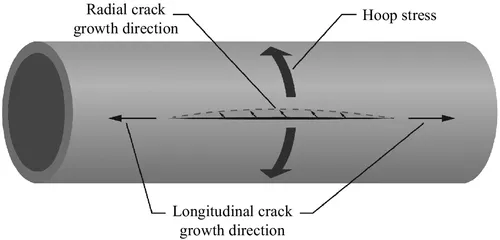
Figure 1.1 Schematic pipeline showing the orientation of hoop stress resulting from internal pressure and the preferential orientation of crack growth.
Stresses other than pressure-induced hoop stress can affect pipeline integrity. Residual stresses caused by inadvertent dents or gouges can contribute to crack initiation and growth. Welding can also be a source of residual stresses. Another of the more common stresses that can cause pipeline failures are those caused by geological forces, such as landslides, earthquakes, or other large-scale soil or pipeline movement. These can result in axial stresses that cause failures transverse to the pipe’s longitudinal direction, such as at girth welds.
Data from 2011 show that material and weld failures constitute the largest incident type for both hazardous liquid and gas transmission systems (Figures 1.2 and 1.3). Other authors have indicated that third party damage is the most common cause of incidents in gas transmission systems [4]. The following sections outline specific pipeline failure mechanisms and provide examples to illustrate key phenomena. A summary of failure mechanisms presented in this chapter is shown in Table 1.1, which also serves as an outline for the content presented in this chapter.
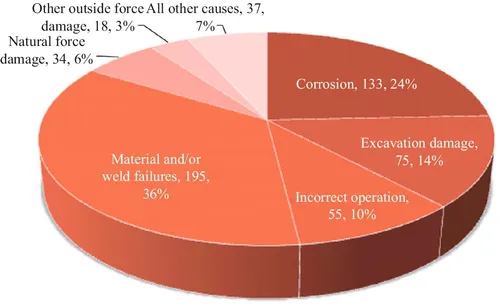
Figure 1.2 The distribution of incidents in hazardous liquid lines is shown between the years of 2006 and 2010 [20].
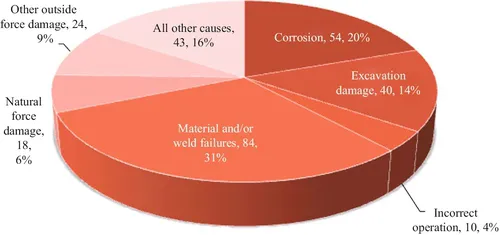
Figure 1.3 The distribution of incidents in gas transmission lines is shown between the years of 2006 and 2010 [20].
Table 1.1
Summary of Failure Mechanisms Presented in this Chapter
Mechanisms
Mechanical damage
Lap-weld defects
Electric-resistance weld defects
Flash-weld defects
Submerged-arc weld defects
Shielded metal arc weld defects
General corrosion
High-pH stress corrosion cracking
Near-neutral pH stress corrosion cracking
Hydrogen stress cracking
Grooving corrosion
Fatigue
2 Mechanical Damage
Mechanical damage occurs when a pipeline is struck by mechanical equipment, such as a backhoe. Mechanical damage has been characterized by some of the most common causes of pipeline rupture [5]. If the mechanical strike does not immediately rupture the pipe, the formation of the dent or gouge will often result in local stress concentration and residual stresses. API 579 and ASME B31.8 provide guidance for the assessment of the dent or gouge on pipeline integrity [6,7]. An undented pipe does not develop any through-wall bending stresses when pressurized because of the smooth, axi-symmetric curvature of the wall. However, inward dents in a mechanically damaged pipe locally invert the nominal pipe wall curvature. Internal pressurization tends to evert the inward dent, developing locally high through-thickness bending stresses in the dent with the peak tensile stress in the root of the dent on the outer diameter (OD) surface [8,9]. In the absence of pressure-induced stresses, yielding of the pipe steel during inward indentation introduces residual bending stresses in the pipe wall that remain after the indenter is removed. These residual stresses, which can exceed yield-strength levels, are typically tensile in the root of the dent on the OD side and compressive on the inner diameter (ID) side [8]. Axial cracks are often observed in larger pipeline gouges, as shown in Figure 1.4. These mechanically induced cracks can provide sufficient stress intensity to initiate either progressive or overload cracking, depending on pipeline loading conditions. Metallographic examination of these dent-induced cracks indicates a characteristic 45° orientation with respect to the radial direction; examples are shown in Figure 1.5. These 45° “shear” cracks are formed by shear stresses caused during indenter-induced gouging and then eversion upon removal [5]. Finite element analysis can be conducted to calculate indentor forces required to cause the dent or gouge, and may be able to help determine which types of equipment may have caused the damage [8].
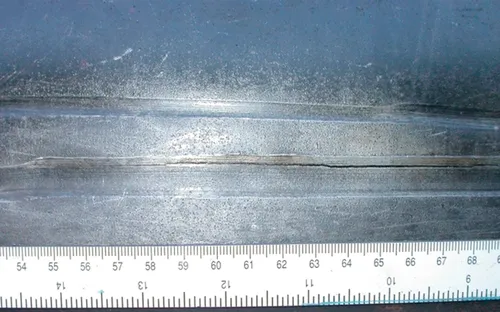
Figure 1.4 Example axial crack caused by mechanical damage.
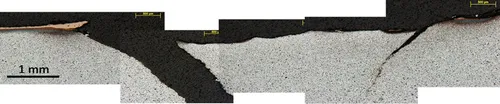
Figure 1.5 Exampl...
Table of contents
- Cover image
- Title page
- Table of Contents
- Copyright
- Contributors
- Preface
- Chapter 1: Failure analysis of oil and gas transmission pipelines
- Chapter 2: Modern analytical techniques in failure analysis of aerospace, chemical, and oil and gas industries
- Chapter 3: Methods for assessing defects leading to gas pipe failure
- Chapter 4: Failure of glass fiber-reinforced epoxy pipes in oil fields
- Chapter 5: Failures and integrity of pipelines subjected to soil movements
- Chapter 6: Oil field drill pipes failure
- Chapter 7: Failure analysis and solution studies on drill pipe thread gluing at the exit side of horizontal directional drilling
- Chapter 8: Causes and conditions for reamer blade balling during hole enlargement while drilling
- Chapter 9: Analysis of reamer failure based on vibration analysis of the rock breaking in horizontal directional drilling
- Chapter 10: Effect of artificial accelerated salt weathering on physical and mechanical behavior of sandstone samples from surface reservoirs
- Chapter 11: Stochastic failure analysis of defected oil and gas pipelines
- Chapter 12: Determining the cause of a carbon steel joint failure in a gas flow pipeline production facility
- Chapter 13: Experimental and numerical investigation of high-pressure water jetting effect toward NPS8 natural gas pipeline integrity—Establishing safety distance perimeter
- Chapter 14: Graphitization in pressure vessels and piping
- Chapter 15: Cases of failure analysis in petrochemical industry
- Chapter 16: Failure analysis of heat exchanger tubes in petrochemical industry: Microscopic analysis approach
- Chapter 17: Failure of 17-4 PH stainless steel components in offshore platforms
- Chapter 18: Fracture representation and assessment for tubular offshore structures
- Chapter 19: Manufacturing, testing, and operational techniques to prevent sour service damages
- Chapter 20: The role of microfractography in failure analysis of machine components and structures
- Index
Trusted by 375,005 students
Access to over 1.5 million titles for a fair monthly price.
Study more efficiently using our study tools.
Frequently asked questions
Yes, you can cancel anytime from the Subscription tab in your account settings on the Perlego website. Your subscription will stay active until the end of your current billing period. Learn how to cancel your subscription
No, books cannot be downloaded as external files, such as PDFs, for use outside of Perlego. However, you can download books within the Perlego app for offline reading on mobile or tablet. Learn how to download books offline
Perlego offers two plans: Essential and Complete
- Essential is ideal for learners and professionals who enjoy exploring a wide range of subjects. Access the Essential Library with 800,000+ trusted titles and best-sellers across business, personal growth, and the humanities. Includes unlimited reading time and Standard Read Aloud voice.
- Complete: Perfect for advanced learners and researchers needing full, unrestricted access. Unlock 1.5M+ books across hundreds of subjects, including academic and specialized titles. The Complete Plan also includes advanced features like Premium Read Aloud and Research Assistant.
We are an online textbook subscription service, where you can get access to an entire online library for less than the price of a single book per month. With over 1.5 million books across 990+ topics, we’ve got you covered! Learn about our mission
Look out for the read-aloud symbol on your next book to see if you can listen to it. The read-aloud tool reads text aloud for you, highlighting the text as it is being read. You can pause it, speed it up and slow it down. Learn more about Read Aloud
Yes! You can use the Perlego app on both iOS and Android devices to read anytime, anywhere — even offline. Perfect for commutes or when you’re on the go.
Please note we cannot support devices running on iOS 13 and Android 7 or earlier. Learn more about using the app
Please note we cannot support devices running on iOS 13 and Android 7 or earlier. Learn more about using the app
Yes, you can access Handbook of Materials Failure Analysis with Case Studies from the Oil and Gas Industry by Abdel Salam Hamdy Makhlouf,Mahmood Aliofkhazraei in PDF and/or ePUB format, as well as other popular books in Tecnologia e ingegneria & Combustibili fossili. We have over 1.5 million books available in our catalogue for you to explore.