eBook - ePub
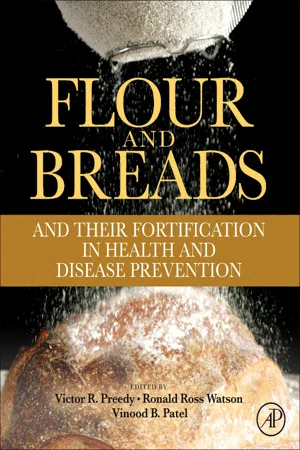
Flour and Breads and their Fortification in Health and Disease Prevention
- 542 pages
- English
- ePUB (mobile friendly)
- Available on iOS & Android
eBook - ePub
Flour and Breads and their Fortification in Health and Disease Prevention
About this book
Bread and flour-based foods are an important part of the diet for millions of people worldwide. Their complex nature provides energy, protein, minerals and many other macro- and micronutrients. However, consideration must be taken of three major aspects related to flour and bread. The first is that not all cultures consume bread made from wheat flour. There are literally dozens of flour types, each with their distinctive heritage, cultural roles and nutritive contents. Second, not all flours are used to make leavened bread in the traditional (i.e., Western) loaf form. There are many different ways that flours are used in the production of staple foods. Third, flour and breads provide a suitable means for fortification: either to add components that are removed in the milling and purification process or to add components that will increase palatability or promote health and reduce disease per se.
Flour and Breads and their Fortification in Health and Disease Prevention provides a single-volume reference to the healthful benefits of a variety of flours and flour products, and guides the reader in identifying options and opportunities for improving health through flour and fortified flour products.
- Examines those flour and bread related agents that affect metabolism and other health-related conditions
- Explores the impact of compositional differences between flours, including differences based on country of origin and processing technique
- Includes methods for analysis of flours and bread-related compounds in other foods
Information
Subtopic
Food ScienceChapter 1. The Science of Doughs and Bread Quality
Cristina M. Rosell
Department of Food Science, Institute of Agrochemistry and Food Technology, Spanish Scientific Research Council, Valencia, Spain
Chapter Outline
Introduction3
Nutritional Value of Cereals and the Impact of Milling5
Bread Dough Modifications during the Bread Making Process5
Biochemical Changes during Bread Making8
Bread Quality: Instrumental, Sensory, and Nutritional Quality11
Conclusion13
Summary Points13
References13
Worldwide, bread is one of the most consumed foodstuffs, with an average consumption ranging from 41 to 303 kg/year per capita. Bread is the product of fermenting and baking a mixture of flour, water, salt, and yeast as the basic ingredients. The conventional bread making process involves mixing, proofing, and baking. Mixing of the ingredients leads to a dough with proper extensional characteristics. The proofing step allows the dough to attain a spongy texture. Finally, baking yields a readily digestible, flavorful loaf with aerated crumb structure. Numerous physicochemical, microbiological, and biochemical changes, motivated by the mechanical-thermal action and the microorganisms and endogenous enzymes activities, contribute to bread quality. An overview of the contribution of wheat to daily food intake and the impact of processing and bread making on wheat dough properties and also bread quality is presented in this chapter.
Introduction
Cereals and cereal-based products have constituted the major component of the human diet throughout the world since the earliest times. Cereal crops are energy dense, providing approximately 10–20 times more energy than most juicy fruits and vegetables. Major cereal crops include wheat, rice, corn, and barley. The cereal crop most produced is corn (or maize) (31%), but it has relatively less importance than wheat and rice because it is not directly used for human consumption. Wheat and rice are the most important cereals with regard to human nutrition, and they account for 55% of the total cereal production. Nutritionally, they are important sources of dietary protein, carbohydrates, the B group vitamins, vitamin E, iron, trace minerals, and fibers. It has been estimated that global cereal consumption directly provides approximately 45% of protein and energy necessary for the human diet and only approximately 7% of the total fat (Table 1.1). The specific contribution of wheat to daily food intake corresponds to approximately 20% of the required energy and protein for the human diet (see Table 1.1).
| Food Consumption (kg/Capita/Year) | Food Consumption (kcal/Capita/Day) | Protein Consumption (g/Capita/Day) | Fat Consumption (g/Capita/Day) | |
|---|---|---|---|---|
| Total | 2808.87 | 75.72 | 79.63 | |
| Cereals | 151.07 | 1302.75 | 31.62 | 5.49 |
| Wheat | 67.00 | 518.00 | 15.34 | 2.18 |
| Milled rice | 54.21 | 541.92 | 10.07 | 1.28 |
| Barley | 1.13 | 8.04 | 0.23 | 0.03 |
| Maize | 18.54 | 152.72 | 3.66 | 1.22 |
| Rye | 0.98 | 7.42 | 0.20 | 0.03 |
| Oats | 0.52 | 2.94 | 0.12 | 0.05 |
| Millet | 4.05 | 33.26 | 0.89 | 0.35 |
| Sorghum | 3.90 | 32.72 | 0.97 | 0.33 |
| Other cereals | 0.74 | 5.73 | 0.16 | 0.02 |
Cereals have a variety of uses as food, although only two cereals, wheat and rye, are suited for the preparation of leavened bread. Nevertheless, wheat is a unique cereal that is suitable for the preparation of a wide diversity of leavened breads that meet consumer demands and requirements worldwide (Figure 1.1) (Rosell, 2007a). Among baked goods, bread has been a staple food for many civilizations. Even today, bread and cer...
Table of contents
- Cover Image
- Table of Contents
- Front Matter
- Copyright
- List of Contributors
- Preface
- Chapter 1. The Science of Doughs and Bread Quality
- Chapter 2. Monitoring Flour Performance in Bread Making
- Chapter 3. South Indian Parotta: An Unleavened Flat Bread
- Chapter 4. Sourdough Breads
- Chapter 5. Focaccia Italian Flat Fatty Bread∗
- Chapter 6. Flour and Bread from Black-, Purple-, and Blue-Colored Wheats
- Chapter 7. Emmer (Triticum turgidum spp. dicoccum) Flour and Breads
- Chapter 8. Einkorn (Triticum monococcum) Flour and Bread
- Chapter 9. Maize: Composition, Bioactive Constituents, and Unleavened Bread
- Chapter 10. Amaranth: Potential Source for Flour Enrichment
- Chapter 11. Quinoa: Protein and Nonprotein Tryptophan in Comparison with Other Cereal and Legume Flours and Bread
- Chapter 12. Sorghum Flour and Flour Products: Production, Nutritional Quality, and Fortification
- Chapter 13. Buckwheat Flour and Bread
- Chapter 14. Non-Starch Polysaccharides in Maize and Oat
- Chapter 15. Gluten-Free Bread
- Chapter 16. Dietary Fiber from Brewer’s Spent Grain as a Functional Ingredient in Bread Making Technology
- Chapter 17. Composite Flours and Breads: Potential of Local Crops in Developing Countries
- Chapter 18. Legume Composite Flours and Baked Goods: Nutritional, Functional, Sensory, and Phytochemical Qualities
- Chapter 19. Potential Use of Okra Seed (Abelmoschus esculentus Moench) Flour for Food Fortification and Effects of Processing
- Chapter 20. Apricot Kernel Flour and Its Use in Maintaining Health
- Chapter 21. Macadamia Flours
- Chapter 22. Banana and Mango Flours
- Chapter 23. Use of Potato Flour in Bread and Flat Bread
- Chapter 24. Mineral Fortification of Whole Wheat Flour: An Overview
- Chapter 25. Iron Particle Size in Iron-Fortified Bread
- Chapter 26. Iodine Fortification of Bread
- Chapter 27. Phytochemical Fortification of Flour and Bread
- Chapter 28. Carotenoids of Sweet Potato, Cassava, and Maize and Their Use in Bread and Flour Fortification
- Chapter 29. Production and Nutraceutical Properties of Breads Fortified with DHA- and Omega-3-Containing Oils
- Chapter 30. Fortification with Free Amino Acids Affects Acrylamide Content in Yeast Leavened Bread
- Chapter 31. Barley β-Glucans and Fiber-Rich Fractions as Functional Ingredients in Flat and Pan Breads
- Chapter 32. Antioxidant Activity and Phenolics in Breads with Added Barley Flour
- Chapter 33. Partial Substitution of Wheat Flour with Chempedak (Artocarpus integer) Seed Flour in Bread
- Chapter 34. Effect of Starch Addition to Fluid Dough During the Bread Making Process
- Chapter 35. Fermentation as a Tool to Improve Healthy Properties of Bread
- Chapter 36. Apple Pomace (By-Product of Fruit Juice Industry) as a Flour Fortification Strategy
- Chapter 37. Use of Sweet Potato in Bread and Flour Fortification
- Chapter 38. Fortification of Bread with Soy Proteins to Normalize Serum Cholesterol and Triacylglycerol Levels
- Chapter 39. Dietary Breads and Impact on Postprandial Parameters
- Chapter 40. Fortification of Vitamin B12 to Flour and the Metabolic Response
- Chapter 41. Metabolic Effects of β-Glucans Addition to Corn Maize Flour
- Chapter 42. Lupine Kernel Fiber: Metabolic Effects in Human Intervention Studies and Use as a Supplement in Wheat Bread
- Chapter 43. Metabolic Effects of Propionic Acid-Enriched Breads
- Chapter 44. Folic Acid and Colon Cancer: Impact of Wheat Flour Fortification with Folic Acid
- Chapter 45. Effects of the Soybean Flour Diet on Insulin Secretion and Action
- Chapter 46. Metabolic Effects of Bread Fortified with Wheat Sprouts and Bioavailability of Ferulic Acid from Wheat Bran
- Index
Trusted by 375,005 students
Access to over 1.5 million titles for a fair monthly price.
Study more efficiently using our study tools.
Frequently asked questions
Yes, you can cancel anytime from the Subscription tab in your account settings on the Perlego website. Your subscription will stay active until the end of your current billing period. Learn how to cancel your subscription
No, books cannot be downloaded as external files, such as PDFs, for use outside of Perlego. However, you can download books within the Perlego app for offline reading on mobile or tablet. Learn how to download books offline
Perlego offers two plans: Essential and Complete
- Essential is ideal for learners and professionals who enjoy exploring a wide range of subjects. Access the Essential Library with 800,000+ trusted titles and best-sellers across business, personal growth, and the humanities. Includes unlimited reading time and Standard Read Aloud voice.
- Complete: Perfect for advanced learners and researchers needing full, unrestricted access. Unlock 1.5M+ books across hundreds of subjects, including academic and specialized titles. The Complete Plan also includes advanced features like Premium Read Aloud and Research Assistant.
We are an online textbook subscription service, where you can get access to an entire online library for less than the price of a single book per month. With over 1.5 million books across 990+ topics, we’ve got you covered! Learn about our mission
Look out for the read-aloud symbol on your next book to see if you can listen to it. The read-aloud tool reads text aloud for you, highlighting the text as it is being read. You can pause it, speed it up and slow it down. Learn more about Read Aloud
Yes! You can use the Perlego app on both iOS and Android devices to read anytime, anywhere — even offline. Perfect for commutes or when you’re on the go.
Please note we cannot support devices running on iOS 13 and Android 7 or earlier. Learn more about using the app
Please note we cannot support devices running on iOS 13 and Android 7 or earlier. Learn more about using the app
Yes, you can access Flour and Breads and their Fortification in Health and Disease Prevention by Victor R Preedy,Ronald Ross Watson,Vinood B. Patel,Victor R. Preedy in PDF and/or ePUB format, as well as other popular books in Technology & Engineering & Food Science. We have over 1.5 million books available in our catalogue for you to explore.