- 1,192 pages
- English
- ePUB (mobile friendly)
- Available on iOS & Android
eBook - ePub
Oil Spill Science and Technology
About this book
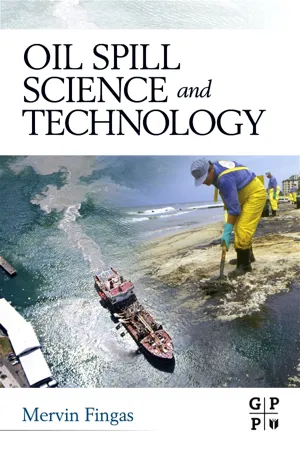
The National Academy of Sciences estimate that 1.7 to 8.8 million tons of oil are released into world's water every year, of which more than 70% is directly related to human activities. The effects of these spills are all too apparent: dead wildlife, oil covered marshlands and contaminated water chief among them. This reference will provide scientists, engineers and practitioners with the latest methods use for identify and eliminating spills before they occur and develop the best available techniques, equipment and materials for dealing with oil spills in every environment. Topics covered include: spill dynamics and behaviour, spill treating agents, and cleanup techniques such as: in situ burning, mechanical containment or recovery, chemical and biological methods and physical methods are used to clean up shorelines. Also included are the fate and effects of oil spills and means to assess damage.
- Covers spill dynamics and behaviour
- Definitive guide to spill treating agents
- Complete coverage of cleanup techniques
- Includes fate and effects of oil spills and means to assess damage
Information
Subtopic
Scienze ambientaliTable of contents
- Cover Image
- Table of Contents
- Front Matter
- Copyright
- Preface
- About the Contributors
- Chapter 1. Introduction
- Chapter 2. Spill Occurrences: A World Overview
- Chapter 3. Introduction to Oil Chemistry and Properties
- Chapter 4. Measurement of Oil Physical Properties
- Chapter 5. Introduction to Oil Chemical Analysis
- Chapter 6. Oil Spill Remote Sensing: A Review
- Chapter 7. Laser Fluorosensors
- Chapter 8. Introduction to Spill Modeling
- Chapter 9. Evaporation Modeling
- Chapter 10. Models for Water-in-Oil Emulsion Formation
- Chapter 11. Oil Spill Trajectory Forecasting Uncertainty and Emergency Response
- Chapter 12. Physical Spill Countermeasures
- Chapter 13. Weather Effects on Oil Spill Countermeasures
- 13.1. Introduction
- 13.2. Review of Literature on Spill Countermeasures and Weather
- 13.3. Development of Models for Effectiveness of Countermeasures
- 13.4. Overview of Weather Limitations
- 13.5. Summary and Conclusions
- Chapter 14. Spill-Treating Agents
- Chapter 15. Oil Spill Dispersants: A Technical Summary
- 15.1. Introduction
- 15.2. The Basic Physics and Chemistry of Dispersants
- 15.3. The Basic Nature of Dispersions or Oil-in-Water Emulsions
- 15.4. Effectiveness
- 15.5. Monitoring
- 15.6. Physical Studies
- 15.7. Toxicity
- 15.8. Biodegradation
- 15.9. Other Information
- 15.10. Summary and Conclusions
- Chapter 16. A Practical Guide to Chemical Dispersion for Oil Spills
- Chapter 17. Procedures for the Testing and Approval of Oil Spill Treatment Products in the United Kingdom—What They Are and Considerations for Development
- Chapter 18. Formulation Changes in Oil Spill Dispersants: Are They Toxicologically Significant?
- Chapter 19. Environment Canada's Methods for Assessing Oil Spill Treating Agents
- Chapter 20. The United States Environmental Protection Agency: National Oil and Hazardous Substances Pollution Contingency Plan, Subpart J Product Schedule (40 Code of Federal Regulations 300.900)
- Chapter 21. Surface-Washing Agents or Beach Cleaners
- Chapter 22. Review of Solidifiers
- Chapter 23. An Overview of In-Situ Burning
- 23.1. Introduction
- 23.2. An Overview of in-situ Burning
- 23.3. Assessment of Feasibility of Burning
- 23.4. Equipment—Selection, Deployment, and Operation
- 23.5. Possible Spill Situations
- 23.6. Post-burn Actions
- 23.7. Health and Safety Precautions during Burning
- Chapter 24. Shoreline Countermeasures
- Chapter 25. Automated Assessment and Data Management
- Chapter 26. Submerged Oil
- Chapter 27. Effects of Oil in the Environment
- Chapter 28. Introduction to Oil Spill Contingency Planning and Response Initiation
- Chapter 29. The Role of the International Tanker Owners Pollution Federation Limited
- Chapter 30. Safety Issues at Spills
- Chapter 31. Natural Resource Damage Assessment
- Chapter 32. Seafood Safety and Oil Spills
- Chapter 33. The Torrey Canyon Oil Spill, 1967
- Chapter 34. The Ekofisk Bravo Blowout, 1977
- Chapter 35. The Sea Empress Oil Spill, 1996
- Chapter 36. The Braer Oil Spill, 1993
- Chapter 37. 1991 Gulf War Oil Spill
- Chapter 38. Tanker SOLAR 1 Oil Spill, Guimaras, Philippines: Impacts and Response Challenges
- Conversions
- Index
Trusted by 375,005 students
Access to over 1.5 million titles for a fair monthly price.
Study more efficiently using our study tools.
Frequently asked questions
Yes, you can cancel anytime from the Subscription tab in your account settings on the Perlego website. Your subscription will stay active until the end of your current billing period. Learn how to cancel your subscription
No, books cannot be downloaded as external files, such as PDFs, for use outside of Perlego. However, you can download books within the Perlego app for offline reading on mobile or tablet. Learn how to download books offline
Perlego offers two plans: Essential and Complete
- Essential is ideal for learners and professionals who enjoy exploring a wide range of subjects. Access the Essential Library with 800,000+ trusted titles and best-sellers across business, personal growth, and the humanities. Includes unlimited reading time and Standard Read Aloud voice.
- Complete: Perfect for advanced learners and researchers needing full, unrestricted access. Unlock 1.5M+ books across hundreds of subjects, including academic and specialized titles. The Complete Plan also includes advanced features like Premium Read Aloud and Research Assistant.
We are an online textbook subscription service, where you can get access to an entire online library for less than the price of a single book per month. With over 1.5 million books across 990+ topics, we’ve got you covered! Learn about our mission
Look out for the read-aloud symbol on your next book to see if you can listen to it. The read-aloud tool reads text aloud for you, highlighting the text as it is being read. You can pause it, speed it up and slow it down. Learn more about Read Aloud
Yes! You can use the Perlego app on both iOS and Android devices to read anytime, anywhere — even offline. Perfect for commutes or when you’re on the go.
Please note we cannot support devices running on iOS 13 and Android 7 or earlier. Learn more about using the app
Please note we cannot support devices running on iOS 13 and Android 7 or earlier. Learn more about using the app
Yes, you can access Oil Spill Science and Technology by Mervin Fingas, Mervin Fingas,Merv Fingas in PDF and/or ePUB format, as well as other popular books in Tecnologia e ingegneria & Scienze ambientali. We have over 1.5 million books available in our catalogue for you to explore.