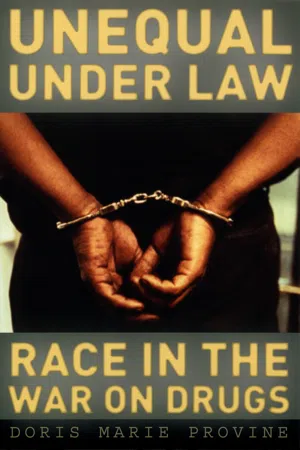
Race is clearly a factor in government efforts to control dangerous drugs, but the precise ways that race affects drug laws remain difficult to pinpoint. Illuminating this elusive relationship, Unequal under Law lays out how decades of both manifest and latent racism helped shape a punitive U.S. drug policy whose onerous impact on racial minorities has been willfully ignored by Congress and the courts.
Doris Marie Provine's engaging analysis traces the history of race in anti-drug efforts from the temperance movement of the early 1900s to the crack scare of the late twentieth century, showing how campaigns to criminalize drug use have always conjured images of feared minorities. Explaining how alarm over a threatening black drug trade fueled support in the 1980s for a mandatory minimum sentencing scheme of unprecedented severity, Provine contends that while our drug laws may no longer be racist by design, they remain racist in design. Moreover, their racial origins have long been ignored by every branch of government. This dangerous denial threatens our constitutional guarantee of equal protection of law and mutes a much-needed national discussion about institutionalized racism—a discussion that Unequal under Law promises to initiate.
Doris Marie Provine's engaging analysis traces the history of race in anti-drug efforts from the temperance movement of the early 1900s to the crack scare of the late twentieth century, showing how campaigns to criminalize drug use have always conjured images of feared minorities. Explaining how alarm over a threatening black drug trade fueled support in the 1980s for a mandatory minimum sentencing scheme of unprecedented severity, Provine contends that while our drug laws may no longer be racist by design, they remain racist in design. Moreover, their racial origins have long been ignored by every branch of government. This dangerous denial threatens our constitutional guarantee of equal protection of law and mutes a much-needed national discussion about institutionalized racism—a discussion that Unequal under Law promises to initiate.