eBook - PDF
Picturing the Book of Nature
Image, Text, and Argument in Sixteenth-Century Human Anatomy and Medical Botany
- English
- PDF
- Available on iOS & Android
eBook - PDF
Picturing the Book of Nature
Image, Text, and Argument in Sixteenth-Century Human Anatomy and Medical Botany
About this book
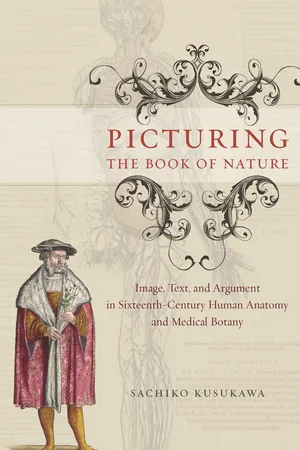
Because of their spectacular, naturalistic pictures of plants and the human body, Leonhart Fuchs's De historia stirpium and Andreas Vesalius's De humani corporis fabrica are landmark publications in the history of the printed book. But as Picturing the Book of Nature makes clear, they do more than bear witness to the development of book publishing during the Renaissance and to the prominence attained by the fields of medical botany and anatomy in European medicine. Sachiko Kusukawa examines these texts, as well as Conrad Gessner's unpublished Historia plantarum, and demonstrates how their illustrations were integral to the emergence of a new type of argument during this periodāa visual argument for the scientific study of nature.
To set the stage, Kusukawa begins with a survey of the technical, financial, artistic, and political conditions that governed the production of printed books during the Renaissance. It was during the first half of the sixteenth century that learned authors began using images in their research and writing, but because the technology was so new, there was a great deal of variety of thoughtāand often disagreementāabout exactly what images could do: how they should be used, what degree of authority should be attributed to them, which graphic elements were bearers of that authority, and what sorts of truths images could and did encode. Kusukawa investigates the works of Fuchs, Gessner, and Vesalius in light of these debates, scrutinizing the scientists' treatment of illustrations and tracing their motivation for including them in their works. What results is a fascinating and original study of the visual dimension of scientific knowledge in the sixteenth century.
Frequently asked questions
Yes, you can cancel anytime from the Subscription tab in your account settings on the Perlego website. Your subscription will stay active until the end of your current billing period. Learn how to cancel your subscription.
No, books cannot be downloaded as external files, such as PDFs, for use outside of Perlego. However, you can download books within the Perlego app for offline reading on mobile or tablet. Learn more here.
Perlego offers two plans: Essential and Complete
- Essential is ideal for learners and professionals who enjoy exploring a wide range of subjects. Access the Essential Library with 800,000+ trusted titles and best-sellers across business, personal growth, and the humanities. Includes unlimited reading time and Standard Read Aloud voice.
- Complete: Perfect for advanced learners and researchers needing full, unrestricted access. Unlock 1.4M+ books across hundreds of subjects, including academic and specialized titles. The Complete Plan also includes advanced features like Premium Read Aloud and Research Assistant.
We are an online textbook subscription service, where you can get access to an entire online library for less than the price of a single book per month. With over 1 million books across 1000+ topics, weāve got you covered! Learn more here.
Look out for the read-aloud symbol on your next book to see if you can listen to it. The read-aloud tool reads text aloud for you, highlighting the text as it is being read. You can pause it, speed it up and slow it down. Learn more here.
Yes! You can use the Perlego app on both iOS or Android devices to read anytime, anywhere ā even offline. Perfect for commutes or when youāre on the go.
Please note we cannot support devices running on iOS 13 and Android 7 or earlier. Learn more about using the app.
Yes, you can access Picturing the Book of Nature by Sachiko Kusukawa in PDF and/or ePUB format, as well as other popular books in History & European Renaissance History. We have over one million books available in our catalogue for you to explore.
Information
Table of contents
- Contents
- Acknowledgments
- List of Illustrations
- Introduction
- Part 1. Printing Pictures
- Part 2. Picturing Medicinal Plants
- Part 3. Picturing Human Anatomy
- Epilogue
- Notes
- Bibliography
- Index