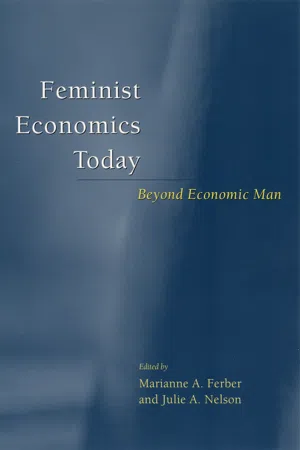
The 1993 publication of Marianne A. Ferber and Julie A. Nelson's Beyond Economic Man was a landmark in both feminist scholarship and the discipline of economics, and it quickly became a handbook for those seeking to explore the emerging connections between the two. A decade later, this book looks back at the progress of feminist economics and forward to its future, offering both a thorough overview of feminist economic thought and a collection of new, high-quality work from the field's leading scholars.
eBook - ePub
Feminist Economics Today
Beyond Economic Man
- English
- ePUB (mobile friendly)
- Available on iOS & Android
eBook - ePub
Feminist Economics Today
Beyond Economic Man
About this book
Information
Publisher
University of Chicago PressYear
2020Print ISBN
9780226242071
9780226242064
eBook ISBN
9780226775166
1
Separative and Soluble Selves: Dichotomous Thinking in Economics
. . . Paula England
Hidden assumptions related to gender have affected the deep theoretical structure of neoclassical economics. Economists have had one notion of the self for market behavior—individuals are atomized and self-interested, with preferences that no one can change. But there is a very different image of the self for the family, albeit as often tacit as explicit. The family is seen to form our preferences when we are young, and family members are seen to share money and care for each other, with little regard to narrow self-interest. The two spheres are dichotomized, with analysis of the market taking an extreme “separative” view of the self and analysis of the family an extreme “soluble” view.
In this chapter, I review feminist theorizing that criticizes the separative/soluble dichotomy that permeates thinking about the self in Western thought. I then apply these insights to a criticism of neoclassical economics.1
I call one notion of the self “separative” because it presumes that humans are autonomous, impermeable to social influences, and lack sufficient emotional connection to each other to feel any empathy. I argue that three of the most basic assumptions in neoclassical economic theory imply a separative notion of the self. The three assumptions are that interpersonal utility comparisons are impossible, that tastes are exogenous to economic models and unchanging, and that actors are selfish (have independent utilities). While each assumption is occasionally challenged, most mainstream economists accept them without much consideration. I argue that they are grounded in a general tendency in Western thought to posit and valorize the separative self. Because it ignores the inexorable interdependency of human life and the importance for human wellbeing of connection, feminists have criticized this model of the self as inaccurate and as not worthy as a moral ideal.
In contrast, however, when economists talk about the family, they seem to have an image of selves so soluble that they have no independent will or interest. It is all for one and one for all. This is explicit in Becker’s 1991 work A Treatise on the Family, usually credited as starting the “new home economics.”2 He posits selfishness in markets but altruism in the family, with family members acting as if they are maximizing a single family utility function. Conflicts of interest between family members and self-interested maneuvering for advantage are ignored, or at least downplayed. Drawing on the feminist critique of the “soluble” pole of the separative/soluble dichotomy, I apply this to economic work on the family, arguing that economists exaggerate the connective empathy and altruism within families.
I then consider recent developments in economics that provide a partial corrective to this dichotomous notion of the self. I discuss bargaining models of the family, which acknowledge conflicts of interest and self-interested maneuvering within the family. I also consider efforts by mainstream economists to relax the assumption that preferences are exogenous and unchanging. I argue that both are useful correctives to overly dichotomized thinking, in that the theory of endogenous tastes assumes a less impermeable self, while bargaining theories bring in some degree of separation between family members. I also argue, however, that if we really want to eschew dichotomies, the unmet challenge is a model of behavior across family and market spheres that captures both the individuated and connective aspects of life.
Finally, I consider how recent work on care by feminist economists has tried to meet this challenge. Work on caregiving (parenting, paid child care, teaching, nursing, counseling, and so forth) represents an attempt, still in progress, to eschew the separative/soluble dichotomy and theorize work done in both families and markets as involving both altruistic and narrowly self-interested motives.
Feminist Critiques of the Separative/Soluble Dichotomy in Conceptions of the Self
Before applying a feminist critique to economic theory, it is first necessary to clarify what I mean by feminist theory. One result of the entry of women, often feminists, into the academy in the last twenty years has been the allegation that theories in every discipline have been affected by gender bias. Over time, feminist thought has become increasingly diverse and today contains much healthy controversy. However, common to virtually all feminist views is the belief that women are subordinated to men to a degree that is morally wrong and unnecessary. Beyond this, views differ as to the sources of women’s disadvantage and the proper remedy.
Two major, though not mutually exclusive, emphases within feminist thinking can be discerned: One body of thought emphasizes the exclusion of women from traditionally male activities and institutions. For example, laws, cultural beliefs, and other discriminatory practices have excluded most women from political office, religious leadership, military positions, and traditionally male crafts and professions within paid employment. These exclusions are significant for women since activities traditionally regarded as male include those associated with the largest rewards of honor, power, and money. The mechanisms of exclusion are sometimes so effective that most women do not choose to enter “male” domains, although a minority has always attempted to do so. Here feminists see the corrective to be allowing women to participate in these spheres on an equal basis with men. This goal is especially emphasized by liberal feminists3 but is shared by almost all feminists. These “masculine” domains have been seen as allowing and even requiring autonomy and self-interested striving; the sense in which the men in these roles have actually been dependent on and connected to women and other men has been repressed. But because the domains have been at least rhetorically associated with the separative self, the part of feminism that insists on women’s equal right to enter these roles can be seen to encourage the development of a more separated, autonomous self in women.
A second body of feminist thought emphasizes the devaluation of and low material rewards accorded to activities and traits that traditionally have been deemed appropriate for women. The sexism here is in failing to see how traditionally female activities or dispositions contribute to the economy, society, or polity. Examples include failing to see how much child rearing, household work, and volunteer work contribute to “the wealth of nations.” Another example is failing to see the extent to which work in predominantly female occupations contributes to firms’ profits, the issue raised by the movement for “comparable worth” in wage setting (England 1992; Steinberg 2001). Feminists who emphasize this sort of sexism see the remedy to include changing values that deprecate traditionally female activities as well as allocating higher rewards to such activities. This position is sometimes called “cultural feminism” (Warren 2001),4 and some socialist feminists argue for this revalorization as well. Because many of women’s traditional caretaking activities are embedded in familial relationships and are motivated, at least in part, by altruism or obligation, one can see this strain of feminism as valorizing connection as an ideal.
Sometimes these two feminist positions are thought to be in conflict: the first is seen as advocating that women enter traditionally male activities, while the second is seen to advocate women’s continued attention to traditionally female activities. Of course, it is entirely possible to believe that we should acknowledge the value of traditionally female activities and reward them accordingly without believing that women should continue to do a disproportionate share of these activities. Indeed, a culture that valorized traditionally female activities would be expected to encourage men as well as women to acquire these skills and values. Therefore, the two feminist positions can be seen as compatible, since together they would agree that activities traditionally associated with either men or women should be open to both men and women, while simultaneously encouraging more equal valuation of and rewards for both kinds of activities. But there is a tension between them in that the first valorizes separation more and the second valorizes connection more.
Could we valorize both connection and autonomy? Could we imagine male and female selves that were both connective and yet somewhat individuated? Implicitly or explicitly, the weight of Western thought answers both questions with a “no.” The terms separative and soluble were coined by theologian Catherine Keller (1986), who discussed their link to pervasive gender dichotomies in Western thought. In the simplest (sexist) formulations, men are seen as naturally separative, individuated, autonomous, and dominating, while women are seen as naturally soluble, yielding, connected, and dominated.
In such dichotomous thinking, the only choices are to be either thoroughly masculine and separative, or thoroughly feminine and soluble. Separation and connection are seen as representing opposite poles that war with each other. To the extent that one is separate, one is not soluble, and vice versa. To the extent that one is feminine, one is less masculine (as in the preandrogyny conception of gender), and vice versa.
In this view, to valorize one pole implies less value for the other. Historically, only men were considered fully human, since women seem to give up most of what is seen as valuably human in order to bear the burden of connection. No wonder then that liberal feminists thought the only corrective was to seek separation and autonomy for women, and no wonder that men saw only fearful loss in pursuing connection. This way of looking at things was undoubtedly influenced by the hierarchical organization of actual gender relations, such that men had authority over women and devised systems of thought that valorized their own activities.
This dichotomous thinking about the self does not allow recognition of the ways in which some degree of individuation may enhance intimacy, or that empathy may actually be enhanced by being in touch with the desires underlying one’s own self-interested striving. The feminist position that I draw upon here argues for delinking separation/connection from gender in prescriptions, and for seeing that individuation and connection are not necessarily at war with each other. The nondichotomous position might be called “individuals-in-relation” (see Nelson, chap. 3 in this volume) or “relational autonomy” (Mackenzie and Stoljar 2000).
But because separation had been so glorified in western thought, at least for men, and had been held out as the only fully human model of the self, the feminist critique had to start with an attack on the valorization of the separative self and of its descriptive accuracy for men or women, and particularly for women. This feminist critique of the separative self model was first applied in a number of disciplines other than economics. Seyla Benhabib (1987) traces the ideal of separative autonomy through liberalism in political philosophy. This tradition (whether the version of Hobbes, Locke, Rousseau, Kant, or Rawls) discusses moving from a “state of nature” to the metaphorical “contract” to set up the state. While the contract is seen to increase civility and justice, men are seen as separative and autonomous both before and after the contract. Authors failed to recognize that men are not entirely autonomous—that no man would have survived to adulthood but for the nurturing of a woman. Women’s nurturing work was taken for granted and excluded from political theory; women and family bonds were seen as “part of nature” within a metaphysic that denigrated nature. Women’s activities did not count as “moral”; only exercising “autonomy” in the public sphere did. Thus the separative self was valued, while nurturant connection was ignored or deprecated.
Psychologists have pointed out a similar emphasis on separation in developmental psychology (Chodorow 1978; Gilligan 1982). Carol Gilligan points out that Freud, Jung, Erikson, Piaget, and Kohlberg, despite their differences, all viewed individuation as synonymous with maturation and viewed connection to others as developmentally regressive. They did not acknowledge learning the capacity for intimacy and nurturance as part of maturation.
The separative self is glorified in the philosophy of science as well. Evelyn Fox Keller (1983, 1985) argues that objectivity has been defined in terms of the separation of the subject (the scientist) from the object of study. Emotional connections with one’s subject matter are seen as contaminating knowledge. Keller insists, however, that some of our deepest scientific insights come from the ability to empathize with those whose behavior we study.
Some feminists applauded “connection valorizing” authors such as Chodorow (1978), Gilligan (1982), E. Keller (1985), Ruddick (1989), and Held (1993) for their insistence that social scientists include the parts of human experience traditionally assigned to women in their theories. Others thought it perverse to romanticize traditionally female characteristics such as caring, yielding, altruism, and selflessness, arguing that these are understandable but self-defeating adaptations to men’s domination over women (Hoagland 1988). Another objection was to the tendency of those valorizing connection to exaggerate gender differences on this dimension. This objection was paired with a fear that exaggerations of gender differences—even if seen as environmentally created rather than innate—could be used to keep women out of powerful positions (Epstein 1988; Aries 1996).
Since the early critiques of the “separative self,” feminists have also become increasingly suspicious of any “universal” notion of womanhood. Poststructuralists have argued against any universal notion of human, female, or male nature (Fraser and Nicholson 1990; Nicholson 1990; Charusheela and Zein-Elabdin, chap. 8 in this volume). Feminist theorists of color (such as Brah 2001; Collins 1990) have argued that it is often the experiences of relatively privileged white women that have been described as “the feminine” to be either rejected or valorized. For example, when one considers how insensitive white women have ofte...
Table of contents
- Cover
- Copyright
- Title Page
- Contents
- Preface
- Introduction: Beyond Economic Man, Ten Years Later
- 1. Separative and Soluble Selves: Dichotomous Thinking in Economics
- 2. Contracting for Care
- 3. Separative and Soluble Firms: Androcentric Bias and Business Ethics
- 4. Feminist Theory and Racial Economic Inequality
- 5. Economic Rationality and Globalization: A Feminist Perspective
- 6. The Application of Mainstream Economics Constructs to Education: A Feminist Analysis
- 7. Economics, Policy Analysis, and Feminism
- 8. Feminism, Postcolonial Thought, and Economics
- Contributors
- Notes
- Index
Trusted by 375,005 students
Access to over 1.5 million titles for a fair monthly price.
Study more efficiently using our study tools.
Frequently asked questions
Yes, you can cancel anytime from the Subscription tab in your account settings on the Perlego website. Your subscription will stay active until the end of your current billing period. Learn how to cancel your subscription
No, books cannot be downloaded as external files, such as PDFs, for use outside of Perlego. However, you can download books within the Perlego app for offline reading on mobile or tablet. Learn how to download books offline
Perlego offers two plans: Essential and Complete
- Essential is ideal for learners and professionals who enjoy exploring a wide range of subjects. Access the Essential Library with 800,000+ trusted titles and best-sellers across business, personal growth, and the humanities. Includes unlimited reading time and Standard Read Aloud voice.
- Complete: Perfect for advanced learners and researchers needing full, unrestricted access. Unlock 1.5M+ books across hundreds of subjects, including academic and specialized titles. The Complete Plan also includes advanced features like Premium Read Aloud and Research Assistant.
We are an online textbook subscription service, where you can get access to an entire online library for less than the price of a single book per month. With over 1.5 million books across 990+ topics, we’ve got you covered! Learn about our mission
Look out for the read-aloud symbol on your next book to see if you can listen to it. The read-aloud tool reads text aloud for you, highlighting the text as it is being read. You can pause it, speed it up and slow it down. Learn more about Read Aloud
Yes! You can use the Perlego app on both iOS and Android devices to read anytime, anywhere — even offline. Perfect for commutes or when you’re on the go.
Please note we cannot support devices running on iOS 13 and Android 7 or earlier. Learn more about using the app
Please note we cannot support devices running on iOS 13 and Android 7 or earlier. Learn more about using the app
Yes, you can access Feminist Economics Today by Marianne A. Ferber, Julie A. Nelson, Marianne A. Ferber,Julie A. Nelson in PDF and/or ePUB format, as well as other popular books in Social Sciences & Economic Theory. We have over 1.5 million books available in our catalogue for you to explore.