On January 5, 1845, the Prussian cultural minister received a request by a group of six young men to form a new Physical Society in Berlin. In fields from thermodynamics, mechanics, and electromagnetism to animal electricity, ophthalmology, and psychophysics, members of this small but growing group—which soon included Emil Du Bois-Reymond, Ernst Brücke, Werner Siemens, and Hermann von Helmholtz—established leading positions in what only thirty years later had become a new landscape of natural science. How was this possible? How could a bunch of twenty-somethings succeed in seizing the future?
In Aesthetics, Industry, and Science M. Norton Wise answers these questions not simply from a technical perspective of theories and practices but with a broader cultural view of what was happening in Berlin at the time. He emphasizes in particular how rapid industrial development, military modernization, and the neoclassical aesthetics of contemporary art informed the ways in which these young men thought. Wise argues that aesthetic sensibility and material aspiration in this period were intimately linked, and he uses these two themes for a final reappraisal of Helmholtz's early work. Anyone interested in modern German cultural history, or the history of nineteenth-century German science, will be drawn to this landmark book.
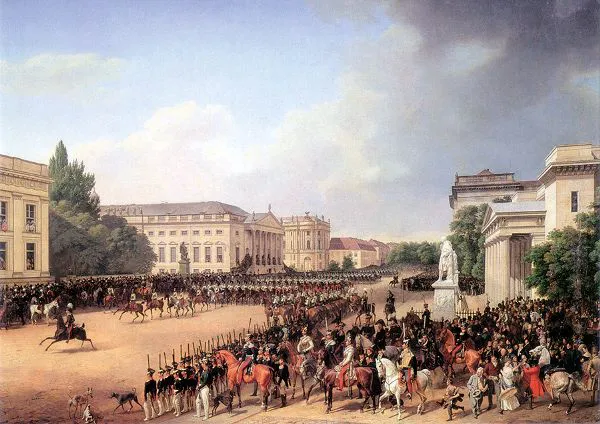
On a sunny morning in the late summer of 1824, a great parade of heavy cavalry rode down Unter den Linden, the boulevard of royal display and of public self-presentation in Berlin, running from the Brandenburg Gate in the west to the Royal Palace of King Friedrich Wilhelm III in the east. The spectacle celebrated a long-delayed visit of the King’s eldest daughter Charlotte (Czarina Alexandra of Russia from 1825) and her husband Archduke Nicholas (Czar Nicholas I), whom the King treated like a son. It also symbolized the continuation of the Prussian-Russian alliance, which had endured since the Wars of Liberation from Napoleon (Befreiungskriege), 1813–1815. To mark the occasion, Nicholas commissioned Franz Krüger, a painter favored at the court for his portrait-like renderings of high-spirited horses and their equally high-born riders, to capture the spectacle (fig. 1.1). Nicholas himself led the 6th Brandenburg Cuirassier Regiment, of which the king had made him formal commander upon his betrothal to Princess Charlotte in 1817. Krüger’s Parade auf dem Opernplatz gives a panoramic view, a carefully constructed wide-angle perspective. Measuring two and a half by three and three quarters meters, it took six years to complete and set a new standard for the genre. It will provide the stage here on which the young men who would found the Berlin Physical Society in 1845 formed their identities and their ambitions.1 They and their science are my ultimate goal.
Figure 1.1 Franz Krüger, Parade auf dem Opernplatz in Berlin, 1824–30, oil on canvas, 249 × 374 cm. Staatliche Museen zu Berlin, Nationalgalerie, Inv.-Nr. A II 648. Photo by Jörg P. Anders.
The painting captures the eye from a distance for its bright and animated realism, almost photographic in architectural detail and full of motion. On reflection, however, the picture has a strange composition. It inverts the expected social order. Structurally, Krüger has borrowed a technique familiar from landscape paintings, in which a valley or stream running diagonally before a mountainous terrain focuses attention on the action of symbolic figures in a sylvan foreground. Similarly, he uses the strong diagonal formed by the parade route to separate background from foreground. But the royal court, who formed the actual social focus of the spectacle and in the tradition of such paintings of historical events should have been foregrounded, are displaced into the background. They sit on their horses in the near anonymity of the shadows cast by the grand buildings defining the far side of the street, although on very close inspection each is presented in a miniature portrait. Friedrich Wilhelm is visible astride a light brown horse between the Prinzessinenpalais on the left, private residence of his second wife, and the tall statue on the tree-shaded Opernplatz of General G. L. von Blücher, one of the heroes of the Befreiungskriege. Nicholas, rather than riding at the head of his troops, is riding in the opposite direction to salute the king, with his back to the viewer. The royal princes and top generals, so dark as to be almost unrecognizable, observe from their horses to the left and right of the king.
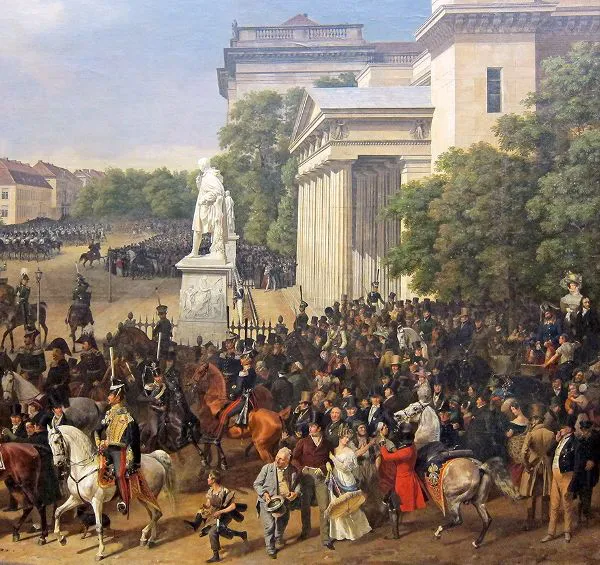
In sharp contrast, the viewer’s interest lights immediately on the highly individualized crowd on the right. They pay little attention to the theater of absolute monarchy before them but attend to their own theater of seeing and being seen. Krüger apparently shares their vision of themselves as the new center of social importance, for he presents each of them in miniature portraits as well. They form a kind of microcosm of that diverse body called the “public” (Öffentlichkeit; see the introduction) and are people who would be recognized by anyone familiar with public life in Berlin in the late twenties. Over fifty have been identified. They include a number of aristocratic administrators and advisors who saw themselves as representatives of the new Prussia governed by a professional elite of civil servants composed of well-educated citizens, the so-called Bildungsbürgertum.2
The movement from background on the left to foreground on the right thus portrays a kind of social transition: from the military rulers to a collection of mounted middle-level officers in the center mixed with standing notables to the more fully civilian society on the right. Modern viewers may be likely to see in this a challenge to the authority of Friedrich Wilhelm and Czar Nicholas. But that cannot be quite how the rulers saw it, since the czar and czarina both expressed their delight with the painting. Friedrich Wilhelm even commissioned Krüger to repeat it for “Eine preussische Parade” in 1839. He certainly did recognize, however, that the Bildungsbürgertum had acquired a position in society, and an attendant administrative role, that was as necessary to the well-run state as their promotion of political responsibility in a civil society was problematic.
The Public
As discussed in the introduction, the task of this volume will be to locate the pursuit of natural science within this state-centered construction of public consciousness by looking for the resources of the ambitious young reformers who founded the Berlin Physical Society in 1845. In his Parade, Krüger has collected together a number of the major figures for this cultural location. Literally, the painting locates them in relation to buildings that symbolize architecturally the new position of the educated elite in society and that here stand behind them (fig. 1.2). The prominent Doric columns define the portico of the Neue Wache, built between 1816 and 1818 by Karl Friedrich Schinkel, whose neoclassical buildings were reshaping civic consciousness. Literally the “new guardhouse” of the royal guard but figuratively the “new guard,” the Neue Wache symbolized in the minds of liberals the new citizen army (including some middle-class officers) that had defeated Napoleon in the Befreiungskriege, also called, with the stress on domestic liberalization, the Wars of Freedom (Freiheitskriege).
Figure 1.2 Krüger, Parade, detail. The “public.”
The “new guard,” in this vision, would be the agents responsible for maintaining constant vigilance against external aggression and for building the Prussian future, despite increasing signs of reactionary absolutism. As a visionary participant in this movement toward a modernized state, Schinkel had designed the Neue Wache as a bridge between civilian and military life.3 It stands between the new University of Berlin rising behind it, established in 1810 on the educational theories of Wilhelm von Humboldt, who was then directing cultural affairs in the interior ministry, and the eighteenth-century Armory (Zeughaus), symbol of Prussian military might under Frederick the Great. The armory itself is not actually visible, for we view the scene from one of its upper windows, where Krüger stood to construct his panorama. But we should see Schinkel’s neoclassicism in its intended function, uniting military and public virtue and testifying to the Humboldtian ideal of Bildung, of the cultivated self, as the model of the self-motivated citizen in a modern state.
This ideal appears most explicitly in the glistening white statue of General Gerhard von Scharnhorst as a latter-day Greek hero. Krüger has made him the central focus of the painting, much enlarged by its wide-angle perspective. He stands before the Neue Wache as an integral part of Schinkel’s design, paired with another hero of the wars, General Friedrich Wilhelm von Bülow, largely obscured behind him. Scharnhorst had led the reorganization of the army that followed its humiliation by Napoleon in 1806, pressing constantly for the eradication of aristocratic privilege, for utilization of the talents of commoners in the officer corps, and for activating the latent strength and self-motivation of the entire citizenry in the army. After his death from wounds suffered in the battle of Groß-Görschen in 1813, he was lionized as the hero of liberation but also of liberal reform. Particularly significant for the painting was his foundation of the Kriegsschule in 1810 as a kind of military university for training young officers whose position would be based on accomplishment rather than birth. Although on a smaller scale, the Kriegsschule emphasized many of the same virtues of Wissenschaft (science, both natural and human) and Bildung that marked Humboldt’s plans for the University at the same time except that Scharnhorst placed mathematics at the center of the military curriculum in parallel with classical languages at the University.
Scharnhorst’s statue provides an image of civic humanism. The sculptor Christian Daniel Rauc...
Table of contents
Cover
Title Page
Copyright Page
Dedication
contents
Introduction
1 Parade auf dem Opernplatz
2 Pegasus and the Muses (Museums) of Art, Industry, and Science: Section 1: Altes Museum, University, and Bauschule
3 Pegasus and the Muses (Museums) of Art, Industry, and Science: Section 2: Gewerbehaus
4 Modernizing Military Schools: Self-Acting Officers and Instruments
5 What’s in a Line?
6 The Berlin Physical Society
7 The Mechanism of Matter: Hermann Helmholtz’s Erhaltung der Kraft
8 “A Spectacle for the Gods”
Epilogue: Kunst-Technik
Acknowledgments
Bibliography
Index
Trusted by 375,005 students
Access to over 1.5 million titles for a fair monthly price.
Study more efficiently using our study tools.
Frequently asked questions
Yes, you can cancel anytime from the Subscription tab in your account settings on the Perlego website. Your subscription will stay active until the end of your current billing period. Learn how to cancel your subscription
No, books cannot be downloaded as external files, such as PDFs, for use outside of Perlego. However, you can download books within the Perlego app for offline reading on mobile or tablet. Learn how to download books offline
Perlego offers two plans: Essential and Complete
Essential is ideal for learners and professionals who enjoy exploring a wide range of subjects. Access the Essential Library with 800,000+ trusted titles and best-sellers across business, personal growth, and the humanities. Includes unlimited reading time and Standard Read Aloud voice.
Complete: Perfect for advanced learners and researchers needing full, unrestricted access. Unlock 1.5M+ books across hundreds of subjects, including academic and specialized titles. The Complete Plan also includes advanced features like Premium Read Aloud and Research Assistant.
Both plans are available with monthly, semester, or annual billing cycles.
We are an online textbook subscription service, where you can get access to an entire online library for less than the price of a single book per month. With over 1.5 million books across 990+ topics, we’ve got you covered! Learn about our mission
Look out for the read-aloud symbol on your next book to see if you can listen to it. The read-aloud tool reads text aloud for you, highlighting the text as it is being read. You can pause it, speed it up and slow it down. Learn more about Read Aloud
Yes! You can use the Perlego app on both iOS and Android devices to read anytime, anywhere — even offline. Perfect for commutes or when you’re on the go. Please note we cannot support devices running on iOS 13 and Android 7 or earlier. Learn more about using the app
Yes, you can access Aesthetics, Industry, and Science by M. Norton Wise in PDF and/or ePUB format, as well as other popular books in Biological Sciences & Art Theory & Criticism. We have over 1.5 million books available in our catalogue for you to explore.