![]()
CONTENTS OF THE THIRD VOLUME.
A
Adive
Agouti
Akouchi
Ai
An Amphibious Animal of New South Wales
Ant-eater, the Great
the Middle
the Lesser
Antelope, the Common
the Barbary
the Scythian
the Striped
Ape, the Pigmy
the Long-armed
the Barbary
Armadillo
the Three-banded
the Six-banded
the Eight-banded
the Nine-banded
the Weasel-headed
Ass
Axis
B
Baboon
the Great Ribbed-nose
the Small Ribbed-nose
the Pig-tailed
Baboon, the Dog-faced
the Ursine
Babiroussa
Babr
Badger
the Stinking
the Sow
Bat
the Short-eared
the Long-eared
the Noctule, or Great
the Pipistrelle
the Barbastelle
the Serotine
the Horse Shoe
the Great Ternate
the Rougette, or Lesser Ternate
the Spectre
the Senegal
the Bull-Dog
the Bearded
the Striped
Bear, the Brown
the Black
the Polar
Beaver
the Little
Bison
Blue Goat
Boar, the Wild
the Common, or Domestic
the African Wild
Bucha
Buffalo
C
Callitrix
Camel
the Arabian
Cameleopard
Capibara
Caracal
the Nubian
Carcajou
Caribou
Cat, the Domestic
the Wild
the Wild Red
of Angora
Cavy, the Restless
the Spotted
the Long-nosed
the Akouchi
the Rock
Chevrotain
Chinche
Civet
Coaita
Coati
Conepate
Corin
Couguar
Coquallin
Cow
D
Deer, Red
the Fallow
Dog
the Shepherd’s
the Cur
the Greenland
the Bull
the Mastiff
the Bari
the Dalmation, or Coach
the Irish Grey-hound
the Highland Grey-hound
the Gazehound
the Greyhound
the Italian Grey-hound
the Lyemmer
the Lurcher
the Tumbler
the Terrier
the Beagle
the Harrier
the Fox-Hound
the Old English Hound
the Kibble Hound
the Blood-Hound
the Spanish Pointer
the English Setter
the Newfoundland
the Rough Water
Dog, the Large Water-Spaniel
the Small Water-Spaniel
the Springer, or Cocker
King Charles’s
the Pyrame
the Shock
the Lion
the Comforter
the Turnspit
the Pug
Dormouse, the Greater
the Lesser
Douc
Dromedary
E
Elephant
Elk
the American
Elk Antelope
Ermine
Exquima
F
Ferret
Fitchet
Fossane
Foumart
Fox
the Greyhound
the Mastiff
the Cur
the Black
the Cross
the Arctic
Free Martin
G
Gazelles
Gemse-Bok
Genet
Giraffe
Gnu
Goat
the Chamois
of Angora
of Thibet
of Portugal
the Syrian
the African
Grunting Ox
Grys-Bok
Guanacos
Guinea Pig
Glutton
H
Hamster
Hare
the Alpine
Hart Beest
Hedge-Hog
Hippopotamus
Hog
Horse
the Arabian
the Race Horse
the Hunter
Old English Road
the Black
Pony
the Common Cart
Horse, the Improved Cart
Pack Horse
Hyena, the Striped
the Spotted
I
Ibex
Ichneumon
Irbys
J
Jackal
Jaguar
Jerboa
K
Kabassou
Kanguroo
Kanguroo Rat
Kevel
Klip-Springer
Koba
Koedoe
L
Lama
Leming
Leopard
Lion
Lion-Ape
Loris
Louchu
Lynx
the Bay
M
Macauco, the Yellow
the Ring-tailed
the Tailless
the Mongooz
the Black
Mangabey
Manis
the Long-tailed
Marapute
Margay
Marmot
the Quebec
the Earless
the Tailless
the Lapland
Martin
Yellow-breasted
Meminna
Mexican Hog
Mole
Radiated
the Yellow
Monax
Monkey, the Hare-lipped
the Patas, or Red
the Chinese Bonnet
the Callitrix, or Green
the Varied, or Mona
the Preacher
the Spider
the Weeper
the Saimira, or Orange
the Fox-tailed
the Great-eared
the Striated
the Silky
Monkey, the Red-tailed
the Mico, or Fair
Mouflon, or Musmon
Mouse
Long-tailed Field
Short-tailed Field
Shrew
Water Shrew
Dwarf
Mule
Musk
Musk-Bull
Musquash, or Little Beaver
Mustache
N
Nanguer
Nems
Nyl-Ghau
O
Ocelot
Ondatra
Opossum, Saragoy
Murine
Mexican
the Phalanger
the Spotted
the Vulpine
the Flying
of Van Diemen’s Land
Squirrel
Oran-Outang
Otter
the Sea
Ounce
Ox
Holstein, or Dutch Breed
Improved ditto
the Lancashire
the Lancashire Ox
Kyloe
Wild Cattle
Orignal
P
Pacos
Panther
Patas
Peccary
Persian Savage
Phalanger
Pied Goat
Pigmy Ape
Polecat
Porcupine
the Brazilian
the Canada
Potto
R
Rabbit
the Domestic
of Angora
the Hooded
Raccoon
Ram, Black-faced
Heath
Cheviot
Tees-Water
Ditto improved
Rat
Water
Musk of Canada
Muscovy Musk
Ratel
Ree-Bok
Riet
Rein-Deer
Rhinoceros
the Two-horned
Roe-Buck
Ruminating Animals
S
Sable
Sagoin
Sajou
Saki
Saccawinkee
Sand Bear
Sapajou
Sarluc
Scaly Lizard
Sea-Horse
Seal
the Hooded
the Ursine
Serval
Sheep
Lincolnshire Breed
Dorsetshire ditto
the Short
Leicestershire do
Mr Culley’s Breed
the Shetland
Dunky, or Dwarf
Sheep, the Tartarian
the African, or Guinea
the Many-horned
the Broad-tailed
of Thibet
the Wallachian
Sifac
Skunk
Sloth
Souslik
Sow, of the Improved Breed
Chinese
Springer
Squirrel
the Grey
the Black
the Ground
the Hudson’s Bay
the Barbary
the Palm
the Fat
the Garden
the Flying
the Great Flying
the Hooded
the Long-tailed
Stag, or Red-Deer
the Corsican
the Axis, or Ganges
Steen-Bok
Stifling, or Squash
Stoat
Suricate
Syah-Gush
Swift Antelope
T
Talopoin
Talgoi
Tanrec
Tapiir
Tarsier
Tendrac
Tiger
the Black
the Cat
U
Unau
Urns, or Wild Bull
Urchin
V
Vansire
W
Walrus
Wanderou
Weasel
the White
the Madagascar
the Pine
the Fisher
the Four-toed
the Brazilian
Wolf
the New South Wales
Wolverine
Wombach
Wood Goat
Z
Zebra
Zebu
Zemni
Zibit
Zizel
Zorilla
Notes
![]()
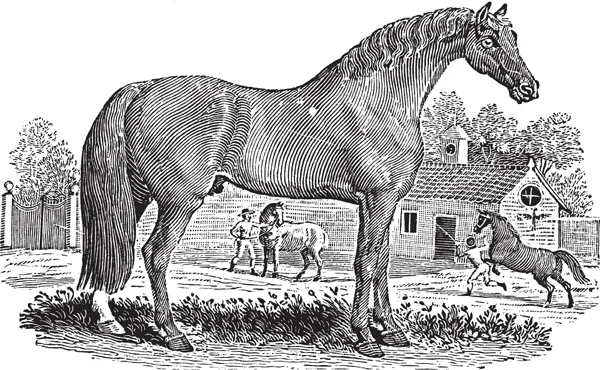
THE HORSE.
(Equus Caballus, Linnæus.—Le Cheval, Buffon.)
THE various excellencies of this noble animal, the grandeur of his stature, the elegance and proportion of his parts, the beautiful smoothness of his skin, the variety and gracefulness of his motions, and, above all, his utility, entitle him to a precedence in the history of the brute creation.
The Horse, in his domestic state, is generous, docile, spirited, and yet obedient; adapted to the various purposes of pleasure and convenience, he is equally serviceable in the draught, the field, or the race.
There are few parts of the known world where the Horse is not produced; but if we would see him in the enjoyment of his native freedom, unsubdued by the restraints man has imposed upon him, we must look for him in the wild and extensive plains of Africa and Arabia, where he ranges without control in a state of entire independency. In those immense tracts, the wild Horses may be seen feeding together, in droves of four or five hundred; one of them always acting as sentinel, to give notice of approaching danger: this he does by a kind of snorting noise, upon which they all run off with astonishing rapidity. The wild Horses of Arabia are esteemed the most beautiful in the world: they are of a brown colour, their mane and tail of black tufted hair, very short; they are smaller than the tame ones, are very active, and of great swiftness. The most usual method of taking them is by snares or pits formed in the sand. It is probable there were once wild Horses in Europe, which have long since been brought under subjection. Those found in America were originally of the Spanish breed, sent thither upon its first discovery, which have since become wild, and spread themselves over various parts of that vast continent. They are generally small, not exceeding fourteen hands high, with thick heads and clumsy joints; their ears and necks are longer than those of the English Horses. They are easily tamed; and if by accident they should regain their liberty, they seldom become wild again, but know their master, and may be easily caught by him.
At the age of two years,*1 the Horse is in a condition to propagate. The mare is generally in season from the latter end of March till the beginning of June; but her chief ardour for the Horse continues only fifteen or twenty days. She goes with young eleven months and some days; continues to breed till the age of sixteen or eighteen years; and lives, on an average, between twenty and thirty years.
Although the Horse is endowed with vast strength and powers, he seldom exerts either to the prejudice of his master: on the contrary, he shares with him in his labours, and seems to participate in his pleasures: generous and persevering, he gives up his whole powers to the service of his master; though bold and intrepid, he represses the natural vivacity and fire of his temper, and not only yields to the hand, but seems to consult the inclination of his rider.
But it must continue to be matter of regret to every feeling mind, that these excellent qualities should be often shamefully abused in the most unnecessary exertions; and the honest labours of this noble animal thrown away in the ungrateful task of accomplishing the purposes of unfeeling folly, or lavished in gratifying the expectations of an intemperate moment.
![]()
THE ARABIAN HORSE.
THERE is scarcely an Arabian, how poor soever in other respects, but is possessed of his Horse, which he considers as an invaluable treasure. Having no other dwelling but a tent, the Arabian and his Horse live upon the most equal terms: his wife and family, his mare and her foal, generally lie indiscriminately together; whilst the little children frequently climb without fear upon the body of the inoffensive animal, which permits them to play with and caress it without injury. The Arabs never beat their Horses; they speak to, and seem to hold friendly intercourse with them: they never whip them, and seldom, but in cases of necessity, make use of the spur. Their agility in leaping is wonderful; and if the rider happen to fall, they are so tractable as to stand still in the midst of the most rapid career. The Arabian Horses, in general, are less than the Race Horses of this country; they are easy and graceful in their motions, and rather inclined to leanness. It is worthy of remark, that, instead of crossing the breed, the Arabs take every precaution to keep it pure and unmixed: t...