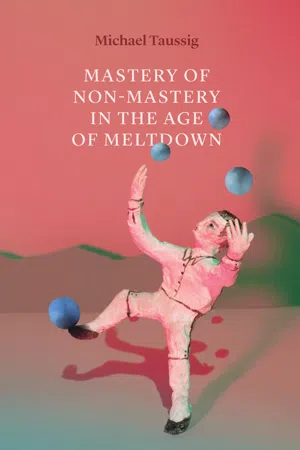
For centuries, humans have excelled at mimicking nature in order to exploit it. Now, with the existential threat of global climate change on the horizon, the ever-provocative Michael Taussig asks what function a newly invigorated mimetic faculty might exert along with such change. Mastery of Non-Mastery in the Age of Meltdown is not solely a reflection on our condition but also a theoretical effort to reckon with the impulses that have fed our relentless ambition for dominance over nature.
Taussig seeks to move us away from the manipulation of nature and reorient us to different metaphors and sources of inspiration to develop a new ethical stance toward the world. His ultimate goal is to undo his readers' sense of control and engender what he calls "mastery of non-mastery." This unique book developed out of Taussig's work with peasant agriculture and his artistic practice, which brings performance art together with aspects of ritual. Through immersive meditations on Walter Benjamin, D. H. Lawrence, Emerson, Bataille, and Proust, Taussig grapples with the possibility of collapse and with the responsibility we bear for it.
- English
- ePUB (mobile friendly)
- Available on iOS & Android
eBook - ePub
Mastery of Non-Mastery in the Age of Meltdown
About this book
Information
Publisher
University of Chicago PressYear
2020Print ISBN
9780226698670
9780226684581
eBook ISBN
9780226698700
1 MIMETIC EXCESS
From the wheel to the atom bomb, from Mendel’s peas to DNA, from shamans to Sergei Eisenstein’s cream separator, we have excelled in mimicking nature so as to exploit it, just as we exploit each other and ourselves.
If I am correct in assuming that global meltdown amplifies mimetic and animistic impulses as never before, might mimetic excess provide us with a way out, providing a mutuality geared to the mastery of non-mastery, therewith giving the planet and ourselves a break?
Mimesis is a form of trickery as well as magic. Adorno put it rather beautifully—but then he had a beautiful subject—when he described Walter Benjamin’s method, or was it a trick, as the need for everything to “metamorphose into a thing in order to break the catastrophic spell of things.”1
My favorite example of mimesis is the human face, faced with another face as mask and window to the soul. How skilled we are at reading and responding facially, which here means acting, or should I say, feigning insensibly fast, subliminally mirroring reciprocities and anticipations.
But perhaps we should start with something simpler, like the mimesis between the wing of a bird and that of an airplane. Have you never wondered how a cross-section so cunning and simple can lift you off the ground? Now multiply this to infinity—lift off, I should say, start flying—for is not our world, both artificial and natural, a treasure trove of analogies and similarities? Are not these analogies alive with the reciprocating tension of the gift that binds them and endows them with empathetic force?
But if the bird’s wing is a gift to civilization, what does the bird get in return?
That is the question.
Consider the mimetic faculty. In 1933 Walter Benjamin pointed to what he considered humans’ loss of alertness to similarities in his essay “Doctrine of the Similar,” followed months later by his essay “On the Mimetic Faculty.” Little more than three pages each, these essays were ignored or smuggled sotto voce into major contributions to critical thinking, most notably Horkheimer and Adorno’s riff on anti-Semitism in the Third Reich, their analysis of shamanism as an early attempt at the domination of nature, and Adorno’s weighty aesthetic theory, in which Benjamin’s idea of mimesis fuels a persistent train of thought.2 In each of these instances, however, the mimetic faculty is treated like an embarrassing family member whose name is to be avoided but whom, at crucial times, proves indispensable.
“Nature creates similarities. One need only think of mimicry,” begins Benjamin’s essay on mimesis. “The highest capacity for producing similarities, however, is man’s. His gift of seeing resemblances is nothing more than a rudiment of the powerful compulsion in former times to become and behave like something else.”3
To become and behave like something else.
A bold statement. A statement those of us in an English-speaking tradition and coming out of anthropology would recognize as mimetic with what, in The Golden Bough, is called “sympathetic magic.”4 But for Benjamin the mimetic faculty goes further than what is generally meant by magic.
It is his thesis that over the long haul of Western history, from the ancient world to the present, the mimetic faculty, though still an active presence among children (and, we might add, in magical practices), has been largely eclipsed from conscious awareness. And not just eclipsed but actively repressed, as if it were dangerous, not only childish but barbaric, animal, inferior. Hence our term “aping” and Franz Kafka’s astonishing story of Red Peter, an ape who was able to mimic humans and lecture to an academy in Berlin on what it was like to become human.
But given its essential role in human affairs, has the mimetic faculty really been eclipsed? Or has it, like a dammed river, found alternative routes? Benjamin suggests that “non-sensuous correspondences” provide mimetic links between things and activities not obviously mimetically related, and then he takes a further step, suggesting that language itself can be thought of in this way too.
For now, though, let me return to the bird’s wing and that of the airplane to suggest a further and radical development in our time on account of changes affecting the mimetic faculty wrought by climate change. Now we are flying fast and high, mimetic beings in wonderlands of what until recently was pure make-believe. One minute it’s winter, the next, summer. Tremors and drought shake the earth and its peoples, while the far-fetched notion that the real is really made up has become real. The bird’s wing is different now. Transformation, mirroring, and boxes within boxes, as in a Harry Potter universe, best characterize our present dispensation. At the risk of being thought too fanciful, I call this situation “the metamorphic sublime.”
Running through all of this is a colonial endowment of mimicry miming itself—what I call mimetic excess.
Let me explain.
In a darkened classroom around 1990, screening Jean Rouch’s film Les maîtres fous, made in Ghana in 1955 just before independence. (Note the title: “the mad masters.”) The film concerns migrants from the French colony of Niger enacting in trance the spirits of French officials, seen now in black bodies gesticulating wildly and disjointedly, eyes rolling, spume frothing from their mouths. They enact mini-dramas of transgression and of military discipline. Transgression and discipline conjoined! Fancy that! They eat dog and they carry (toy) rifles. They exult in the exercise of mastery over craven subjects crawling on the ground. The crucial point is that the bodies in trance are and manifestly are not the French officials. The bodies mimic, yet the result is not without parody, and parody (as Steve Feld once pointed out) is mimesis with one aspect accentuated, which is all you need for mimetic excess.5 Yet even without accentuation, to be mimed is disconcertng. These men and women from Niger, part of the Hauka cult, thus bring out the wildness, the spirituality, and—most important—the sheer bluff their masters enact in the colonial theatricalization of mastery in general. Jean Genet’s play Les Negres is based on this, gets its steam from this. To mime is to get the power of what is mimed and power over it. All that plus parody as well!
Then we screened Jerry Leach and Gary Kildea’s film Trobriand Cricket: An Ingenious Response to Colonialism, filmed in 1972–1973. This shows Trobriand men enacting synchronized dance routines at dramatic moments during the game of cricket. One dance evokes sea birds darting over the waves, another, US bombers lifting off the tarmac in the Trobriand islands during World War II.
We are told that cricket was introduced by missionaries to displace war. (!) We could say that the game here is mimetic of war, at least in the opinion of the missionaries. The Trobrianders copied English cricket but added their own ideas, including magic, bowling with the same arm movements as hurling a spear, and allowing political agreements between rival chiefs to decide which team should win. Mimesis is always creative. (Deleuze and Guattari get it wrong when they insist it means direct copying.)
At what I take to be the crucial moments in each film, the magic of mimesis billows forth in jaw-dropping juxtapositions orchestrated by the film editor. In Les maîtres fous, an egg is cracked over the head of a small, painted wooden statue of the colonial governor placed among the entranced bodies, followed immediately by a shot of the British governor of Ghana stepping from his limousine during a state ceremony, displaying his hat of ostrich plumes, yellow with a white surround, like a cracked egg in a frying pan.6
In Trobriand Cricket we see dancers imitating sea birds, then footage of sea birds skimming the waves, then back to the dancers. We see dancers—crouched bodies arranged in lines, arms vibrating, magical plant leaf ornaments quivering—then footage of a World War II bomber (with the name, speaking of mimesis, birds, and airplanes, of “Squawking Hawk”).
And we gasp.
I have thought a lot about that gasp, that in-drawing of breath when words fail, the body emptying out at the marvel of it all.
This reaction, I suggest, is more than an appreciation of filmmaking wit. It is a visceral reaction to a bodily history of the mimetic faculty, from the miming body in the colony to the mimetically capacious machinery in the metropole such as the movie camera. The gasp is not merely colonial history in a nutshell but a moment in which the mimetic faculty speaks for itself. The instrumental function of mimesis, used to colonize nature from the shaman’s gestures, drugs, and chants to the atomic bomb is exceeded in this moment in a burst of sheer joy and wonder that I call the mastery of non-mastery.
Check it out for yourself, the filmic miming of miming itself!
2 THE EXPOSITION OF THE NON-DOGMATIC CANNOT BE DOGMATIC
Mastery of non-mastery is what Roland Barthes described as “an ethic, a guide to life lived through twinklings of tact in an anecdotal discourse recruited to outsmart mastery.”1
This involves much by way of experiment and failure.
The first experiment, in 2008, was “Something Is Happening,” a series of five-minute talks by four people organized by Jordan Crandall, who was teaching visual studies at a local university. The talks took place at locations two to three miles apart on the coast in southern California.2
We started on a beach. The speakers stood. The audience stood. The waves crashed. Language became something else.
Then we moved to a cliff-face, a forest, and lastly a town. In retrospect I see the talks as timed to the rotation of our planet, and hence tied to our bodies in relation to the sun.
Dusk evoked memories of how my mother, on the other side of the Pacific, used to say this was the saddest time of day, something I would hear and read often in my life and in literature: as the starting point in Manuel Puig’s Cae la noche tropical, and as the endpoint in Virginia Woolf’s The Waves.
But they wrote before.
Before Meltdown.
It was not only sadness, of course. Sunset was mixed with turning life over, just as the ground under our feet was turning. Things then are recalibrated with what filmmakers call the “magic hour.” Animals put on a show. The owl of Minerva emerges, as Hegel points out in relation to historical knowledge, and sometimes your heart leaps as starlings in their multitudes wheel and somersault across the darkening sky, love poems maybe, ecstasy for sure, sheer joy it seems—what Bataille should have chosen as his symbol of dépense, meaning spending for the hell of it. It’s even got a name that makes you shiver. Murmuration, it’s called. In Gravity’s Rainbow, the birds arrive ahead of the bombers and rockets. The radar operators call them angels.3
It was a largely unconscious knowledge I was tapping into, what I came to call the bodily unconscious, in which the body came to mean my body, your body, and the body of the world. We are solar-oriented creatures in so many ways without knowing it, but now with climate change, I believe, we are becoming more aware of our bodies and of how perturbing and interesting is our relation to the cosmos at large. It is not that the bodily unconscious becomes conscious or even partially conscious, for it could not function unless it remains unconscious. Its forays into consciousness have to be furtive and sporadic, so to speak, leaving tremors, which is what language and consciousness pick up on.
When I put it like this you have to wonder how we could ever have thought of language as separable from where and especially when it is happening We have language by the beach, language at the cliff-face, language in the town; language at dawn, midday, or dusk; language right here on this page.
There was another thought attached to this, the question of how innocent an act is it, really, to delve into the workings of the bodily unconsciousness. Might it not be better left alone, away from the attentions of Dupont USA, the US National Science Foundation, and Big Pharma? (Fat chance.)
The second experiment leading to this book was the “Sun Theater” performed with the fluctuant light of dusk in Helsinki, Berlin, and New York, where at the Whitney Museum, February 2013, the text was accompanied by Anni Rossi playing viola and piano, as well as by a masked dancer, Kyle Bukhari. Images were projected from outside through the floor-to-ceiling windows. Language became something else in this theater-piece pressing on ritual. And why ritual? There must have been a sense that the mastery of non-mastery has an affinity with snow falling through translucent images as a masked dancer winds through the audience, come what may.
The third experiment is the book before you, situated between science fiction, the weather, and high theory.
Enmeshed in the two previous happenings, it began as a hybrid object—part theater-script (left-hand page) and part commentary on the script (right-hand page)—but the script resisted the distinction between theater and commentary, make-believe and belief, wind and words. Such is the mastery of non-mastery, what Roland Barthes in ...
Table of contents
- Cover
- Title Page
- Copyright Page
- Dedication
- CONTENTS
- Smoke and Mirrors
- 1 | Mimetic Excess
- 2 | The Exposition of the Non-Dogmatic Cannot Be Dogmatic
- 3 | Nietzsche’s Tuning Fork, Kafka’s Sirens
- 4 | Twilight of the Idols
- 5 | Catastrophe: The Solar Inversion of Satanic Denial
- 6 | Metamorphic Sublimity
- 7 | Re-Enchantment of Nature
- 8 | In Your Bones You Know Otherwise
- 9 | Planetarium
- 10 | Sunset
- 11 | In the Beginning Was the Firefly
- 12 | The Sun Is an Indian Shaman
- 13 | Lightning
- 14 | Is Magic Domination of Nature?
- 15 | The Alpha and Omega of All Mastery
- 16 | Art versus Art
- 17 | Subterranean Cities of Sleep
- 18 | Magic Hour
- 19 | Julio Reyes’s Phantom Ship
- Acknowledgments
- Notes
- Works Cited
- Index
Trusted by 375,005 students
Access to over 1.5 million titles for a fair monthly price.
Study more efficiently using our study tools.
Frequently asked questions
Yes, you can cancel anytime from the Subscription tab in your account settings on the Perlego website. Your subscription will stay active until the end of your current billing period. Learn how to cancel your subscription
No, books cannot be downloaded as external files, such as PDFs, for use outside of Perlego. However, you can download books within the Perlego app for offline reading on mobile or tablet. Learn how to download books offline
Perlego offers two plans: Essential and Complete
- Essential is ideal for learners and professionals who enjoy exploring a wide range of subjects. Access the Essential Library with 800,000+ trusted titles and best-sellers across business, personal growth, and the humanities. Includes unlimited reading time and Standard Read Aloud voice.
- Complete: Perfect for advanced learners and researchers needing full, unrestricted access. Unlock 1.5M+ books across hundreds of subjects, including academic and specialized titles. The Complete Plan also includes advanced features like Premium Read Aloud and Research Assistant.
We are an online textbook subscription service, where you can get access to an entire online library for less than the price of a single book per month. With over 1.5 million books across 990+ topics, we’ve got you covered! Learn about our mission
Look out for the read-aloud symbol on your next book to see if you can listen to it. The read-aloud tool reads text aloud for you, highlighting the text as it is being read. You can pause it, speed it up and slow it down. Learn more about Read Aloud
Yes! You can use the Perlego app on both iOS and Android devices to read anytime, anywhere — even offline. Perfect for commutes or when you’re on the go.
Please note we cannot support devices running on iOS 13 and Android 7 or earlier. Learn more about using the app
Please note we cannot support devices running on iOS 13 and Android 7 or earlier. Learn more about using the app
Yes, you can access Mastery of Non-Mastery in the Age of Meltdown by Michael Taussig in PDF and/or ePUB format, as well as other popular books in Social Sciences & Cultural & Social Anthropology. We have over 1.5 million books available in our catalogue for you to explore.