A dramatic shift is taking place in Israel and America. In Israel, the deepening occupation of the West Bank is putting Israeli democracy at risk. In the United States, the refusal of major Jewish organisations to defend democracy in the Jewish state is alienating many young liberal Jews from Zionism itself. In the next generation, the liberal Zionist dream, the dream of a state that safeguards the Jewish people and cherishes democratic ideals, may die.
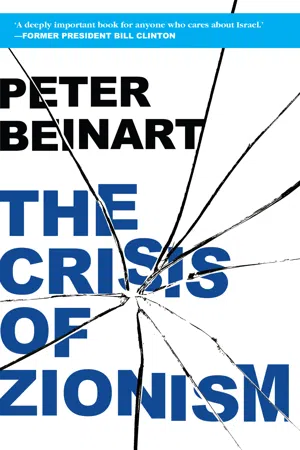
In The Crisis of Zionism, Peter Beinart lays out in chilling detail the looming danger to Israeli democracy and the American Jewish establishment's refusal to confront it. And he offers a fascinating, groundbreaking portrait of the two leaders at the centre of the crisis: Barack Obama, America's first 'Jewish president', a man steeped in the liberalism he learned from his many Jewish friends and mentors in Chicago; and Benjamin Netanyahu, the Israeli prime minister who considers liberalism the Jewish people's special curse. These two men embody fundamentally different visions, not just of American and Israeli national interests, but of the mission of the Jewish people itself.
Beinart concludes with provocative proposals for how the relationship between American Jews and Israel must change, and with an eloquent and moving appeal for American Jews to defend the dream of a democratic Jewish state before it is too late.
- 304 pages
- English
- ePUB (mobile friendly)
- Available on iOS & Android
eBook - ePub
The Crisis Of Zionism
About this book
Information
Subtopic
Política1

The Crisis in Israel
AS A ZIONIST, I BELIEVE THAT AFTER TWO MILLENNIA OF HOME-lessness, the Jewish people deserve a state dedicated to their protection in their historic land, something enjoyed by many peoples who have suffered far less. As a partisan of liberal democracy, I believe that to honor that history of suffering, a Jewish state must offer equal citizenship to all its inhabitants. In the spirit of Hillel, it must not do to others what Jews found hateful when done to them. Are these principles in tension? Absolutely. There will always be tension between Israel’s responsibility to the Jewish people and its responsibility to all its people, Jewish and non-Jewish alike. But as the scholars Alexander Yakobson and Amnon Rubinstein have noted, “Tension between values, in and of itself, is no indication that one of the competing values is illegitimate.” If there is tension between Zionism and liberal democracy, there is also tension between economic development and environmental protection, or government spending and fiscal discipline, or civil liberties and national defense, or many other goals that governments rightly pursue. At the heart of the Zionist project is the struggle to reconcile these two valid but conflicting ideals. If Israel fails in that struggle, it will either cease being a Jewish state or cease being a democratic one. Today, it is failing, and American Jews are helping it fail.
Theodor Herzl would be distraught, but not surprised. The man who founded the Zionist movement did not merely want a Jewish state. He wanted a Jewish state that cherished liberal ideals. And he knew that to create such a state, Jews would have to wage a battle for its soul. In 1902, he wrote a novel called Altneuland (Old New Land) about a future Jewish country. Herzl’s Jewish country is an impressive place. It guarantees freedom of speech and freedom of religion; rabbis enjoy “no privileged voice in the state.” The book’s hero, a presidential candidate named David Littwak, speaks Arabic, and one of his closest allies is an Arab engineer from Haifa. In their political party, Littwak tells a visitor, “We do not ask to what race or religion a man belongs. If he is a man that is enough for us.”
But, Littwak admits, “there are other views among us.” Their foremost proponent is a Rabbi Geyer, who seeks to strip non-Jews of the vote. Herzl modeled Geyer on an anti-Semitic demagogue in his native Austria, thus raising the specter that once Jews enjoyed power they might persecute others in the same way gentiles had persecuted them. The novel ends with the campaign between Littwak’s party and Geyer’s. “You must hold fast to the things that have made us great: To liberality, tolerance and love of mankind,” one of Littwak’s supporters tells a crowd. “Only then is Zion truly Zion!” In his final words, the outgoing president declares, “Let the stranger be at home among us.” After a fierce contest, Littwak’s party wins, Geyer leaves the country, and in the novel’s epilogue, Herzl implores readers to make his Zionist dream come true.
As a vision of the Zionist future, Altneuland has its problems. While Herzl believed deeply in equality for individual Arabs, he could not imagine an Arab national movement demanding a state in Palestine of its own. (His rival, the cultural Zionist Ahad Ha’am, knew better, insisting that “This land is also their national home … and they have the right to develop their national potential to the best of their ability.”) Still, for all its flaws, Altneuland shows that while Zionism was a nationalist movement, it was also, from the beginning, a liberal one. (Even those early Zionists who identified themselves as socialists mostly shared a liberal conception of freedom of conscience and equality under the law.) Zionism’s founding fathers—men like Herzl, Moses Hess, and Leon Pinsker—were children of the Enlightenment. Earlier in their lives, each had hoped that as the nations of Europe dedicated themselves to the rights of man they would eventually extend those rights to Jews. When anti-Semitism refused to climb into history’s grave, and instead reincarnated itself in racial, pseudoscientific form, the Zionist intellectuals lost faith in Europe and decided that only in their own state could Jews live safe, full lives. But they did not lose faith in Enlightenment ideals; they transplanted them. “We don’t want a Boer state,” wrote Herzl in his diary, expressing revulsion at racist Afrikaner nationalism. “But a Venice.”
But Herzl knew that a tolerant, cosmopolitan republic like Venice was not preordained, that Jews were entirely capable of birthing a Boer state. This conflict, between the desire to build a Jewish state premised on liberal democratic principles and the temptation to flout those principles in the name of Jewish security and power, runs throughout the Zionist enterprise. It is the battle every Zionist generation wages against itself. In May 1948, in “The Declaration of the Establishment of the State of Israel,” the state’s founders promised “complete equality of social and political rights to all its inhabitants irrespective of religion, race or sex.” Yet in the war that preceded and followed those majestic words, Zionist forces committed abuses so terrible that David Ben-Gurion, Israel’s first prime minister, declared himself “shocked by the deeds that have reached my ears.” In the town of Jish, in the Galilee, Israeli soldiers pillaged Arab houses, and when the residents protested, took them to a remote location and shot them dead. During the war, roughly 700,000 Arabs left Palestine, and irrespective of whether most left their homes voluntarily or were forced out, Israel refused to let them return.
In the struggle to build a Jewish state in the face of implacable foes, the liberal ideals outlined by Israel’s founders were brutally flouted. But the fact that those liberal ideals existed at all created space for democratic struggle. When the war of independence ended, Israel gave citizenship to the Arabs still living within its territory, which was more than the refugees gained in most of the Arab countries to which they fled. The rights of Israeli Arabs were curtailed, to be sure: in Israel’s first decades, most lived under martial law. But Arab and Jewish Israelis joined together to protest this blatant discrimination, and in 1966 martial law was lifted. Massive inequities remained, but it was possible to believe that, slowly and fitfully, the gap between Zionism and liberalism was narrowing, that Israel was moving in the direction of Herzl’s dream.
Then, in 1967, the Six-Day War turned history’s trajectory upside down. With its Arab neighbors poised to attack, Israel struck first, fought brilliantly, conquered the West Bank of the Jordan River, among other territories, and began to settle the land (a process made easier by the Arab world’s apparent refusal to offer peace, even if Israel gave the new territories back). For a country built by pioneers, this was natural. Settling land—especially land as rich with biblical meaning as the West Bank—was in the Zionist DNA. The problem was that this time, liberal ideals did not tether the Zionist project. A year after it eliminated its most flagrant discrimination against its own Arab citizens, Israel made itself master of millions of Palestinian Arabs who enjoyed no citizenship at all. Suddenly, Rabbi Geyer had a kingdom of his own.

It is as if Altneuland’s election had ended with each party governing part of the land. In David Littwak’s Israel, the Israel born in 1948, liberal Zionism, to some extent, exists. Israel’s Arab citizens enjoy individual rights like freedom of speech, assembly, and worship. They sit in Israel’s parliament, the Knesset, and on its Supreme Court. Arab Israelis also enjoy the kind of group rights for which many ethnic and religious minorities yearn. They maintain their own religious courts and their own, state-funded, Arabic-language schools and media. Indeed, Arabic is one of Israel’s official languages. Arab citizens have also made dramatic educational and economic gains under Israeli rule. The political scientists Ilan Peleg and Dov Waxman note that in 1948 the illiteracy rate among Israeli Arabs was 80 percent. By 1988, it was 15 percent.
In a nation that has lived since its creation with the ever-present threat of war—a strain that would have turned countries less nourished by liberal ideals into police states—these are impressive accomplishments. The very anti-Zionist critics who attack Israel most ferociously often rely on the work of Israeli historians, Israeli journalists, Israeli human rights activists, and Israeli lawyers. Yet they rarely acknowledge that the ability of Israelis, including Arab Israelis, to damn their government in the harshest of terms—and rarely see the inside of a prison cell—says something admirable about the Zionist project. It is far from clear that, under similar circumstances, any of the democracies that criticize Israel’s human rights record would have done better. Arab Israelis, after all, share an ethnicity with the states and organizations against which Israel has repeatedly gone to war. And some—though not most—Arab Israelis sympathize with those adversaries. Certainly, no American familiar with the way the United States government treated German Americans during World War I, Japanese Americans during World War II, or even Muslim Americans during the “war on terror”—during wars that, unlike Israel’s, mostly took place thousands of miles from America’s shores—has any cause for sanctimony.
Still, as important as it is to honor Israel’s accomplishments, it is even more important to deepen them. And while liberal Zionism is not a fantasy within Israel’s 1967 lines, it is far from a fully fledged reality. The Or Commission, tasked by the Israeli government with investigating conditions for Arab Israelis in 2003, found that “government handling of the Arab sector has been primarily neglectful and discriminatory.” This is especially true when it comes to social services. In part because of historic restrictions on Arab access to Israeli public land, Arab citizens today own less than 4 percent of Israel’s land even though they constitute almost 20 percent of its population. A 2010 study by the Organization for Economic Cooperation and Development found that Israel spends one-third more per Jewish Israeli student than per Arab Israeli student.
There are other inequities, too. While Arab political parties do serve in the Knesset, by long-standing tradition Israeli prime ministers do not include them in their governing coalitions. Most Arab Israelis do not serve in the Israel Defense Forces, a key vehicle for advancement in Israeli society. (Though a small Arabic-speaking religious minority, the Druze, and some Bedouin, do.) And perhaps most fundamentally, Israel’s flag features a Jewish star, its national anthem speaks of “the Jewish soul,” and its immigration policy grants Jews, and only Jews, instant citizenship. Israel is not unique in these respects. The British, Australian, New Zealand, Swiss, Greek, Slovak, Swedish, Norwegian, Finnish, and Danish flags all feature crosses. Germany, Ireland, Finland, Greece, Poland, Hungary, Bulgaria, Slovakia, Slovenia, Croatia, and the Czech Republic—all democracies—maintain immigration policies that favor members of the state’s dominant ethnic group. But all this is cold comfort to Arab Israelis, most of whom feel like second-class citizens, and in important respects, truly are.
Reconciling Zionism and liberal democracy within Israel’s 1967 lines requires two kinds of changes. First, it requires eliminating those inequities that are not inherent to Zionism itself. Being a Jewish state does not require Israel to pursue discriminatory land policies or to spend more on its Jewish citizens than on its Arab ones. To the contrary, such policies violate the “full and equal citizenship” promised Arab Israelis in Israel’s declaration of independence. Similarly, maintaining a Jewish state should not prevent Arab parties from joining government coalitions. While it is true that the major Arab parties do not endorse Zionism, neither do some ultra-Orthodox Jewish parties that regularly sit in the Israeli cabinet. And while it is unrealistic to expect most Arab Israelis to serve in the military (an obligation from which ultra-Orthodox Jews are also largely exempt), the Israeli government should encourage, and eventually even require, them to perform some form of national service, making it clear that greater service to the state and better treatment from it go hand in hand. Finally, as Herzl makes clear in Altneuland, there is nothing in the Zionist project that requires Israel to cede control over marriage to clerics, thus forcing Jews who marry in Israel to be married by a rabbi and Christians or Muslims to be married by a minister or imam. Instituting civil marriage, and thus giving Arabs and Jews the right to marry inside Israel across religious lines, would not only mean greater liberty for Israel’s Arab citizens but for its Jewish ones as well.
Accomplishing all this would be extremely difficult, but not impossible. In fact, one Israeli prime minister moved in exactly this direction. During his second stint in office, between 1992 and 1995, Yitzhak Rabin doubled spending on education for Arab Israelis, ended the discrepancy between the amount the government paid Jewish and Arab families per child, and built dozens of health clinics in Arab Israeli communities. He introduced affirmative action to boost the number of Arab citizens in Israel’s civil service and, while he didn’t formally include Arab parties in his government, he did rely on their support in the Knesset, and thus gave them an unofficial role.
But even if future Israeli leaders were to follow Rabin’s path, they still would not eliminate the inequity in Zionism itself. As a Jewish state, Israel’s anthem, flag, and Jewish right of return would still afford Jewish Israelis a sense of national belonging and national refuge that Arab Israelis lack. This fundamental tension between Zionism and liberal democracy cannot be fully resolved within Israel’s borders. But it can, to some extent, be resolved outside them. Were Israel to permit the creation of a Palestinian state that enabled a Palestinian right of return and expressed Palestinian identity in its anthem and flag, Arab Israelis, like diaspora Jews, would have a country that expressed their special character as a people, even if they chose not to live there. The struggle for a liberal democratic Zionism, therefore, cannot be merely a struggle to afford Arabs individual and even group rights inside a Jewish state. It must also be a struggle to satisfy the Palestinians’ national yearning for a state of their own. If Israel’s founders endorsed the first goal in May 1948, when they created a Jewish state that pledged “complete equality of social and political rights to all its inhabitants irrespective of religion, race or sex,” most Zionist leaders endorsed the second in November 1947, when they embraced the United Nations’ plan to partition British Mandatory Palestine between a Jewish and Arab state. In recent decades, however, the struggle to achieve both these goals has been crippled by Israel’s behavior in the land it conquered in 1967. For the past forty-four years, on the very land on which Palestinians might establish their state—the state that could help fulfill the liberal Zionist dream—latter-day Rabbi Geyers, secular and religious alike, have forged an illiberal Zionism that threatens to destroy it.
The boundary between David Littwak’s Israel and Rabbi Geyer’s winds vertically from just below Nazareth in the north to just above Beersheba in the south. To the west of that line, Israel is a flawed but genuine democracy. To the east, it is an ethnocracy. In the Israel created in 1948, inequities notwithstanding, citizenship is open to everyone. In the Israel created in 1967, by contrast, Jews are citizens of a state whose government they help elect; Palestinians are not. Jews carry identity cards with blue covers, which allow them to travel freely among the West Bank, Jerusalem, and the rest of Israel. West Bank Palestinians carry identity cards with orange or green covers, which deny them access to East Jerusalem, large chunks of the West Bank, and the rest of Israel unless they gain a special—and hard-to-obtain—permit. Jews in the West Bank who violate Israeli law go before civilian courts that afford them the full measure of due process. Palestinians who violate Israeli law go before military courts where, according to a 2007 study by the Israeli human rights group Yesh Din, defendants are often held for months or even years before trial and where fewer than 1 percent are found innocent. This boundary, between a nation where Jewish power is restrained by democratic ideals and a territory where Jewish power runs wild, is called the “green line.” Its existence is what keeps the possibility of liberal Zionism alive.
But the green line is fading. In 1980, around twelve thousand Jews lived east of democracy, with another seventy thousand or so in East Jerusalem, where Palestinians can seek Israeli citizenship but are not born with it. Today, that number is three hundred thousand (with roughly two hundred thousand more in East Jerusalem), and the Jewish population of the West Bank is growing at three times the rate of the Israeli population inside the green line. In 1980, the Knesset did not contain a single Jewish settler. Today, Israel’s foreign minister lives halfway across the West Bank. Over time, democratic and nondemocratic Israel have become Siamese twins. They share the same telephone system, bus system, road system, rail system, water system, and electricity grid. In 2010, Prime Minister Benjamin Netanyahu called Ariel, a settlement that stretches thirteen miles into the West Bank, “the heart of our country.” Many Israeli maps and textbooks no longer show the green line at all.
“The moment of truth,” warns former Knesset speaker Avraham Burg, “is coming very fast.” One day, maybe five years from now, maybe fifteen, maybe it has already happened, the green line will disappear: West Bank settlers will have grown so numerous and so entrenched within the Israeli government, rabbinate, and army that it will be impossible to remove enough of them to create a viable Palestinian state with a border near the green line. When that happens, Zionism as a liberal democratic project will die. If Israel honors the promise in its declaration of independence to provide “full equality of social and political rights” to all the people under its domain, a country of roughly 6 million Jews and 1.5 million Arabs will add close to 2.5 million new Arab citizens in the West Bank and another 1.5 million in the Gaza Strip, which, according to international law and the United States government, Israel still occupies even though no more Jewish settlers live there. And those new Arab citizens will have a population growth rate almost 50 percent higher than Israel’s Jews. By honoring the democratic promises of its founders, Israel will commit suicide as a Jewish state.
Some on the far left yearn for that day. They...
Table of contents
- Cover
- Title
- Copyright
- Dedication
- Contents
- Introduction
- 1 The Crisis in Israel
- 2 The Crisis in America
- 3 Should American Jews Criticize Israel?
- 4 Is the Occupation Israel’s Fault?
- 5 The Jewish President
- 6 The Monist Prime Minister
- 7 The Clash
- 8 The Humbling
- 9 The Future
- Conclusion
- Notes
- Acknowledgments
- Index
Trusted by 375,005 students
Access to over 1.5 million titles for a fair monthly price.
Study more efficiently using our study tools.
Frequently asked questions
Yes, you can cancel anytime from the Subscription tab in your account settings on the Perlego website. Your subscription will stay active until the end of your current billing period. Learn how to cancel your subscription
No, books cannot be downloaded as external files, such as PDFs, for use outside of Perlego. However, you can download books within the Perlego app for offline reading on mobile or tablet. Learn how to download books offline
Perlego offers two plans: Essential and Complete
- Essential is ideal for learners and professionals who enjoy exploring a wide range of subjects. Access the Essential Library with 800,000+ trusted titles and best-sellers across business, personal growth, and the humanities. Includes unlimited reading time and Standard Read Aloud voice.
- Complete: Perfect for advanced learners and researchers needing full, unrestricted access. Unlock 1.5M+ books across hundreds of subjects, including academic and specialized titles. The Complete Plan also includes advanced features like Premium Read Aloud and Research Assistant.
We are an online textbook subscription service, where you can get access to an entire online library for less than the price of a single book per month. With over 1.5 million books across 990+ topics, we’ve got you covered! Learn about our mission
Look out for the read-aloud symbol on your next book to see if you can listen to it. The read-aloud tool reads text aloud for you, highlighting the text as it is being read. You can pause it, speed it up and slow it down. Learn more about Read Aloud
Yes! You can use the Perlego app on both iOS and Android devices to read anytime, anywhere — even offline. Perfect for commutes or when you’re on the go.
Please note we cannot support devices running on iOS 13 and Android 7 or earlier. Learn more about using the app
Please note we cannot support devices running on iOS 13 and Android 7 or earlier. Learn more about using the app
Yes, you can access The Crisis Of Zionism by Peter Beinart, Peter Beinart in PDF and/or ePUB format, as well as other popular books in Política y relaciones internacionales & Política. We have over 1.5 million books available in our catalogue for you to explore.