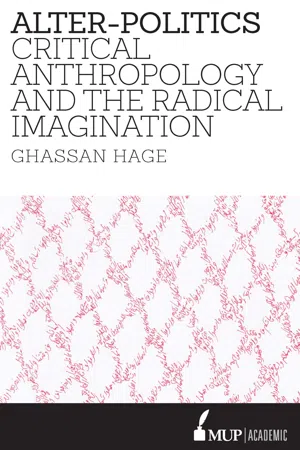
This book is a contribution to a long history of critical writing against an increasingly destructive global order marked by an excessive instrumentalisation, exploitation and degradation of the human and non-human environment, and ridden with unacceptable, but also, importantly, avoidable, forms of inequality, injustice and marginalisation.
Alter-Politics is concerned with the way anthropological critical writing in particular aims to weave oppositional concerns (anti-politics) with a search for alternatives (alter-politics): alternative economies, alternative modes of inhabiting and relating to the earth, alternative modes of thinking and experiencing otherness.
If Alter-Politics privileges alter-politics over oppositional politics, it is not because, as is made clear, the 'alter' moment is more important than the 'anti'. It is because a concern for alter-politics has been less prevalent. The question of 'political passion' is crucial in this conception of the alter-political. For the book argues that it is because radical political passion has been mostly directed towards anti-politics that it has come to dominate over alter-politics. This does not simply mean that political passion needs to be equally directed towards alter-politics. It also means that this passion itself needs to be a radically different kind of political passion once so directed. It is this 'alter-political passion' that Hage strives to create a space for throughout Alter-Politics.
- 241 pages
- English
- ePUB (mobile friendly)
- Available on iOS & Android
eBook - ePub
About this book
Information
1
The globalisation of the late colonial settler condition
I think it was Zygmunt Bauman who once observed that if in modernity the First World showed the Third World an image of its future, in post-modernity the opposite is occurring. This observation often comes to mind as I find myself increasingly noting the emergence of new social, cultural and political phenomena not only in Australia but also elsewhere in the West that remind me of Lebanese society as it evolved before and during the Lebanese civil war (1975–91).
It is good to recall that most Marxist analysts of pre-war capitalist Lebanon used to argue that the country’s economy was warped and underdeveloped because of the relative weakness of its industrial sector relative to the ‘tertiary sector’, which referred to commerce, banking, services and tourism. Today most Western countries have undergone a severe process of de-industrialisation and their economies are characterised precisely by this imbalance. I don’t want to take this analogy too far (it clearly has no place for the role of the mining sector in the Australian economy, for instance), and I am aware that it is very limited and can even be considered superficial. But at the same time I think the basis for such an analogy is real and that it can account for some important similarities.
Take the rise in flashy consumption and the display of wealth that Australia has witnessed in the last thirty years or so. This used to be a far more salient characteristic of the local bourgeoisie in Lebanon than in Australia in the mid-1970s when I first arrived. But this is no longer the case. The fact that exhibitionist bourgeois culture is historically associated with mercantilist and speculative rather than industrialist capitalism goes a long way towards explaining this. To begin with, merchants, bankers and speculators don’t need to reinvest their profits in their enterprise to the same degree that industrialists do, so they usually have a lot more money (‘surplus profit’) left for personal consumption. Furthermore, having their houses, their offices, their cars and themselves looking ‘shiny’ is part of the way merchants, bankers and speculators do business: their facade is part of their assets, or, in Bourdieu-ian terms, their investment in cultural capital is part of the process of maximising their economic capital. It is less so in the case of industrial capitalists.
There is another burgeoning resemblance in this domain, at least as far as Australia is concerned. It is a well-established feature of mercantile/speculative capitalist societies that merchants, bankers, land developers and so on—more so than industrialists—often aim to have themselves or their direct representatives, usually lawyers, elected to parliament to control legislation that is of concern to them. More generally, the state as a legislating body is perceived to be itself less an arbiter between different capitalist interests and more a part of the ‘means of production’ that investors vie to control. This leads to a parliamentary culture in which corruption is more prevalent. And so, in this domain as well, it can be said that the Lebanese parliament of the 1960s was already showing Australian state and federal parliaments an image of their future.
One could make many other comparisons in this domain. There is, however, one broad resemblance that I consider particularly significant and that I want to examine in this chapter. It is the way the dominant political culture of the Lebanese Christians in their attitudes and later in their war against ‘the Muslims’ in Lebanon in the twentieth century offers the West an image of the increasingly dominant political culture that prevails within it today. The likeness between the two struck me in early 2004. At the time, I was on leave at the American University of Beirut and I was reworking parts of my PhD thesis for publication purposes. I had finished writing my thesis in 1987. It was about Lebanese Christians and how they evolved into a warring community from the rise of Lebanese capitalism in the eighteenth century until and during the early part of the Lebanese civil war. Curiously, I began noting that parts of my analysis of this Christian warring culture were actually pertinent to understanding the transformations of the Western culture of national ‘worrying’ that I started examining in my work Against Paranoid Nationalism.1
In my thesis, I had pointed to the similarity between the warring ethos of the Lebanese Christians and that of white South Africans during the Apartheid years, as well as that of the Zionists in Israel. All three, I argued, shared a perception of themselves as a kind of advanced post of Western civilisation in the Third World. All were animated by variations on the sense of a civilising mission, and all felt that the centrifugal/expansionary/colonial (ideological or territorial) propelling motor that stirred them had come to a halt. It is this sense of a stalled expansionist force that allows us to characterise them as late colonial settler social formations. They were animated by a culturally defensive ethos. They felt themselves surrounded by uncivilised hordes of people with whom they had to ‘deal’ in the best way they could, often in a violent and ‘uncivilised’ manner. Yet they always did so while continuing to conceive of themselves as guided, with a kind of noblesse oblige, by what they perceived as the superior values of ‘Western civilisation’. The Christians believed that the Muslims were hell-bent on destroying Western (here portrayed as Christian/Democratic) civilisation in Lebanon; the white South Africans felt the same way about the blacks (here Western civilisation was perceived as white); and the Israelis thought and still think of the Arabs/Palestinians along similar lines (here Western civilisation is perceived as Judeo-Christian in both its religious and its secular manifestations). Interestingly, at the time I was writing my PhD all three groups had ideologues that portrayed them as abandoned by a West that no longer knew how to fight for what it valued most and that no longer had a sense of how, in difficult circumstances, ‘one has to do what one has to do’ to survive.
It was while reading this comparative analysis that Bauman’s argument resurfaced in my head. I felt that those very features that constituted the specificity of Zionist Israel, white South Africa and Christian Lebanon as ‘besieged civilised cultures’ were increasingly becoming part of what defines all Western cultures today. These nationalist warrior cultures of the twentieth century were already showing the West an image of its future, as it has come to be today. Indeed, as is increasingly the case, the dominant forms of imagining ‘the West’ today portray it as if it is one big global, late colonial settler formation, on the defensive despite its expansionary mode of existence; under duress despite its overwhelming power and dominance; confronted, as it imagines itself to be, with an equally global sea of uncivilised others made out of terrorists and asylum seekers. It is in this sense that I want to speak here about a globalisation of the late colonial settler condition.
The globalisation of the Islamic threat
The globalisation of the Islamic other around the world, of which both terrorists and asylum seekers are seen as a manifestation, is one of the key components in generalising this colonial settler condition. Like all processes of cultural globalisation, it involves contradictory processes of cultural homogenisation and heterogenisation.2 Thus while Islam was becoming homogenised as the global threatening other, the category that embodied the Islamic threat differed from one country to another: Asians in Britain (there meaning Indians and Pakistanis), Turks in Germany and North Africans in France. In Australia it was the Lebanese category that came initially to embody this threat, although this perceived ethnicity of Muslims became more diverse in the twenty-first century, expanding to include South Asian and African communities.
One element that contributed to a conception of ‘the Muslim’ as lying outside the multicultural realm of the tolerated other was the existence among them of a substantial and increasing number of ‘seriously religious’ people. To be seriously religious here does not simply mean going frequently to the mosque or holding intense religious beliefs. It does not even denote a high degree of enthusiasm. More importantly, it means considering all aspects of one’s everyday life as ruled by the Laws of one’s God.3 It is this kind of religiosity—given, in particular, that it is the religiosity of an other—that constitutes a serious negation of the logic of multicultural acceptability. Multiculturalism has always found a way (indeed it can be defined by an ability) to find room for minor elements of the law of the other to exist within the dominant national law—here I don’t necessarily mean law in a formal sense, although it could be, but I mean more an anthropological conception of law as ‘the other’s order of things’ or ‘the other’s way of life’. In this sense, we can say that multiculturalism is primarily defined by this relation of encompassment. The dominant national law opens a space—a state of exception if you will—where the law of the other can exist as long as it is encompassed by the national law. The space where the law of the other exists can vary in content and in magnitude, but what cannot possibly change is that the dominant culture has to be the encompassing culture and the law of the other the encompassed culture.
The problem that arises with seriously religious Muslims is that what they see as their laws are nothing short of the Laws of God. These are not equivalent to minor laws such as the rules of a specific national cuisine or even the ethno-specific laws of marriage and kinship. The idea that you can have a space where you can speak your language, eat your food and follow your rituals—as long as you understand that this is a space offered to you, so to speak, by the dominant language, the dominant mode of eating and so on—is relatively unproblematic. But the idea of having the laws of the nation offer a space for the Laws of God is sacrilegious. Indeed, for people who take their religion seriously, the situation is reversed. It is the Laws of God that are the all-encompassing ones and the national laws of the host nation—or any other nation for that matter—that are the minor ones. For a seriously religious Muslim migrant integrating into the host nation, it becomes a matter of finding a space for these national laws within the all-encompassing Laws of God. The very relation of encompassing–encompassed cultures, on which multiculturalism is based, is here inverted, and threatening intimations of ungovernability arise. But this is not where they end. That some Muslims think of themselves as belonging to a politicised transnational community or Umma has given a further earthly flavour to this mode of living under the Law of God, transforming it into a kind of metaphysical transnationalism.
What also made many non-Muslim Westerners experience this religiosity as a threat were the international political developments that articulated themselves to Islamic transnationalism. The starting point of these developments, and what perhaps remains the main important one, is the rise of Iran as an Islamic nation. This has since led to the development of various forms of global Islamic politics—Sunni as well as Shi’a. This has also come to include varieties of Islamic terrorism.
The Iranian revolution, particularly under Khomeini, instituted a rule of law that openly portrayed itself as a kind of transcendent Muslim anti-colonial political will. Subsequently, this political will was perceived for the first time to exercise itself transnationally with the Salman Rushdie affair. It was as if Muslims were suddenly in a position to openly sentence a person living in and subject to the protection of the law of a Western nation-state. Even more threatening to the Western national will, numerous Muslims who were supposed to be docile Western subjects showed themselves to be agents of the transnational Muslim will by calling for the carrying out of, or even volunteering to carry out, the sentence themselves.
Since that time, there have been many occasions when Muslims have shown themselves to be the subjects of a transnational will, laced with anti-colonialism, that is other to that of the West. This has taken a particularly important turn with the 9/11 attacks and the London bombings, which led to the perception of the Islamic will not just as the will of ‘the other’ but also as the will of the enemy. The current worries about Muslim-background Western nationals being affiliated with ISIS, and indeed about ISIS itself, have accentuated this tendency of non-Muslim Westerners to perceive themselves as endangered by a hostile transnational Islamic other. This was central in legitimating the reimagining of Western nations as warring societies, which in turn is a crucial component in the making of the global late colonial settler ethos.
The structure and culture of warring societies
What is a warring society? The first point to make is that warring societies are not societies that are necessarily at war, but of societies that are permanently geared towards war. There is usually a tension between the notion of war and the notion of society, in that war is often seen as a transitional state between two more stable social states whereas society is precisely that stable social state. To talk of warring societies is to talk of social states where war is no longer a transitional state but a permanent feature of the social situation. The whole of society from its economy to its culture becomes part of the reproduction of this permanent state of war.
Perhaps most importantly, what makes societies permanently geared towards war is a reversal of the relation between two of their key constitutive mechanisms. All societies have mechanisms for the production and distribution of the good life, whichever way the good life is culturally defined—materially, emotionally or spiritually. And all societies also have to defend whatever they consider to be the ‘good’ life. It would be idealistic to think that a society could produce a goodness specific to it without engaging in the defence of this particular goodness. Consequently in all societies, defending the ‘good’ interior involves doing ‘bad’ things. To defend democracy, societies engage in non-democratic practices. To defend the rule of law societies have to suspend the rule of law in certain places. To defend a loving society one has to hate those who try to undermine it, and so on. These situations have been increasingly theorised in recent times, following Giorgio Agamben and Carl Schmitt, as ‘states of exception’.4
Again, it would be idealistic to think that a democracy could prevail without such states of exception. The issue is not whether a society does or does not engage in such ‘bad’ and ‘exceptional’ defensive practices. All societies do. What differs between societies is the relation between these ‘bad’ practices and the ‘good’ practices they are protecting. It is also this relation that differentiates between a warring and a non-warring society. In a non-warring society, the ‘bad’ defensive practices are subordinated to the enjoyment of the good life. Those in control of such practices try to ensure that they don’t encroach on the quality of the good life they are there to defend and protect. If they need to act somewhat ‘nastily’ to protect the good life, they ensure that it is done somewhere with minimal visibility, like on the margins of society, in an embassy, on the border, or by a ‘secret service’ somewhere in a dark corner. They work hard on disallowing the ‘bad’ act to disturb the goodness of the ‘good life’ they are protecting. For example, if they are to torture, they do so ‘in the dark’. They don’t let torture infringe on the goodness of the interior.
What defines warring cultures is that the suppressed, exceptional and ‘bad’ mechanisms and practices of defence start surfacing in the ‘good’ interior they are protecting. They become acceptable as part of the internal culture and thus they taint and affect it. The defensive mechanisms gradually start encroaching on the mechanisms of production and distribution of the good life they are supposedly protecting, such that they are no longer subordinated to them. They are mainstreamed into the everyday culture of a society. This can reach such extremes that the defence of the good life makes people forget the good life they are defending, and defensiveness becomes the core constitutive element of a society’s public culture. Thus, it becomes ‘legitimate’ to discuss, in the open, whether torture is necessary to save the public good.
Let me stress this point here: the difference between a warring and non-warring society is not that one engages in torture and the other doesn’t. It is that one does it in the dark, and the other starts discussing the legality of torture in the open. That is, it integrates the discussion of the suspension of society’s goodness within the culture of the good interior itself rather than leaving it hidden in its dark alleys. Thus, in warring societies we have a slow institutionalisation of what in non-warring societies were perceived as states of exception. In making war—a state often perceived as exceptional and transitional—into a self-reproducing and enduring reality, warring societies become prototypical of what has been increasingly referred to as ‘permanent states of exception’. Such societies often speak to themselves and to others this way: ‘We have to engage in torture, all the time; we have to stop these journalists and academics from saying certain things, all the time; we have to imprison children, all the time. Still, even though we are doing it all the time, it is important to realise that, given our good and virtuous culture, this is not what we usually/essentially do. Usually, we don’t torture, we don’t stop people from saying what is on their mind, and we love kids. This is what we are really like.’
In much the same way as the permanent state of exception is legitimised by differentiating between the essential goodness of society and the contingent badness it has to engage with, citizens of warring societies splits themselves into two, into a contingent citizen and an essential citizen. This is an important component of the colonial settler ethos. Lebanese Christians used to argue during the civil war that the very fact that they worried about engaging in uncivilised acts towards the Muslims was itself proof of their degree of civilisation, even as they engaged in quite horrific sectarian massacres.
Essential to the above construction is the portrayal of the warring other, the enemy. Warring societies are often structured around such a significant ‘bad other’—someone who embodies absolute evil, and whose very evil is forcing the good society to be bad and to act in ways to which it is not otherwise predisposed. The Israelis have wonderful national clichés about how the Palestinians have challenged their sense...
Table of contents
- Cover
- Title
- Copyright
- Contents
- Acknowledgements
- Introduction
- Part I
- Part II
- Part III
- Part IV
- Notes
- Bibliography
- Index
Trusted by 375,005 students
Access to over 1.5 million titles for a fair monthly price.
Study more efficiently using our study tools.
Frequently asked questions
Yes, you can cancel anytime from the Subscription tab in your account settings on the Perlego website. Your subscription will stay active until the end of your current billing period. Learn how to cancel your subscription
No, books cannot be downloaded as external files, such as PDFs, for use outside of Perlego. However, you can download books within the Perlego app for offline reading on mobile or tablet. Learn how to download books offline
Perlego offers two plans: Essential and Complete
- Essential is ideal for learners and professionals who enjoy exploring a wide range of subjects. Access the Essential Library with 800,000+ trusted titles and best-sellers across business, personal growth, and the humanities. Includes unlimited reading time and Standard Read Aloud voice.
- Complete: Perfect for advanced learners and researchers needing full, unrestricted access. Unlock 1.5M+ books across hundreds of subjects, including academic and specialized titles. The Complete Plan also includes advanced features like Premium Read Aloud and Research Assistant.
We are an online textbook subscription service, where you can get access to an entire online library for less than the price of a single book per month. With over 1.5 million books across 990+ topics, we’ve got you covered! Learn about our mission
Look out for the read-aloud symbol on your next book to see if you can listen to it. The read-aloud tool reads text aloud for you, highlighting the text as it is being read. You can pause it, speed it up and slow it down. Learn more about Read Aloud
Yes! You can use the Perlego app on both iOS and Android devices to read anytime, anywhere — even offline. Perfect for commutes or when you’re on the go.
Please note we cannot support devices running on iOS 13 and Android 7 or earlier. Learn more about using the app
Please note we cannot support devices running on iOS 13 and Android 7 or earlier. Learn more about using the app
Yes, you can access Alter-Politics by Ghassan Hage in PDF and/or ePUB format, as well as other popular books in Social Sciences & Cultural & Social Anthropology. We have over 1.5 million books available in our catalogue for you to explore.