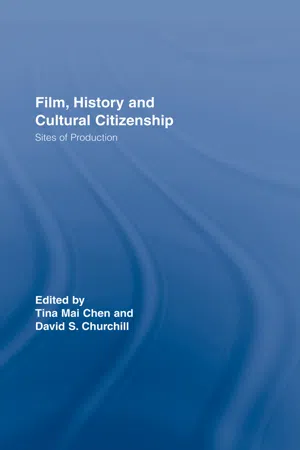
This new book investigates the relationship of film to history, power, memory, and cultural citizenship. The book is concerned with two central issues: firstly, the participation of film and filmmakers in articulating and challenging projects of modernity; and, secondly, the role of film in shaping particular understandings of self and other to evoke collective notions of belonging. These issues call for interdisciplinary and multi-layered analyses that are ideally met through dialogue across place, time, identities and genres. The contributors to this volume enable this dialogue by considering the ways in which cultural expression and identity expressed through film serve to create notions of belonging, group identity, and entitlement within modern societies.
eBook - ePub
Film, History and Cultural Citizenship
Sites of Production
- 250 pages
- English
- ePUB (mobile friendly)
- Available on iOS & Android
eBook - ePub
About this book
Information
1
Introduction
In July 2003 The Washington Post ran an article outlining the work of a French-organized, internationally funded initiative to provide mobile cinemas to Afghanistan (Pitman 2003). Supported by the United Nations, the European Union, and other donors, the French group AINA oversaw the screening of films produced by the Ministry of Information and Culture on the topics of Afghan artists, cultural heritage, and girls’ education. The films were shown in Badakhashan, Kandahar, Jalalabad, Mazar-e-Sharif, Barniyan, Paktia, Herat, and the capital of Kabul. Western reporting such as that offered by Pitman drew upon dichotomous frameworks that positioned Afghans (represented by Afghan women and girls) as the victims of an oppressive Taliban that denied access to modernity, education, and film. This discourse of underdevelopment perhaps explains the international funding and the use of a UN spokeswoman for the news release; it also makes relevant the references to the lack of electricity and communication with the outside world in the “rugged Asian nation filled with remote mountain villages,” and justifies the reclaiming of Afghan culture and heritage through film. The language of orientalism and developmentalism through which the work of the NGO AINA was characterized brings into sharp relief the overlapping historical moments of colonialism and Cold War modernization through which the present, and film as a technology of the modern, acquire meaning.
AINA, an organization with programs “developed to support democracy in Afghanistan through the development of media and cultural expression,” works, in part, by training male and female camera operators and video journalists (http://www.com/filmcatalog/makers/fm658.shtml, accessed 26 June 2006). The ethos behind the program is seemingly informed by scholarly and political concerns with agency in representation. This is an ethos that pervades the work of NGOs and scholars who provide to communities cameras, video, and other media alongside technological knowledge in the hope of enabling marginalized and “othered” peoples to participate in the construction of their identities and social situations.
The films produced by AINA include Afghanistan Unveiled (2003), a film that premiered at a Washington fundraiser and then was screened at various international film festivals. Not surprisingly given the intended audience for the film, the promotional materials for Afghanistan Unveiled unselfconsciously present the mobility of AINA-trained filmmakers and film itself as delivering modernity and light after the darkness of the Taliban. Neither reviewers nor reporters pause to consider the politics of place and history so clearly expressed in the broad operation of film and modernity in this context. Rather, there is an easy comfort with the cosmopolitan subject position that the newly trained Afghan filmmakers are called upon to occupy alongside international activists, and for the entertainment/education of international viewers. But what if we were to think more carefully about the social and political operation of film in this case and the place of film as a site of production of history and cultural citizenship?
With this question in mind, Film, History, and Cultural Citizenship investigates the relationship of film to history, power, memory, and cultural citizenship. We are concerned with three central issues: one, the participation of film and filmmakers in articulating and challenging projects of modernity; two, the role of film in shaping particular understandings of self and other to evoke collective notions of belonging; and, three, the combination of film industry, text, and viewing practices in structuring modes of everyday political life and subjectivities. The contributors to the volume begin from the position that film is a powerful medium that transmits ideological narratives of nation, affiliation, everyday life, identity, and psychological experience. It is then the aim of the volume collectively to investigate the complexity of the historical dynamics that situate modern subjects in cultural frames formed by governments, corporations, the imaginations of filmmakers, and those that view films.
Beyond Filmic Facticity
There is a danger whenever historians approach film criticism that their analysis will focus on the absence of historical accuracy and nuance. Though such criticisms are important—particularly when considering the ideological operation of film and its ability to generate a popular understanding of the past, place and people—this collection seeks to engage film and history beyond the realm of fact. As such, the contributors to Sites of Production engage film scholarship and history across disciplines such as anthropology, sociology, literary studies, media and cultural studies, and history, as well as across film genres including documentary, independent shorts and features, Hollywood features, state-sponsored films, historical films, and popular-scientific productions. This collection’s critical approach embraces textual workings, archival renderings, and the public operation of film. Though diverse in approach, all contributors take seriously the social and historical contexts of film, as well as the more textual relationship between the film and its audiences. Indeed, the multiplicity of audiences, be they dramatically different groups of people in one or more national locales or transnational audiences engaging films on a global scale, is a key concern for many of the authors.
In this volume, the contextual social and historical field refers to the broader socio-political and economic structures in which film is produced, circulated, and viewed, the aesthetic conditions and conventions, as well as the epistemological structures. Because we understand film and those associated with film industries at all levels to be involved in knowledge production, we directly locate our studies of film and history not only within the texts of film and the practices of history, but also within the discourses of film and history. Rudy Koshar argues that, while having its uses, an approach to film that either sees it as secondary illustrative material or a document to be read as archival material is too narrow because of the ways in which it diverts our attention away from understanding film as a way of constructing pasts (Koshar 1995: 155). Koshar draws upon Hayden White’s notion of historiophoty, “the representation of history and our thought about it in visual images and filmic discourse” (White, cited in Koshar 1995: 57) to argue that “the ‘constructedness’ of film, its placement in a studio ‘reality’ far away from the historical reality to which it gestures, could be used by historians as a springboard for considering the strategies, advantages, and shortcomings not of the film but of previous historical narratives, filmic and written.”
This book takes up White and Koshar’s challenge to see film as historiography. In this manner, this book understands the past to be a contentious domain mediated by memory, politics, and the particularities of the archival record. What is at stake, in our minds, are the ways in which film and history produce each other in historically specific and contingent contexts as narrative texts. Yet, we agree with Rebecca Karl (2001) that we must avoid facile observations in the study of either film or history that simply conclude that changing times demand changing uses or interpretations. In the specific contexts of revolutionary and post-revolutionary China, Karl insists that we consider the competing filmic visions of the Opium War produced in China in 1959 and 1997 within “the time-space of a contemporary Chinese cinematic and historical imaginary, particularly by opening a discussion on the problem of ‘historical burdens’ or ‘burdens of history’ as a central topos of Chinese discourse on modern history” (231). This call to think through cinematic and historical visions in relation to specific formulations of history and historical problems as political and literary motifs of space-based modernities informs many of the chapters in this book. The problematic of burdens of history shapes the shared concern of the contributors with the ways in which films engage with historical moments in their narrative and visual texts within and against the available imaginaries of their moments of production and circulation.
As discussed by John Mowitt (this volume), we are concerned not only with film as historiography, then, but also with film as historicity. That is, to use Philip Rosen’s formulation, “the particular interrelations of the mode of historiography and the types of construction of history related to it” (Rosen 2001: xi). For us this is a productive site of tension because it leads us to consider cinema and historiography as social and cultural operations as well as technological and epistemological structures. Contra Rosen, however, we choose not to undertake this through readings of historicity in film theory or specific films but rather by historicizing the specific social and cultural operations of film and historiography across global space and time. Film, like history, is an epistemological form of knowledge production and is often in narrative structure and production linked to projects of national modernization. But if we confine this observation to the study of historical film (Landy 2000) or the New History film (Rosenstone 1995), we privilege analytic frameworks that address the questions of how we can understand history in the visual media, and how the visual media writes histories. Excellent scholarship from precisely this perspective exists. But because we are interested in understanding how film and historiography operate as technological and epistemological forms in relation to projects of national modernization—and challenges to them—this volume takes a different entry point into the relationship between film and history than those works with which it shares a similar theoretical positioning. Rather than focus on the structures of visuality through which film mobilizes and enacts particular historical narratives and moments, we are concerned with the intersecting sites of production of film and history.
By highlighting sites of production we call attention to the multiple registers through which film, representation, and meaning operate. Without creating hierarchies of production, we want to emphasize the embodied craft of film production. This includes the communities of directors, actors, writers, camera operators, sound technicians, editors, and the like who make films (Buddle, Kulchyski), as well as the particular places of production (Hayashi, Naghibi). In addition, the practices and locales of screening and the contexts in which films are viewed/consumed (Chen, Gómez-Barris) also represent sites of historical production that are part of modern social practice and collective experience (Jancovich et al. 2003: 16). Another site of production stressed in this collection is the political economy of film production and its relationship to corporate, national and international networks of funding and development (Churchill, Austin-Smith, Stewart, Hoad). Finally, the representational operation of film and its ideological and historical use by various actors represents a site of production in its ability to generate meaning and agency within a cultural field (Mowitt, Crowe, Dueck). What all the contributors point out is that in the production of meaning and connection, film across these various sites has served cumulatively as a site for the praxis of modernity, a place where meaning and connection are mediated, cultural publics are generated, and the theories and ideologies of the modern are played out and experienced.
As film scholar Miriam Hansen has argued, “whether we like it or not, the predominant vehicles of public memory are the media of technical re/production and mass consumption” (Hansen 1996: 310). Film in its public and collective nature is a particularly powerful medium of memory, of popular history, and historiography. Thus, film is also a classic product of modernity—a modernist form that is simultaneously a response and reaction, even a site of resistance, to the profoundly transforming, shattering, and dislocating effects of modern life. Critical scholarship of film in this register represents the historicization of what we are calling the “lived experience of modernity,” a method of scrutinizing modernity(ies)’s “plurality and complexity” as well as its multiple operations (Hansen 1995; Jameson 2002; Berman 1988: 91; Mitchell 2000; Das 2000). In addition, the focus on site, on the physical and social location of film, as well as the productive realm of ideology, representation, and affect is part of this project of historicization. Though strategies of close textual reading and analyses of form are employed, the ultimate concern of this collection is on the contextual social field and the actors who produce, consume, and utilize film.
Forefront in the lived experience of modernity and the contextual social fields of film is the place of memory, even though history—as a critical epistemological practice—is too often forgotten. Here distinctions need to be made between what is meant by memory as well as the reasons we feel that distinguishing it from history is of importance. Memory has both subjective and collective meanings. On an individual level, common usage of the term memory encompasses the personal recollection of experiences, recalling lived experience and even bearing witness. Yet, personal memories of individuals can be collected and archived to provide an assemblage of experiential memory and a set of documents with which to reconstruct the past. Such an approach has been central to grassroots historians, human rights investigators, and documentary filmmakers. As such, memories can become an evidentiary base for history through an interweaving of mediated experiences with collective identity. In the early decades of the twentieth century the French sociologist Maurice Halbwachs developed the notion of “collective memory” to understand the ways in which memory is historically situated and particular. “Every collective memory,” he wrote, “requires the support of a group delimited in space and time” (Halbwachs 1980: 48). Halbwachs’s formulation is useful in that it is a call to historicize memory and to position it within social and political contexts. In so doing, we are reminded that the interpretation of memory—the afterlife of an event—is imbricated with identity and social class (Ross 2002).
Halbwachs’s attention to the connection between collective memory and groups delimited in space and time, as well as Ross’s attention to the after-lives of event, directly informs the focus of this volume on sites of production of film, history, and cultural citizenship. This book joins recent scholarship that works to understand the spatial and temporal histories within which film and cinema circulate and acquire meaning. Such approaches include a focus on the legal histories of cinematic spaces and their relationship to the city (Liang 2005), geographies of filmic communities and their lived identities (Widdis 2003), and the representability of time in photographic and cinematic technologies (Doane 2002). Along with these studies, this book emphasizes the relationship between the people who live in the times and spaces crosscut by cinema and the lived experiences of modernity mediated by cinema. Our approaches to this relationship range from studies of personal historicity as related to a specific film (Austin-Smith), to specific filmmakers’ mobilization of international funding, audiences, and transnational textual imagery (Stewart, Churchill, Gómez-Barris), to collectivities enabled through film production and circulation (Buddle, Chen, Kulchyski). Moreover, the studies and their specific conclusions underscore our belief that once we begin to analyze spatial and temporal histories of cinema as experiences of modernity we are also drawn into the terrain of states, citizens, and lived identities. We have chosen to think about how issues of state, citizen, and lived identity intersect with film and history through the conceptual framework of cultural citizenship.
Cultural Citizenship’s Relationship to Film and History
Many of the essays in this volume explore the public culture of private emotion and affect. Often posited in geographically national or local spatial realms, the feelings of community, collective identity, cultural citizens, and subjects are nonetheless articulated through the technological production and viewing of films, and in relation to state formations. Within its shifting local, national, and transnational contexts film has served—and at times has been utilized instrumentally—to prevent what political theorist Chantal Mouffe has identified as liberalism’s tendency to “reduce citizenship to a mere legal status” (Mouffe 1992: 227). That is, film can provide a key investment in the cultural capital of citizen/subjects, be they remotely situated rural spectators or cosmopolitan viewers in a modern metropolis. This power of film, and its role as an epistemological technology of knowing and of providing simultaneously shared and profoundly intimate experiences of viewing, is part of what gives film historical significance.
For us, then, the concept of cultural citizenship invokes notions of political citizenship and rights, but highlights the cultural frameworks through which citizenship acquires meaning as lived experience. The state–citizen relation is therefore only one component; and as we demonstrate from a broad set of geographical and historical locations it is a relation oft refracted through media systems and cinematic sites. We ar...
Table of contents
- Cover
- Half Title
- Series Page
- Title
- Copyright
- Contents
- Acknowledgments
- 1 Introduction
- PART I Producing national and transnational imaginaries
- PART II Historical feeling in the sites of production
- PART III The culture of film and the production of history
- Contributors
- Index
Trusted by 375,005 students
Access to over 1.5 million titles for a fair monthly price.
Study more efficiently using our study tools.
Frequently asked questions
Yes, you can cancel anytime from the Subscription tab in your account settings on the Perlego website. Your subscription will stay active until the end of your current billing period. Learn how to cancel your subscription
No, books cannot be downloaded as external files, such as PDFs, for use outside of Perlego. However, you can download books within the Perlego app for offline reading on mobile or tablet. Learn how to download books offline
Perlego offers two plans: Essential and Complete
- Essential is ideal for learners and professionals who enjoy exploring a wide range of subjects. Access the Essential Library with 800,000+ trusted titles and best-sellers across business, personal growth, and the humanities. Includes unlimited reading time and Standard Read Aloud voice.
- Complete: Perfect for advanced learners and researchers needing full, unrestricted access. Unlock 1.5M+ books across hundreds of subjects, including academic and specialized titles. The Complete Plan also includes advanced features like Premium Read Aloud and Research Assistant.
We are an online textbook subscription service, where you can get access to an entire online library for less than the price of a single book per month. With over 1.5 million books across 990+ topics, we’ve got you covered! Learn about our mission
Look out for the read-aloud symbol on your next book to see if you can listen to it. The read-aloud tool reads text aloud for you, highlighting the text as it is being read. You can pause it, speed it up and slow it down. Learn more about Read Aloud
Yes! You can use the Perlego app on both iOS and Android devices to read anytime, anywhere — even offline. Perfect for commutes or when you’re on the go.
Please note we cannot support devices running on iOS 13 and Android 7 or earlier. Learn more about using the app
Please note we cannot support devices running on iOS 13 and Android 7 or earlier. Learn more about using the app
Yes, you can access Film, History and Cultural Citizenship by Tina Mai Chen,David S. Churchill in PDF and/or ePUB format, as well as other popular books in Art & Art Theory & Criticism. We have over 1.5 million books available in our catalogue for you to explore.