eBook - ePub
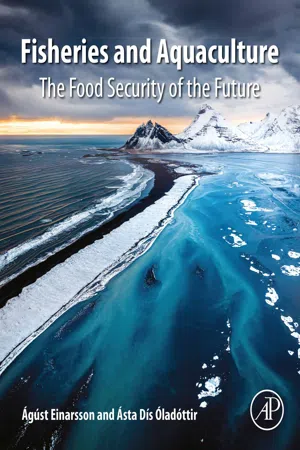
Fisheries and Aquaculture
The Food Security of the Future
- 374 pages
- English
- ePUB (mobile friendly)
- Available on iOS & Android
eBook - ePub
About this book
Fisheries and Aquaculture: The Food Security of the Future takes a multidisciplinary approach in evaluating the fisheries and aquaculture sectors from the scientific and practical perspectives of industry professionals. The authors recognize the importance of looking at the industry from a value chain viewpoint, not only for food security but also for a blue economy. The book takes a unique and innovative approach to show how fisheries and aquaculture can achieve sustainability and how small fishery communities can become highly successful fishery and aquaculture communities and contribute to overall industry globalization.
This is a practical and useful reference for a wide-ranging audience. It is for those who wish to make systematic efforts to develop their fisheries or aquaculture sectors, scientists and researchers, anyone in fisheries management or marine resource management, fish farmers, policy makers, leaders and regulators, operations researchers, as well as faculty and students.
- Presents potential solutions for more economical and sustainable fisheries development
- Provides an overview of the fishing industry's technology options, ranging from less-developed communities to modern high-tech communities
- Demonstrates market principles in the fisheries and aquaculture sectors, particularly demand for seafood in various parts of the world, its availability and the importance of ownership rights
Information
Chapter 1: Introduction
Abstract
This introductory chapter describes in broad terms the development of fisheries through the ages down to the present and lays the foundation for the analysis and clarification of some unique characteristics of fisheries and aquaculture as industries and as a human activity in general, beginning with a brief account of the development of fisheries as a commercial enterprise and covering other aspects, such as the aquatic biosphere. In the course of time, fish became an extraordinarily important commodity, not only as a staple of diet, but also because of the special role it had, and still has, in various religious and secular customs. Fishing and aquaculture are discussed from a historical perspective and a contemporary perspective, describing the importance of fisheries and aquaculture in our day in the light of continuing population growth, the growing need for food, and the increasing attendant environmental concerns.
Keywords
Exclusive economic zone; Fish farming; Food chain; Green Revolution; Marine taxonomy; Overfishing; Population; Religion; Sustainability; World catch
Fisheries have been a human activity since the dawn of the human race, whatever time we decide on as the ‘dawn’ of the human race. Homo sapiens, in more or less the current form of the species, appeared on the scene some 300,000 years ago, and we can safely assume that wherever humans lived near water, and wherever that water was the habitat of fish, humans will have devised a means of catching fish for food, notwithstanding the rather more problematic task of catching fish than other foraging by hunting and gathering. It can be argued that catching prey for food in an environment that is fundamentally hostile to most terrestrial animals, humans being no exception, required a degree of ingenuity and problem-solving skills that foraging for plants, and even hunting land animals, did not call for. Fishing and fish farming, as modern industries, continue to face some of the same challenges, but also other challenges that do not affect other industries.
1.1: The dawn of human communities and the origins of fisheries
Fish has historically been an important element of the human food supply. About 12,000 years ago a new trend is known to have begun, which has been known as the Agricultural Revolution, when humans began taking up fixed residence, cultivating the soil and domesticating animals. This trend originated in the basins of two great rivers, the Euphrates and Tigris in Mesopotamia, which is now known as Iraq, and by the river Nile in Egypt, sowing the seeds of great future empires and the beginning of the recorded history of humankind. A similar trend began in the basins of other great rivers in regions now known as China and India.
As in the case of other living beings, the strife of human life included seeking nutrition and shelter, adapting to adverse conditions, and propagating. But although this struggle was common to all animals, the human endeavour took a more diverse form, and in time Man became the ruler of the world, with the ability to communicate complex thought in language and pictures being a key factor.
In contemplating the development of industries, such as the fishing and fish farming industries, it is interesting to survey all the premises for their development and the time that it took to construct a workable system of trading. Written text is a sine qua non for all but the simplest commercial transactions, and in fact for all human communication of information of any complexity.a Long before the time of the written language, everything that was thought to be worth remembering, or necessary to remember, was preserved in an oral tradition, including laws and lore.
However, writing did not begin with written language as we now know it. Clay tablets were first used to inscribe symbols, as it is an easy matter to etch symbols into soft clay and then allow the clay to harden. The principal purpose of these tablets was to keep count of things when numbers and figures needed to be known and remembered, for instance the quantity of fish sent from one village to another, and, no less importantly, to keep records of debts and balances. This innovation can be traced back to about 3500 BCE (Fig. 1.1).b

Throughout this time, of course, hunting, slaughtering, and processing marine animals for food continued, and it continued everywhere, on the shores of rivers, ponds, lakes, and the sea. We can assume that hooks and lines were early inventions, perhaps following rudimentary spears, and skills at setting traps for fish eventually evolved. Small boats of various kinds allowed fishermen to escape the confines of the shore and seek deeper and richer fishing grounds, and in time larger vessels enabled navigating streams, large lakes, and the seas, first along coasts and later into the vast oceans to discover new fishing grounds and, incidentally, new and unknown lands.
1.2: The role of fish and the sea in religion and lore
The ocean features prominently in ancient religion and lore. In Norse religion, the god Ægir reigned over the sea. The Greek god of the sea, Poseidon, was the brother of Zeus, king of the gods of Olympus. As in the case of Ægir in Norse mythology, Poseidon is depicted as a powerful personage, to be offended at one’s own peril, as Odysseus, or Ulysses, learned to his cost. Neptune of the Romans was their god of the sea and shared most attributes with Poseidon.
As a result of the long-standing relationship between fish and humans, fish have been depicted in all the various art forms—music, paintings, sculptures, lyrics, and narratives—over the centuries. Fish have also been used as a symbol, the most prominent in Western culture probably being the use of the outlines of a fish to indicate sanctuaries for Christians in the time of the Roman Empire, when Christians were being mercilessly persecuted. Jesus Christ, of course, had close links to fishermen, from whose ranks he recruited many of his followers on the Sea of Galilee, and for centuries the Pope’s signet ring was the Fisherman’s Ring, or Annulus piscatoris, which was used as a seal for official papal documents. The reference is to Simon Peter, one of the fishermen on the Sea of Galilee, who became the first bishop of Rome, which later became the office of the Pope (Fig. 1.2).

In most of the religions of the world, fish is seen as a food of choice. Judaism and Islam have strict rules on diet, particularly as regards mammals, what can be eaten and how animals should be slaughtered and prepared.c Not so with fish, neither in those religions nor in Christianity, although there are various caveats regarding the consumption of crustaceans, no doubt rooted in fears of food poisoning. Judaism, however, forbids the consumption of fish without scales, such as sharks and rays, and also whales, which before the invention of taxonomy were generally lumped with fish.
Fish also has a positive image in Buddhism, where it symbolises happiness, among other things. Buddhism imposes various restrictions on the consumption of meat, but none on the consumption of fish, while the Hindu religion has restrictions on both. Many of these old customs linked to fish are outdated in modern society and no longer strictly observed, but their remnants can be widely observed. Religion and custom therefore remain relevant to fisheries and the consumption of fish products in our time. In Catholicism, for instance, there is a tradition of serving fish on Fridays, a remnant from earlier times, when eating flesh other than fish on that day was strictly forbidden. Fish is also traditional fare in the week of Lent among Catholics. As a matter of fact, fasting is not an uncommon religious custom, as in the case of the fasting month of Ramadan in Islam, and the Jewish fast during Yom Kippur, although these fasts have no particular relevance to fish or fish products.
In all countries there are myths, legends, fanciful tales, and seamen’s yarns relating in one way or another to the sea, rivers, and lakes, which, with their aura of profound mystery, have provided both substance and a setting for innumerable stories expressed in narratives or lyrics, ranging from the sirens of the Odyssey and the story of the Lorelei in the river Rhine to the Little Mermaid in Hans Christian Andersen’s fairy tale, and the modern-day giant dinosaur Godzilla, created by the Japanese Ishirō Honda in the mid-20th century and subsequently the subject of countless movies, comics, and computer games. This literary tradition has continued to our day, and the sea will no doubt provide material for fiction and fantasy for as long as the oceans remain the areas of the Earth that we know the least about.
1.3: The oceans and marine taxonomy
The animal kingdom is divided into two main categories: vertebrates and invertebrates.d Detailed taxonomy lies beyond the scope of this book, but in brief terms vertebrates are animals that have vertebra (a spine or an internal skeleton) while invertebrates are either made up entirely of soft tissue or have a stiff supporting structure (exoskeleton) on the outside of their bodies. Vertebrates include the familiar fish, amphibians, reptiles, birds, and mammals, all normal household words, while invertebrates include the somewhat less familiar arthropods (shrimps, lobsters, crabs, etc.), molluscs (oysters, clams, octopuses, etc.), Parazoa (sponges) and echinoderms (sea stars, sea urchins, sea cucumbers, etc.). The fauna is extremely diverse, and although not all its members have commercial value, all of them have a ro...
Table of contents
- Cover image
- Title page
- Table of Contents
- Copyright
- Dedication
- List of figures and tables
- Foreword
- Preface
- Chapter 1: Introduction
- Chapter 2: Fishing and fish farming
- Chapter 3: Market forces and tools to analyse fisheries and aquaculture
- Chapter 4: Environmental issues
- Chapter 5: Fisheries management
- Chapter 6: China, the leading fishing and fish farming country of the world
- Chapter 7: Developing countries
- Chapter 8: Processing and related industries
- Chapter 9: Sales and marketing
- Chapter 10: Finances
- Chapter 11: Globalisation
- Chapter 12: Management
- Chapter 13: Legal framework, research, and some peripheral issues
- Chapter 14: Summary
- Index of names
- Index of terms
- References
Trusted by 375,005 students
Access to over 1.5 million titles for a fair monthly price.
Study more efficiently using our study tools.
Frequently asked questions
Yes, you can cancel anytime from the Subscription tab in your account settings on the Perlego website. Your subscription will stay active until the end of your current billing period. Learn how to cancel your subscription
No, books cannot be downloaded as external files, such as PDFs, for use outside of Perlego. However, you can download books within the Perlego app for offline reading on mobile or tablet. Learn how to download books offline
Perlego offers two plans: Essential and Complete
- Essential is ideal for learners and professionals who enjoy exploring a wide range of subjects. Access the Essential Library with 800,000+ trusted titles and best-sellers across business, personal growth, and the humanities. Includes unlimited reading time and Standard Read Aloud voice.
- Complete: Perfect for advanced learners and researchers needing full, unrestricted access. Unlock 1.5M+ books across hundreds of subjects, including academic and specialized titles. The Complete Plan also includes advanced features like Premium Read Aloud and Research Assistant.
We are an online textbook subscription service, where you can get access to an entire online library for less than the price of a single book per month. With over 1.5 million books across 990+ topics, we’ve got you covered! Learn about our mission
Look out for the read-aloud symbol on your next book to see if you can listen to it. The read-aloud tool reads text aloud for you, highlighting the text as it is being read. You can pause it, speed it up and slow it down. Learn more about Read Aloud
Yes! You can use the Perlego app on both iOS and Android devices to read anytime, anywhere — even offline. Perfect for commutes or when you’re on the go.
Please note we cannot support devices running on iOS 13 and Android 7 or earlier. Learn more about using the app
Please note we cannot support devices running on iOS 13 and Android 7 or earlier. Learn more about using the app
Yes, you can access Fisheries and Aquaculture by Ágúst Einarsson,Ásta Dís Óladóttir in PDF and/or ePUB format, as well as other popular books in Technology & Engineering & Food Science. We have over 1.5 million books available in our catalogue for you to explore.