"His paintings register the upheavals big and small that all cities and cultures are both enduring and sliding toward, unable to halt the passage of time and history."John YauIncludes texts by: John Yau; Francesca Pietropaolo; Raúl Zamudio Taylor; Richard Vine; Dan Cameron; Donald Kuspit; Christian Viveros-Fauné; Florencia San Martín
eBook - ePub
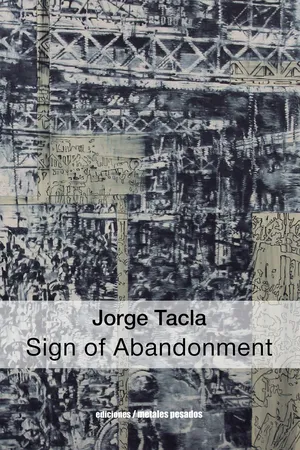
Jorge Tacla: Sign of Abandonment
- 168 pages
- English
- ePUB (mobile friendly)
- Available on iOS & Android
eBook - ePub
Jorge Tacla: Sign of Abandonment
About this book
Information
Topic
ArtSubtopic
Art Theory & CriticismAcknowledgments
I want to express my deep appreciation to:
Donald Kuspit, Christian Viveros-Fauné, Francesca Pietropaolo, Richard Vine, Florencia San Martín, Dan Cameron, John Yau, Raúl Zamudio Taylor, Paula Barría Chateau, Sergio Parra Riquelme, Cristin Tierney, Candace Moeller, María Suárez Ruiz, Alejandra Norambuena, Virginia Gutiérrez, Constanza Alarcón Tennen, Paz Ortúzar, Claudia Bitrán, Ian Cofré, Cristin Tierney Gallery, Metales Pesados.
1 Published in the catalogue for the exhibition Información Restringida (Santiago, Chile: AMS Marlborough Gallery, 1999).
2 Published in the catalogue for the exhibition Shanty Town (New York: Ramis Barquet Gallery, 1998).
3 Published in the catalogue for the exhibition Papel (Santiago, Chile: Animal Gallery, 2010).
4 Roberto Bolaño, “Para Edna Lieberman,” in La Universidad Desconocida (Barcelona: Editorial Anagrama, 2007), 93.
5 In conversation with the author, February 2010.
6 Published in the book Jorge Tacla/Paintings (Santiago, Chile: Celfin Capital/Centro Cultural Estación Mapocho, 2008).
7 Yi-Lan Yeh, Dancing Brush: An Exploration of Taoist Aesthetics (Sydney: University of New South Wales, 2008).
8 Published in the catalogue for the exhibition Self Feeder (Monterrey, Mexico: Ramis Barquet Gallery, 1996).
9 Published in the catalogue for the exhibition Escombros (Santiago, Chile: Animal Gallery, 2010).
10 Published in the catalogue for the exhibition Notes and References (Buenos Aires, Argentina: Der Brücke Gallery, 1993).
11 Published in the book Jorge Tacla/ Internal Biology (Monterrey, Mexico: Ramis Barquet Gallery, 1994).
12 Published in the catalogue for the exhibition Hemispheric Problem. Time and Space in Negative (New York: Nora Haime Gallery, 1991).
13 Published in the catalogue for the exhibition Live Organisms (Caracas, Venezuela: Corp Group Foundation Cultural Center, 1998).
14 Hanna Segal, Dream, Phantasy and Art (London and New York: Tavistock/Routledge, 1991), 54.
15 León Grinberg, Guilt and depression (London and New York: Karnac Books, 1992), 39.
16 Published in the catalogue for the exhibition Hidden Identities (Santiago, Chile: Museo de la Memoria y los Derechos Humanos, 2014).
17 This essay has been written specifically for this book. Translation by María Suárez Ruiz.
18 Cristóbal Joannon, “Sonrisa de Gato,” El Metropolitano (April 2, 2000).
19 Marcelo Rioseco, “La Poética Matemática de Juan Luis Martínez,” Revista Iberoamericana 76, no. 232-233 (July-December 2010): 861. Translation by the author.
20 Enrique Lihn and Pedro Lastra, Señales de Ruta de Juan Luis Martínez (Santiago: Ediciones Archivo, 1987), 7-8. Translation by the author.
21 As Susan Sidlauskas notes in her book Body, Place, and Self in Nineteenth Century Painting (2000), this Degas painting, which was kept hidden by the artist for 35 years and only revealed in 1905, was until recently referred to as The Rape. According to Sidlauskas this title is purely sensationalist, and for decades has served the purpose of the generically functional tale, accepted by the patriarchal Art History hierarchy, of the female servant being raped by her wealthy employer. However, this mysterious indoor scene is not simply a narrative, as Sidlauskas demonstrates, but it offers unconventional and contradictory intersections into subjectivities and interior spaces within the visual culture of Paris during the third quarter of the nineteenth century.
22 Amid the public attending these exhibitions, it’s common to find a diverse crowd from various fields such as the human rights sector, the art world, and the institutional world, as well academia and students. I’m thankful to Cristin Tierney for making me aware of this.
23 La Flaca Alejandra, directed by Carmen Castillo (Chile, France, United Kingdom: 1994).
24 Ibid.
25 Primo Levi, The Drowned and The Saved (Barcelona: Muchnik Editores, 1988), 172.
26 Levi is referring to the Sonderkommandos, the group of deportees that the SS tasked with the gas chambers, and the crematoriums, as well as identifying valuable objects on the bodies. For Levi, the “Special Squadron” meant the most de...
Table of contents
- Cover
- Credits
- Title Page
- Contents
- Ten Things I Want to Say About Jorge Tacla’s Paintings
- The Sprawl: Recent Paintings by Jorge Tacla
- Les intermittences du coeur. Drawing as Memory
- Jorge Tacla: The Third Space of Painting
- Thought in the Wilderness
- Art Among the Ruins
- Drawings
- Jorge Tacla: Notes and References
- Internal Biology
- Memory and Paint: Jorge Tacla’s Meta-Images
- The Poetry of Death Instinct in Jorge Tacla’s Paintings
- Tacla, the Destroyer
- Before, During, and After the Ruins: Jorge Tacla’s Hidden Identities
- Author Biographies
- Jorge Tacla Biography
- Acknowledgments
Trusted by 375,005 students
Access to over 1.5 million titles for a fair monthly price.
Study more efficiently using our study tools.
Frequently asked questions
Yes, you can cancel anytime from the Subscription tab in your account settings on the Perlego website. Your subscription will stay active until the end of your current billing period. Learn how to cancel your subscription
No, books cannot be downloaded as external files, such as PDFs, for use outside of Perlego. However, you can download books within the Perlego app for offline reading on mobile or tablet. Learn how to download books offline
Perlego offers two plans: Essential and Complete
- Essential is ideal for learners and professionals who enjoy exploring a wide range of subjects. Access the Essential Library with 800,000+ trusted titles and best-sellers across business, personal growth, and the humanities. Includes unlimited reading time and Standard Read Aloud voice.
- Complete: Perfect for advanced learners and researchers needing full, unrestricted access. Unlock 1.5M+ books across hundreds of subjects, including academic and specialized titles. The Complete Plan also includes advanced features like Premium Read Aloud and Research Assistant.
We are an online textbook subscription service, where you can get access to an entire online library for less than the price of a single book per month. With over 1.5 million books across 990+ topics, we’ve got you covered! Learn about our mission
Look out for the read-aloud symbol on your next book to see if you can listen to it. The read-aloud tool reads text aloud for you, highlighting the text as it is being read. You can pause it, speed it up and slow it down. Learn more about Read Aloud
Yes! You can use the Perlego app on both iOS and Android devices to read anytime, anywhere — even offline. Perfect for commutes or when you’re on the go.
Please note we cannot support devices running on iOS 13 and Android 7 or earlier. Learn more about using the app
Please note we cannot support devices running on iOS 13 and Android 7 or earlier. Learn more about using the app
Yes, you can access Jorge Tacla: Sign of Abandonment by Candace Moeller,Paula Barría, Candace Moeller, Paula Barría in PDF and/or ePUB format, as well as other popular books in Art & Art Theory & Criticism. We have over 1.5 million books available in our catalogue for you to explore.