Stop Competing on Price is a differentiation manual to sell with dignity at fair prices. To extract the value your business generates. Many companies don't differentiate; and even if they do, fail at communicating it effectively. When a client doesn't perceive a difference, will decide based on price. In this book you will learn how to design and communicate your difference to stop competing on price. This is a book about differentiation. On how to transform an average business into a remarkable one. The problem is not to have a higher price, but not helping the client understand why. Don't be afraid of your competitors' price, but not being able to explain yours.
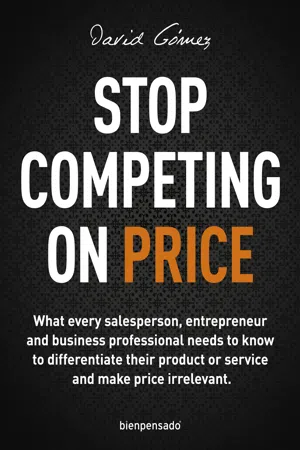
eBook - ePub
Stop Competing on Price
What every salesperson, entrepreneur and business professional needs to know to differentiate their product or service and make price irrelevant.
- 214 pages
- English
- ePUB (mobile friendly)
- Available on iOS & Android
eBook - ePub
Stop Competing on Price
What every salesperson, entrepreneur and business professional needs to know to differentiate their product or service and make price irrelevant.
About this book
Information
Chapter 1
Selling cheap is an option; if you live to tell the tale
Businesses can’t set higher prices for just any reason. Selling at higher prices means creating value for customers and being able to charge for it. Creating sustainable value has a price, so the vast majority of companies need to leverage that price.
Continuously training salespeople to better advise clients costs money. Using high-quality raw materials to improve product performance costs money. Having spacious stores that are comfortable and conveniently located costs money. Offering training to customers costs money. Maintaining a positive work environment in which employees can provide friendlier service costs money. Implementing technologies that make processes simpler costs money. Developing more functional, environmentally-friendly packaging costs money. Delivering faster costs money. Responding responsibly to guarantees costs money.
All of these elements are aspects of your value proposition, and if you were to simply sell cheap, it would be very difficult to provide these benefits to your clients in a sustainable way. If you choose to offer memorable experiences and delight customers, then you need money to do so consistently. Of course, not every customer will be willing to pay for these benefits, and that’s okay. Those customers aren’t your target market.
Being costly is different than being valuable. Something is expensive when customers perceive that it costs more than the perceived benefits they’re getting from it. On the contrary, something is valuable when although it has a high price, it equals or exceeds customer expectations. Although we refer to high-priced products as "expensive," they aren’t all actually "expensive" or costly – some are valuable. It depends on what we get in return. Think about toll fees. They’re not all the same. Some are more "expensive" than others. However, when this increased value is reflected in the quality of road infrastructure (well-maintained roads, proper lighting, multiple lanes, highway security, and signage, among other features), there’s a perception of value.
Selling cheap is, of course, an option. In fact, that’s what many companies end up doing as their only alternative to confronting competitors that focus on price. The problem isn’t selling at lower prices, the problem is that unless you have a strict control of costs, synergies, and efficiencies, lower prices may lead to ruin. In addition, selling cheap leaves little room to maneuver, so you will have to limit the benefits offered. And, as a result, you will end up being very similar to anyone else and might be easily replaced.
I’m not against selling cheap. In fact, in many industries that is the goal: reduce costs to lower the price and allow more people access to certain products or services. The challenge is to lower prices as a result of cost reduction without affecting profitability. Netflix, for example, has started generating its own content, arguing that it significantly reduces the cost per hour to produce its own House of Cards than it does to license all of its programming1. This also further allows the company to offer unique and differentiated material.
Uber has UberPool, a service in which several people going in the same direction share a ride, allowing them to pay far less than they would for an exclusive ride and reducing congestion at the same time. In these cases, lowering the price is the goal.
Telecommunication companies reduce their prices so more people have access to broadband internet services just as airlines lower ticket prices so more people can travel. The decline in prices isn’t just a result of the law of supply and demand, where more competitors offering interchangeable services increase the pressure on prices. Lower prices may also represent a market expansion. When these industries lower their prices, they also expand the overall number of people who can afford to access that market.
Low prices are a form of competition. They’re very demanding and dangerous, but they’re definitely an attractive alternative for certain types of customers. Just look around at any business sector and examine the main selling argument: price. However, given that the vast majority of companies can’t afford to have the lowest prices (because they don’t have the cost controls required to provide a robust value proposition and still be profitable), the alternative is to differentiate in order to compete efficiently. Differentiation allows many organizations to offer significant value propositions to their customers because they have the resources to support and maintain them. It’s difficult to survive being more expensive if you have no relevant argument to justify it.
Very few businesses can compete on price
Anyone can sell cheap. The challenge is selling cheap and being profitable. Nothing destroys the value of a company more than offering low prices without the support of efficient structures, economies of scale, or the conditions that allow for low prices while still making money. IKEA, the Swedish furniture, household items, and decor manufacturing company can offer lower prices because it has economies of scale, saves on transport by packing its easily-assembled products flat (additional products in the same space), and has strict inventory controls, among many other ways of optimizing its entire value chain.
Lowering prices doesn’t mean reducing the profit margin. Lowering prices doesn’t mean earning less per sale, hoping that you can make it up on volume. Every time the price decreases at the expense of profitability, it’s limiting your room to maneuver. You become more vulnerable. With margins that are too narrow, an abrupt change in the exchange rate, an increase in the cost of raw materials, or a slowdown in demand can quickly cause problems.
Even if you have achieved economies of scale and have finely tuned cost controls, it’s a constant game of balancing profitability with the necessity of making investments in order to improve the customer experience, product quality, and service levels. Remember: Not all customers want to buy cheap. There are people who want better solutions and are willing to pay for them. Do not presume that the price is the only variable in play and that it’s the only one that will guide customers in their decision-making. This presumption will lead you to be just another option among many, offering an average product to average customers at an average price. There will be no money for more, no way to afford better services or any kind of differentiation.
Even in markets with low purchasing power where you might think the price is the most critical variable, consumers aren’t willing to buy just for the sake of being cheap. This is the case with the Tata India car brand’s hyped Tata Nano. Proclaimed the world's cheapest car, it hasn’t achieved the level of success that was expected, despite its low price. Perceived as a little more than a motorcycle but less than a car, this 600cc vehicle lacks some elements the consumer is unwilling to negotiate, despite its affordable price of $2,400.
According to a report published by Motor magazine, in the Tata Nano’s nearly first four years of life, it only sold a total of 229,000 units, compared with an annual production that was estimated at 250,0002. That’s a fairly small figure if we consider the more than 1.2 billion inhabitants in India and its average per capita income of $1,600. In a novel effort to recoup sales, the company launched its GenX Nano, seeking to be more attractive to people who have different expectations that include automatic transmission, Bluetooth connectivity, and improved stability for added safety. Of course, all of this has a cost. The price of the GenX Nano began at $3,000, 25 percent more than the initial price. Providing a better product has a cost. Low price plus high quality is an unlikely equation.
However, this doesn’t mean you can’t eliminate some elements in order to develop a less expensive product. The point is to eliminate things that aren’t critical for customers. Unlike the case of the Nano, Ford's strategy with the introduction of the EcoSport in the early 2000s was brilliant. In his book Los Secretos de los Precios (The Secrets of Prices), my friend Ariel Baños, director of fijaciondeprecios.com in Argentina, gives a detailed account of how this brand, understanding market trends, customer desires, and user habits, developed a winning vehicle by lowering costs without sacrificing the elements that were important for customers. Baños explained that while there was an important market for people who liked all-terrain vehicles, few could afford the price, leading them to finally settle on a sedan.
"The market research that they conducted revealed some truly amazing information about the habits and needs of buyers of all terrain vehicles. It indicated that 66% of users used the all-wheel drive very sporadically, while 14% were not interested in ever going beyond asphalt. That is to say that 80% of users in reality were not using the all-wheel drive on vehicles of this type,” says Baños3.
The market research showed that what customers valued most was the off-road aspect, meaning the robust body structure, bumpers, and wheels, among other features while things like all-wheel drive, engine power, or internal finishes were not as prized, even though these were the reasons people were paying a higher price. Following this discovery, Ford developed its Amazon project, launching the Brazil-manufactured EcoSport in 2003 for several countries in Latin America.
"It was a vehicle with all the appearance of an aggressive all terrain, but the initial model had the performance, platform, and ultimately the price of an average street car. This initial model generated a major revolution in the market. It came equipped with simple traction, the same as almost any street car, and its platform, surprisingly, was the same as the small, urban Ford Fiesta. This was because the Amazon project envisaged a single basic platform for an entire family of vehicles, which allowed a significant reduction in production costs. Ford's approach was so successful that the EcoSport model quickly climbed to the top spot in sales in all countries where it was marketed. Thousands of buyers who never imagined owning an all terrain were able to afford the Ford EcoSport thanks to its competitive retail price, which was almost 25 percent less than the cheapest all terrain on the market at that time," Baños explains.
Your company already has a business model it is using to compete. It has designed its value proposition to meet the specific needs of customers who are willing to pay for them. As we will see throughout this book, companies try to focus on those for whom their business model has been designed and present their value...
Table of contents
- Introduction
- Chapter 1
- Chapter 2
- Chapter 3
- Chapter 4
- Chapter 5
- Chapter 6
- Chapter 7
- Chapter 8
- How to communicate your difference
- Chapter 9
- Chapter 10
- 10 Unbreakable Laws to Stop Competing on Price
- Acknowledgements
- Anmerkungen
Trusted by 375,005 students
Access to over 1.5 million titles for a fair monthly price.
Study more efficiently using our study tools.
Frequently asked questions
Yes, you can cancel anytime from the Subscription tab in your account settings on the Perlego website. Your subscription will stay active until the end of your current billing period. Learn how to cancel your subscription
No, books cannot be downloaded as external files, such as PDFs, for use outside of Perlego. However, you can download books within the Perlego app for offline reading on mobile or tablet. Learn how to download books offline
Perlego offers two plans: Essential and Complete
- Essential is ideal for learners and professionals who enjoy exploring a wide range of subjects. Access the Essential Library with 800,000+ trusted titles and best-sellers across business, personal growth, and the humanities. Includes unlimited reading time and Standard Read Aloud voice.
- Complete: Perfect for advanced learners and researchers needing full, unrestricted access. Unlock 1.5M+ books across hundreds of subjects, including academic and specialized titles. The Complete Plan also includes advanced features like Premium Read Aloud and Research Assistant.
We are an online textbook subscription service, where you can get access to an entire online library for less than the price of a single book per month. With over 1.5 million books across 990+ topics, we’ve got you covered! Learn about our mission
Look out for the read-aloud symbol on your next book to see if you can listen to it. The read-aloud tool reads text aloud for you, highlighting the text as it is being read. You can pause it, speed it up and slow it down. Learn more about Read Aloud
Yes! You can use the Perlego app on both iOS and Android devices to read anytime, anywhere — even offline. Perfect for commutes or when you’re on the go.
Please note we cannot support devices running on iOS 13 and Android 7 or earlier. Learn more about using the app
Please note we cannot support devices running on iOS 13 and Android 7 or earlier. Learn more about using the app
Yes, you can access Stop Competing on Price by David Gómez, Paul Jaramillo Birmaher, Sandra Beckwith, Paul Jaramillo Birmaher,Sandra Beckwith in PDF and/or ePUB format, as well as other popular books in Business & Sales. We have over 1.5 million books available in our catalogue for you to explore.