The autobiography of Dame Beryl Grey, now in paperback.
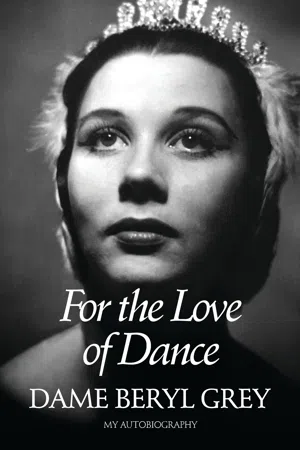
Dame Beryl's life is defined by her love of dance. Both as a ballerina and an Artistic Director she helped make British ballet the powerhouse it is today. Knowing and working with virtually everyone in ballet, she reveals fascinating insights into the people, characters and institutions that made up world dance in the 20th century.
Grey began her dancing career with the Sadler's Wells Ballet in 1943 at the unprecedented early age of 14. Her natural virtuosity saw her quickly promoted, dancing her first Giselle at 17, and Princess Aurora at 19. Dame Beryl was the first English ballerina to dance at the Bolshoi and the Kirov, as well as the Peking Ballet.
Asked to become Artistic Director of what is now English National Ballet, her love of dance allowed her to navigate the tricky passage from ballerina to leader of a dance company. Over ten years she transformed that Company with new dancers, new ballets, a new home and new audiences. Based on her letters and diaries, For the Love of Dance is an extraordinary tale of an extraordinary woman and a life given to her first love - dance.
- 510 pages
- English
- ePUB (mobile friendly)
- Available on iOS & Android
eBook - ePub
For the Love of Dance
About this book
Information

Part One – As A Dancer
Prologue
In writing these memoirs I realise how much dance has encircled and enriched my life. I was an only child and my parents were determined not to spoil me, to encourage me to have faith in God, to listen, obey and respect authority and always to work hard – invaluable lessons for life, as well as for a career in the theatre.
My dancing took me across the world from the Royal Opera House, Covent Garden, to the Bolshoi Theatre in Moscow and to many other renowned theatres. I met numerous prominent people and worked with the greats of the ballet world. This book traces my progress from a young child, working under Ninette de Valois; touring with the Sadler’s Wells Ballet during the war, sometimes stepping in for Margot Fonteyn; appearing worldwide as a freelance ballerina; directing and touring internationally with London Festival Ballet (now English National Ballet).
I hope I reveal to the reader the excitement and transience of theatre life with all its ups and downs; the thrill of dancing for an audience; the tingling moments of anticipation on hearing the orchestra warm up before the curtain rises; alighting alone on stage, bathed in a sea of lights, the power of the music lifting me into another world.
Performing is a unique and divine experience which I will always see as a joy and privilege, communicating to an audience through the beauty of ballet and the love of dance.
1 How It All Started
My life has encompassed many dramatic situations, both on-stage and off, so I suppose it was appropriate that the circumstances of my birth on 11 June 1927 were full of danger for me and my mother. In the private London nursing home at the bottom of Highgate Hill the surgeon said to my father: ‘Mr Groom, I have to warn you that either your wife or your baby will die, they cannot both survive this confinement, even though I am planning to give Mrs Groom “Twilight Sleep”.’
But survive we both did, and my mother lived for a further twenty-five years to see me established as a leading ballerina at the Royal Opera House, Covent Garden. Her courage and love remain my inspiration to this day, together with my father’s faith and deep love for us both.
Neither of my parents had an easy start in life; my mother, Annie, was brought up by her uncle and step-mother in less than affluent circumstances, and my father, Arthur Groom, who everyone called Bob, the last of six children, had rickets as a child. Both knew poverty, and suffered as a result, yet both overcame those disadvantages through hard work and determination. They were childhood sweethearts, who attended the same school in Hackney, London, where they met and fell in love, and remained sweethearts throughout their lives.
The First World War separated them; my father was in the thick of the fighting and blinded for several weeks by mustard gas. Despite my mother’s longing to leave her unhappy home at the cessation of war, my father would not contemplate marriage until he could provide for her adequately and offer her a decent home. After two years of saving they were married in November 1920.
Due to my mother’s poor health they were advised to wait a few years before thinking of having a child, and what a harrowing time my arrival caused them. Yet whatever trials accosted them, they were always so loving and close throughout their marriage to the time my mother died in 1952. They would go everywhere together and were never seen apart. This devotion and loyalty was the background of my childhood, a living example of faith and true love.
December 1952 saw the worst pea-soup fog London ever experienced, causing many deaths, and it is as if in a haze I recall the events leading up to this, my first deeply personal loss. My mother’s operation was at 4.30pm on 19 December, and that very evening I was to dance in a Royal Gala at Covent Garden. It was the only Royal Gala I was ever given at Covent Garden, dancing the lead in a full-length ballet, Swan Lake. I was dancing my favourite role, Odette / Odile in a production newly designed by Leslie Hurry about which there was much interest and excitement.
Neither of my parents could be at the Opera House, as they would have been normally – my mother on the operating table, my father by her bedside until the hospital assured him that the operation had gone well.
After the Gala, with the nervous strain and excitement of the performance over, my father gave me encouraging news. But at daybreak the next day, happiness was soon swept away. I cannot describe the awfulness – I had always had a very powerful bond with my mother. She had been a constant reassuring presence, and had guided, encouraged and supervised all my early training. Then, suddenly, she was no longer there.
How blessed I had been by her love and sacrifices which I always took for granted. How fortunate I was now, to have Sven, a wonderfully compassionate husband, to support me, as well as my father, during those frantic days searching for a burial place near Coulsdon where our family enjoyed so many happy years together.
The one uplifting event at this sad time was the totally unexpected arrival of a telegram from the Queen Mother expressing her sympathy at my loss. It was like a magical star dropping from the heavens, and I will always treasure this comforting message from our gracious Queen Mother.
How terrible it was for my father when the light of his life was taken from him, and for the next thirty years he faced life alone, faithful to his Annie to the end. He died peacefully in Sussex, January 1973 and was laid to rest on a bright winter’s morning beside my mother in the cemetery on Epsom Downs.
2 Early Blossoms, The Beginnings
In writing this autobiography it becomes clear to me that so much that happened in my life just fell into place, as if an unknown power was looking after me, directing and controlling everything.
My parents held no ambition for me to become a dancer. As an only child I joined my two cousins in dancing classes once a week at Sherborne Preparatory School, which we three attended. The dance teacher, Madeleine Sharp, was unusually gifted and destined to become the foremost dance teacher of young children in this country. It was she who spotted my talent and gave me such a remarkably sound early training, watching my every move. Even today I meet those whose childhood and adult life has been enriched by her teaching.
Madeleine Sharp was a striking personality, always impeccably dressed, with gorgeous hats and matching gloves. Her strong features and radiant, confident smile brought out the best in her pupils, combining strictness with encouragement. After only a few months she asked my mother if I could undertake more frequent training, suggesting that I take part in her more advanced classes in Bromley. This is where I first met Gillian Lynne, now famous for her choreography, including the Lloyd Webber musicals, Cats and Phantom of the Opera. We struck up a lasting friendship, which we still hold dear today.
We both benefited from the all-round training we were given by Madeleine – ballet, Greek, national dances, musical comedy, tap, ballroom dancing, even mime, and I recall dancing with skipping ropes, too – an astonishing range. Madeleine had a gift for imaginative, simple dance arrangements for her young pupils for whom she designed all the costumes herself. Her annual shows at the Rudolf Steiner Theatre in London were of an exceptionally high standard, and I used to look forward to these occasions with great excitement. Our make-up was carefully plastered on us, the only aspect I strongly disliked.
My mother took my training very seriously and followed Madeleine’s instructions to the letter. Overseeing my exercises every morning before school and every afternoon on my return home, she always referred to the detailed notes she made. As well as running our home and tending the garden she was a very gifted needlewoman, making all our clothes. I cannot help but wonder at the preparation and care with which my mother supervised my practice routines at home and rehearsed me in my solos. She played the piano well and had a beautiful voice. I would listen to her and my father singing together, songs from operettas, so popular pre-war.
My father arranged a mirror behind a barre, which he installed in our lounge, and there I worked very hard every day of the week including Sundays. I didn’t mind all that training; in fact I was so much in love with dance that I wanted to be the best in my class and outshine everyone. It did not bother me that I missed many children’s parties and other children’s activities. ‘Miss Sharp’ took a keen interest in me, and I wanted her and my parents to be pleased.
My first ever public appearance, at the age of three, was with my father on New Year’s Eve in our local, large public house The Red Lion, in Coulsdon, the village we moved to from London. The upstairs ballroom was packed with revellers wearing paper hats amid a sea of multi-coloured balloons, and as a clock struck loud and long, I danced in the New Year while my father, disguised as the Old Year, limped sadly away from the scene, pushed out by the lithe New Year. I loved that experience, although I disliked being woken from sleep in a warm bed, to be dressed in a pretty but thin frock, with a little make-up applied to my face. My mother was very strict about my getting sufficient rest and sleep and for years insisted that I lie down before an event, something that I have done all through my life. How invaluable that little rest is, always.
Today, after eighty years or so, the spot where I made my public debut is almost unrecognisable. The nice old Red Lion has been pulled down to make way for a wide main road leading uphill past our church, transforming the formerly quiet Woodcote Grove Road into a main thoroughfare. At the northern approach more buildings have been demolished to accommodate a fast new highway uphill and away to the south from Coulsdon towards the M25. It is quite bewildering, as are so many other changes one encounters today.
Many changes are inevitable with the tremendous increase in road traffic, but some remain questionable. Although I am sad that the Red Lion pub in Coulsdon has vanished, I realise that it is also a question of fashion and finance. Pubs with baronial ballrooms on the first floor are almost non-existent. Guilds and merchants no longer dine in the ornate splendour of these banqueting rooms, only echoes of past Masonic meetings remain, drifting like cobwebs on the breeze. In the past in these grand halls many a young ballet dancer struggled to remain upright on a shiny, slippery floor with sliding chairs masquerading as barres. Now we have specially designed dance studios with nonslip, well sprung floors, barres, mirrors and all the accessories expected in today’s safety-conscious society. Dancing is no longer taught in a teacher’s own sitting room or in makeshift back rooms, as was often the case in the twenties and thirties when there was far less money about and far less interest in dance as a serious art.
When I reached six, Miss Sharp advised my parents to send me for elocution, piano and singing lessons, all of which I thoroughly enjoyed. I had little time or interest for play, but I resented having to practise on Sundays. That was the day I went to church with my father in the morning while my mother was cooking the Sunday roast. Lunch over, I was off to Sunday school in the early afternoon. Once back home, I loved to open my dolls house, unpack my farmyard animals, carefully arranging my tin hedges and trees. This was my regular special Sunday treat. As I grew older I was given a train set of which I was extremely proud, and I kept it neatly packed in a wooden box my father had made for me.
My teddy bear lived on my bed, sleeping with me each night. Yet even with him beside me I was frightened of the dark, and my parents always kept a light on outside my bedroom on the landing until I fell asleep. I had a few small dolls, including a lovely velvety black doll with large gold earrings, named Belinda. Another favourite was made of white porcelain and called Ethel; her eyes rolled whenever she was moved. She had a pristine white cotton dress edged with lace, a plain cotton petticoat plus pantaloons, and I enjoyed dressing and undressing her, for she possessed a little voice when she was tipped upside down!
On my sixth birthday my father’s senior manager, Mr Bond, and his wife gave me a large beautifully dressed doll. We were the same height: I was a small child until growing taller by fourteen. My parents thought I should give it away as I already had some dolls. I was broken-hearted and have never forgotten how fine and big the doll was and how much I longed to keep her. But my parents wanted me to realise that some children had no toys or dolls and that I must learn to give, even if it hurt, which it most certainly did!
Two years later, that same manager gave me an invaluable opportunity – to speak in public. He and his wife were very fond of my parents and invited all three of us to join his party to see the Crazy Gang at the London Palladium. It was my first grown-up evening out, and was followed by dinner at the Florence restaurant in Rupert Street, Soho. At the end of the meal Mr Bond asked me to get up and tell all those present at his birthday table, in my own words, that they were now permitted to smoke. I was so surprised and used to obeying my elders without question that I stood up and apparently pleased all those present. That experience remained with me, giving me confidence through many a nerve-racking occasion.
I know that many families thought dance a very dubious activity for a child. That was certainly true of my first headmistress at Sherborne Preparatory School, Miss Constance Horsey. Although permitting once-a-week dance classes as a way of achieving good deportment, she was horrified when my father informed her that I had been offered a scholarship to the Vic Wells Ballet School, which he thought I should accept. Miss Horsey saw a dance career as a stupid waste of an intelligent girl, wishing me instead to study at a grammar school before going on to university. Thank goodness the writer, Arnold Haskell, pronounced intelligence as a necessary element for a successful career in dance.
I was fortunate that my prep school training was sound, with a careful balance of all general subjects, together with painting, singing and sports. We had a marvellous art teacher who encouraged me to enter my watercolour of an iris flower in a competition for young people at the Royal Academy of Arts. I was nine when it was sent in, and I was one of the fortunate children whose paintings were hung there for a short time. The previous year I had became the proud possessor of a certificate of merit from the Royal Society for the Prevention of Cruelty to Animals for an essay on ‘Kindness to Animals’. I have always loved animals and dogs in particular.
My favourite dog was a beautiful black Scots terrier who I promptly christened Boo-Boo. She and I became firm friends. She used to watch me practise at home and join in; trying to catch my feet when I was learning to master ‘beats’ (jumping in the air and switching the front foot to the ba...
Table of contents
- Front Cover
- Half-Title Page
- Title Page
- Copyright Page
- Contents
- List of Illustrations
- Foreword – Clement Crisp OBE. R.
- Preface – Adam Darius
- Part One – As a Dancer
- Part Two – As Director
- Index
Trusted by 375,005 students
Access to over 1.5 million titles for a fair monthly price.
Study more efficiently using our study tools.
Frequently asked questions
Yes, you can cancel anytime from the Subscription tab in your account settings on the Perlego website. Your subscription will stay active until the end of your current billing period. Learn how to cancel your subscription
No, books cannot be downloaded as external files, such as PDFs, for use outside of Perlego. However, you can download books within the Perlego app for offline reading on mobile or tablet. Learn how to download books offline
Perlego offers two plans: Essential and Complete
- Essential is ideal for learners and professionals who enjoy exploring a wide range of subjects. Access the Essential Library with 800,000+ trusted titles and best-sellers across business, personal growth, and the humanities. Includes unlimited reading time and Standard Read Aloud voice.
- Complete: Perfect for advanced learners and researchers needing full, unrestricted access. Unlock 1.5M+ books across hundreds of subjects, including academic and specialized titles. The Complete Plan also includes advanced features like Premium Read Aloud and Research Assistant.
We are an online textbook subscription service, where you can get access to an entire online library for less than the price of a single book per month. With over 1.5 million books across 990+ topics, we’ve got you covered! Learn about our mission
Look out for the read-aloud symbol on your next book to see if you can listen to it. The read-aloud tool reads text aloud for you, highlighting the text as it is being read. You can pause it, speed it up and slow it down. Learn more about Read Aloud
Yes! You can use the Perlego app on both iOS and Android devices to read anytime, anywhere — even offline. Perfect for commutes or when you’re on the go.
Please note we cannot support devices running on iOS 13 and Android 7 or earlier. Learn more about using the app
Please note we cannot support devices running on iOS 13 and Android 7 or earlier. Learn more about using the app
Yes, you can access For the Love of Dance by Dame Beryl Grey in PDF and/or ePUB format, as well as other popular books in Media & Performing Arts & Dance. We have over 1.5 million books available in our catalogue for you to explore.