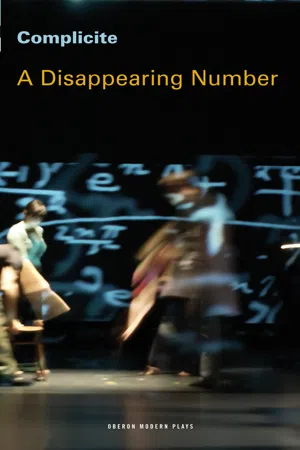
A Disappearing Number takes as its starting point the story of one of the most mysterious and romantic mathematical collaborations of all time. Simultaneously a narrative and an enquiry, the production crosses three continents and several histories, to weave a provocative theatrical pattern about our relentless compulsion to understand.
A man mourns the loss of his lover, a mathematician mourns her own fate. A businessman travels from Los Angeles to Chennai pursuing the future; a physicist in CERN looks for it too. The mathematician G.H. Hardy seeks to comprehend the ideas of the genius Srinivasa Ramanujan in the chilly English surroundings of Cambridge during the First World War. Ramanujan looks to create some of the most complex mathematical patterns of all time.
Threaded through this pattern of stories and ideas are questions. About mathematics and beauty; imagination and the nature of infinity; about what is continuous and what is permanent; how we are attached to the past and how we affect the future; how we create and how we love.
The book features an essay by Marcus du Sautoy, Professor of Mathematics at Wadham College, Oxford, and an introduction by Simon McBurney. The Complicité production was an astonishing success during its run at the Barbican, London in Spring 2007, winning The Evening Standard's Best New Play Award 2007. Called ' Mesmerizing' by the New York Times, 'A Disappearing Number' is a brilliant play, aided with original music composed by the award winning DJ, producer and writer Nitin Sawhney.
'A Disappearing Number' was revived at the Novello Theatre, London in autumn 2010.
- 88 pages
- English
- ePUB (mobile friendly)
- Available on iOS & Android
eBook - ePub
A Disappearing Number
About this book
Information
1
A university lecture hall, with a large whiteboard in the centre. To one side, a desk and an overhead projector; to the other side, a door and a portable lectern. On the wall close to the door is a telephone.
AL stands next to the desk with his back to the audience. RUTH enters. She writes “1, 2, 3, 4, 5’ on the whiteboard.
RUTH: (Nervous.) Good evening ladies and gentlemen. I’d like to go through one or two very basic mathematical ideas that are integral to this evening so that the recurrent mathematical themes become clear to you all.
Right, OK. (Beat.) Let’s consider these sets of numbers. (She writes them up as she speaks.) 2, 4, 6, 8, 10…2, 3, 5, 7, 11…1, 2, 4, 8, 16… These are known as sequences, and they have two characteristics. The terms can go on forever and they have a pattern, which helps you to continue the sequence. Some patterns are more obvious than others. With these numbers (Indicates the first sequence.) the pattern is very clear. But in this sequence, (Indicates the second sequence.) the primes, the pattern is less obvious. Is there a pattern at all? To find the hidden pattern you sometimes need to look at them in a new way. If we add together the terms of a sequence, we would have what is known in mathematics as a series. (She writes four “+’s between the numbers.)
So, 1+2+4+8+16 is a finite series with 5 terms, with the sum of 31. If we allow the series to continue forever, it would become an infinite series. And it is clear that the sum of: 1+2+4+8+16 and so on to infinity is itself infinite, making it a divergent series. That is to say it diverges from zero, that is to say the difference between the sum and zero widens infinitely.
(She writes the maths up as she speaks.) I can also express the above series as the sum of integral powers of 2. 2 to the power of 0 plus 2 to the power of 1 plus 2 squared plus 2 cubed plus 2 to the power of 4 plus… Or using the sigma notation of a sum we can write it another way: “the sum from r equals zero to infinity of 2 to the power of r.’
I would like to show you another divergent series, perhaps the simplest of all: 1+2+3+4+…and so on to infinity equals infinity. All of this is very logical. Now I’m going to do something very strange. I’m going to disrupt our sense of logic and I’m going to show you something really thrilling.
1+2+3+4+5+ and so on to infinity equals minus one twelfth. (Beat.) “How can this be?’ And you’d be right to think so! But let me show you how one can obtain this anomalous result using the Functional Equation of the Riemann Zeta Function. And this is how it goes…
RUTH begins to write out the Functional Equation of the Riemann Zeta Function (see Appendix). The maths gets quicker and more complicated.
2 to the power of 1 minus Z, times the gamma of Z, times the zeta of Z, times the cosine of a half pi Z, is equal to pi to the power of Z, times the zeta of 1 minus Z. This is only true for complex values of z. Where z equals x plus i y, where i is the square root of minus 1 – our imaginary number.
The gamma of z is a very well known definition. The gamma of z is equal to the integral from 0 to infinity of e to the minus t times t to the power of z minus 1 with respect to t. For complex z this is equal to z minus 1 factorial.
Enter ANINDA RAO. He watches RUTH.
The zeta of z equals the sum from n equals 1 to infinity of 1 over n to the power of z. I’m going to put the value 2 into this equation (For which, remember, it is not defined) and then I will show you what happens.
2 to the power of 1 minus 2, times the gamma of 2, times the zeta of 2, times the cosine of a half pi times 2. A half of 2 is 1 so we have the cosine of just pi is equal to pi squared, times the zeta of 1 minus 2…RUTH continues to lecture, oblivious, as ANINDA addresses the audience.
ANINDA: (In an Indian accent.) You’re probably wondering at this point if this is the entire show. I’m Aninda, this is Al and this is Ruth. (Pause. His accent changes.) Actually, that’s a lie. I’m an actor playing Aninda, he’s an actor playing Al and she’s an actress playing Ruth. But the mathematics is real. It’s terrifying, but it’s real.
When I was a child I had a real problem with mathematics. I remember I had a chart on the back of my door. It went, “1 – One Tractor’. “2 – Two Pineapples’. And, for a reason that nobody could explain, there were three medicine bottles. Then, four pears…and five oranges. Of course when they added one plus two equals three, I tried to understand how one tractor plus two pineapples could make three medicine bottles. (Beat.) They’d talk about five oranges, which was fine, but when they took away the oranges, that’s when the problems began. As I got older they replaced the numbers with letters – a, b, c…x, y, z. So just to walk into a maths class would bring me out in a cold sweat. That’s when I thought I had a problem with abstract thinking, but I had no problem with other imaginary ideas. In the school playground I would pretend to be the headmaster of my primary school, Mr Stoddart. I’d do this (He strikes a silly pose.) and the other children would laugh. Of course, I wasn’t really Mr Stoddart, I was PRETENDING to be Mr Stoddart. (Beat.) But I still had a problem with the idea that this (Indicates the maths.) is real. In fact we could say that this is the only real thing here.
(He approaches RUTH, who is still lecturing.) Just to prove to you that we are in the imaginary world of the theatre, I’ll take her glasses. (He lifts the glasses off her face, puts his fingers through the eye holes.) There’s no glass in there! Bloody useless! Even her voice can be changed…all I have to do is this. (He fiddles with an imaginary dial and RUTH’s voice becomes ridiculously high-pitched.) Now the maths is even more mystifying! Of course I’m not actually doing this, it’s the sound man up there. (He indicates the box atthe back of the auditorium.) Everything is fake BUT the mathematics. (He picks up a phone, attached to the wall.) This phone for example… “Hello mum?’… no mum, no ring tone! (He pushes the door open.) This door doesn’t lead anywhere! I can push these walls right off! (He pushes the wall which gracefully slides offstage. The other walls do likewise. A dark void is revealed behind. A MUSICIAN walks onstage and takes a seat with his tablas to one side.) This is Hiren Chate. He is real and he will really play the real tablas.
And now, I can do what I could never do at...
Table of contents
- Front Cover
- Half-title page
- Title Page
- Copyright
- Contents
- Introduction by Simon McBurney
- A most romantic collaboration by Marcus du Sautoy
- A note on the text
- A Disappearing Number
- Appendix
Trusted by 375,005 students
Access to over 1.5 million titles for a fair monthly price.
Study more efficiently using our study tools.
Frequently asked questions
Yes, you can cancel anytime from the Subscription tab in your account settings on the Perlego website. Your subscription will stay active until the end of your current billing period. Learn how to cancel your subscription
No, books cannot be downloaded as external files, such as PDFs, for use outside of Perlego. However, you can download books within the Perlego app for offline reading on mobile or tablet. Learn how to download books offline
Perlego offers two plans: Essential and Complete
- Essential is ideal for learners and professionals who enjoy exploring a wide range of subjects. Access the Essential Library with 800,000+ trusted titles and best-sellers across business, personal growth, and the humanities. Includes unlimited reading time and Standard Read Aloud voice.
- Complete: Perfect for advanced learners and researchers needing full, unrestricted access. Unlock 1.5M+ books across hundreds of subjects, including academic and specialized titles. The Complete Plan also includes advanced features like Premium Read Aloud and Research Assistant.
We are an online textbook subscription service, where you can get access to an entire online library for less than the price of a single book per month. With over 1.5 million books across 990+ topics, we’ve got you covered! Learn about our mission
Look out for the read-aloud symbol on your next book to see if you can listen to it. The read-aloud tool reads text aloud for you, highlighting the text as it is being read. You can pause it, speed it up and slow it down. Learn more about Read Aloud
Yes! You can use the Perlego app on both iOS and Android devices to read anytime, anywhere — even offline. Perfect for commutes or when you’re on the go.
Please note we cannot support devices running on iOS 13 and Android 7 or earlier. Learn more about using the app
Please note we cannot support devices running on iOS 13 and Android 7 or earlier. Learn more about using the app
Yes, you can access A Disappearing Number by Simon McBurney (Theatre Complicite) in PDF and/or ePUB format, as well as other popular books in Literature & British Drama. We have over 1.5 million books available in our catalogue for you to explore.