1
THE WASTE LAND
The Five Sisters, West Lothian, Scotland
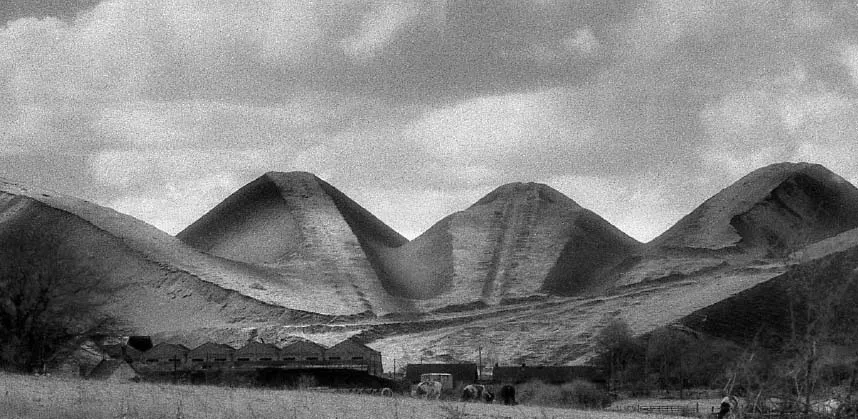
Fifteen miles south west of Edinburgh, a knuckled red fist rises from a soft green landscape: five peaks of rose-gold gravel stand bound together by grass and moss, like a Martian mountain range or earthworks on the grandest of scales. They are spoil heaps.
Each peak rises along a sharp ridge from the same point on the ground, fanning outwards, in geometric simplicity. Along these ridges, tracks once bore carriages aloft, carrying tons of steaming, shattered rock: discards from the early days of the modern oil industry.
For around six decades from the 1860s, Scotland was the world’s leading shale oil producer, thanks to an innovative new method of distillation which wrought liquid fuel from this rubble. These strange peaks stand in monument to those years, when 120 works belched and roared, wrestling 600,000 barrels of oil a year from the ground in what had been, shortly before, a sleepy, agricultural region. The process was costly and effortful, however. To extract the oil, the shale had to be shattered and superheated. And it produced huge quantities of waste: for every 10 barrels of oil, 6 tons of spent shale would be produced. In total, two hundred million tons of the stuff – and it had to go somewhere. Hence these enormous slag heaps. Twenty-seven of them in all, of which nineteen survive.
But to call them slag heaps is to understate their size, their stature, their constant presence in the landscape; unnatural both in form and scale. Locally, they are called ‘bings’ – from the Old Norse, bingr, a heap, a tip, a bin.
This particular formation, the five-pronged pyramid, is known as the Five Sisters. Each of the sisters slopes gradually to its highest point, then falls steeply away. They rise from a flat and otherwise rather unremarkable landscape – muddy fields, pylons, hay bales, cattle – to become the most significant landmarks of the region: some pyramidal or square; some organic and lumpen; others still rising raw-flanked and red to plateaus like Uluru.
Mere tips at first, they grew into heaps that shifted and reformed like dunes. Then hillocks. Then, finally, mountains made from small chips of stone – each the size of a fingernail or a coin, with the brittle texture of broken terracotta. These mountains grew and spread, as barrow after barrow was dumped upon the heap. They rose from the land like loaves, swallowing all they came into contact with: thatched cottages, farmyards, trees. Under the northernmost arm of the Five Sisters an entire Victorian country house – stone-built and grand, with wide bay windows and a central cupola – lies entombed beneath the shale.
Oil production continued on a massive scale here until the Middle East’s vast reserves of liquid oil came into ascendancy. In Scotland, the last shale mine closed in 1962, bringing to an end a local culture and way of life, leaving mining villages without the mines to employ them, and only the massive, brick-red bings as souvenirs. For a long time the bings were disliked: barren wastes that dominated the skyline, fit only to remind the region’s inhabitants of an industry gone bust and an environment pillaged. No one wants to be defined by their spoil heaps. But what to do about them? That wasn’t clear.
A few were levelled. A few later quarried afresh, as the red stone flakes – ‘blaes’ as they are technically known – found a second life as a construction material. For a time blaes turned up everywhere: fashioned into pinkish building blocks, used as motorway infill, and – for a time – surfacing every all-weather pitch in Scotland, including the one at my high school. Blaes stuck in grazed knees, collected in our gym shoes, left a tell-tale dust across the jumpers used as goal posts – and generally formed the brick-red backdrop to our communal coming of age. But mainly the bings lay abandoned and ignored. After a while, the villages in their shadows grew used to their silent presence. To enjoy them, even.
It’s easy to find the bings. You can see them from miles off. Just drive until you can’t get any closer, and hop the fence. There’s no fanfare. They are spoil heaps the size of cathedrals or hangars or office blocks, rising from the fields in artificial formations.
* * *
My aunt and uncle live in West Lothian, not far from the Five Sisters and even closer to their even larger cousin at Greendykes. Last time we went to visit my relatives, my partner and I took a detour to climb the sleeping giant. The light was flat and silver, the sky grey and cottoned over with cloud. We parked in a semi-derelict industrial estate, between rust-streaked Nissen huts and faded signposts, and wandered out into a landscape of almost unbelievable strangeness, like the first colonists on a new planet. Sculpted by wind and rain, there were outcrops and boulders comprised of a conglomerate of compressed blaes, a rock form all its own, in Martian red and violet-grey where the outer blaes had chipped away to reveal fresher stones – with that smooth, almost greasy look of chipped flint, olive-tinged – not yet discoloured by oxidation.
Deep ponds of bottle green had gathered in hollows at the base of the slope, at the foot of each dell and gully formed by the tip’s puckered edges, their outlines picked out in the acid green of the pond weed and hair-thin grasses that intermingled in the shallows. Water lilies poked their noses through the surface, where tiny insects skated by. Whip-thin birches sprung with unlikely fervour from their gravel beds, silk-skinned and shining and bearing tiny buds of sweet new leaves. We pressed between the birches, along a narrow footpath, to emerge at the base of the bing proper, and found its vast red flanks rising ahead of us, contours and crannies picked out dramatically in vegetation, and striated with tracks.
We began to climb, but the going was difficult. The blaes had solidified into a dense conglomerate to form rock faces in places, in others scree. Elsewhere, the outermost layer was grassed over but crumpled, like laundry, where the skin had slipped down, and when we put our weight on it we post-holed as if through rotten snow. Grit collected in our shoes. We had to stop to empty them out, and I felt a flush of something like nostalgia.
After a fashion, we reached the top – a wind-battered upland that offered panoramic views across clean-swept fields to Niddry Castle, a sixteenth-century tower, behind which yet another bing – a sheer cliff of spent blaes, ruddy-faced but streaked with green and grey – stood breathing down its neck. And beyond, yet more, rising proud from the flats.
The flora here was a strange mix; it was hard to get a fix on the sort of climate we found ourselves in. Russet shoots of willowherb were coming up across the tops, as they might along any roadside in the country. But other than that, the vegetation had a sparse, sub-arctic feel: a close crop of soft-furred leaves and starred flowers and short, blonde grass. But there was red clover too, with their sweet heads full of nectar just beginning to open, and spotted orchids. The year’s first bumblebees blundered by, revving their engines. Buds and shoots were snaking up, out of the gravel. The land basking, warming, ready to bloom. It was the end of April. Impossible not to think of T. S. Eliot:
breeding
Lilacs out of the dead land, mixing
Memory and desire, stirring
Dull roots with spring rain.
Back in 2004, the ecologist Barbra Harvie made a survey of the bings’ flora and fauna and found to almost everyone’s surprise that, while no one had been looking, they had transformed into unlikely hotspots for wildlife. ‘Island refugia’ she termed them: little islands of wildness in a landscape dominated by agriculture and urban development. Hares and badgers, red grouse, skylarks, ringlet butterflies and elephant hawkmoths, ten-spotted ladybirds. Among the flora was a diverse array of orchids – the vanishingly rare Young’s helleborine, a delicate, many-headed flower in pale greens and pinks, found in only ten locations in Britain (all post-industrial, two of them bings); the early purple orchid in ragged mauve; the greater butterfly orchid, with its winged petals – and a genetically distinct birch woodland that had established naturally at the base of the tiny bing at Mid Breich.
Overall, Harvie recorded over three hundred and fifty plant species on the bings – more than can be found on Ben Nevis – including eight nationally rare species of moss and lichen, among them the exquisite brown shield-moss, whose thin tendrils loft targes to the sky like an army in miniature. Over the space of a half-century, these once-bare wastelands had somehow, magically, shivered into life.
Eliot’s wastelanders – or some of them – transpire to be his contemporaries: modern commuters flooding across London Bridge at dawn, lonely typists whiling away evenings in bedsits. In a sense, we are all residents of the Waste Land still – and I felt it keenly then, standing at the prow of this great memorial to ecological degradation.
What are the roots that clutch, what branches grow
Out of this stony rubbish?
Eliot’s Waste Land drew from the ‘perilous forest’ of Celtic mythology, a land ‘barren beyond description’ through which a hero must pass to find the Otherworld, or the holy grail. The bings, too, already offer a glimpse of what we might find on the other side: recuperation, reclamation. A self-willed ecosystem is in the process of building new life, of pulling itself bodily from the wreckage. In starting again from scratch, and creating something beautiful.
* * *
Blasted to 500ºC before they were dumped, still roasting, on the tip, the blaes would initially have formed a vast sterile desert devoid of seeds or spores. The regrowth we see now, then, began from absolute zero – no soil, no nothing – as part of a process known as ‘primary succession’.
First came the pioneers: lacy foliose lichens, curling at the edges and growing in coral-like reefs; Stereocaulon, the snow lichens, forming up in crusts. Green mosses laid over the gravel like a picnic blanket, soft and welcoming. Then, the ruderal plants – from the Latin rudera: of the rubble – the wildflowers and deep-rooted grasses that colonised the loose chutes of scree, stabilising them like marram grass on sand dunes. Kidney vetch and toadflax, bluebells and plantain, yellow rattle, pearlwort, speedwell, sweet cicely. In the damp clefts, seeds of the hawthorn and the rosehip and the birch caught purchase, took root.
All these materialised as if by magic: blown in on the winds, or spread by birds, or in the droppings of animals (what ecologists call, poetically, ‘seed rain’). They are the few survivors of a much greater experimental programme, the hardy few who found a toehold in the spoil heaps and made it work for them. The more there are, the easier it becomes for others, as organic matter builds up as leaf mould and deadwood and algae, and acts as a compost for the next generation. To begin with, the bings would have been species-poor, and then a fluctuating assemblage of species would have played across their faces as each tried out new forms of what they might become. Montane species, common weeds, escaped ornamentals. But over time, species accrue, bed down. And now, the bings come to act almost as an archive of biodiversity for the local area.
And though the bings are a remarkable example of primary succession in action, they are not unprecedented. In nature, the process takes place only rarely – on newly formed dunes, or volcanic islands bubbling into the open from underwater vents. But humans have a bad habit of stripping the land bare of all its life, and starting the process all over again.
In the wake of the London Blitz, the director of Kew Gardens noted a similar process taking place in the charred and ruinous bombsites that pitted the capital. In a 1943 pamphlet, ‘The Flora of Bombed Areas’, E. J. Salisbury described ‘the rapid clothing of the blackened scars of war by the green mantle of vegetation’. These plants grew up spontaneously, he noted, upon the bare rubble and in the ruins of the houses. The ‘dust-like spores’ of mosses, ferns and fungi drifted in through the broken windows; the soft, silken seeds of the willowherb parachuted in from site to site (each young plant, he added, might produce 80,000 seeds a season). So too did the pennant-yellow flags of ragwort and groundsel and coltsfoot, and the wispy, wand-like fleabane, and the sow-thistle and the dandelion, and the tiny, star-flowered chickweed.
All the time, these seeds and spores – the potential for wildflowers, of wild life – are drifting by us on the air, waiting for their chance. As a petri dish left out will soon grow cultures of its own, a sterilised bombsite or lava flow or bing will do the same, but on a grander scale. All they need is a place to land.
And as the wounds of the Blitz were skinning over in London, and the oil shale industry was sputtering to a close in lowland Scotland, on the other side of the world a similar process was just cranking into motion in the wake of yet more bombs. This time, underwater.
* * *
The Bikini Atoll, a ring of coral islets encircling a turquoise lagoon, was used by the United States as a nuclear weapons testing site during the 1940s and ’50s – most notably for the 1954 Castle Bravo test, when a thermonuclear device more than seven thousand times the force of that dropped on Hiroshima was detonated, producing an explosion of such unexpected force it shocked the scientists that designed it and ultimately prompted a worldwide ban on atmospheric testing.
The blast gouged a crater more than a mile across and 260 feet (80 metres) deep, vaporised two islands, and formed a vast mushroom cloud of steam, superheated air and pulverised coral, a luminous globe of fire like a second sun, and turned the sky scarlet. It rose 130,000 feet (40 kilometres) into the atmosphere, before the fallout snowed back down upon the Marshall Islands in a blizzard, burning everything it touched. The waters of the lagoon flash-boiled as temperatures rose to 55,000ºC, and rushed outwards as waves 100 feet high, which stirred up a million tons of sand that smothered any coral that had survived the initial blast. It left a blighted underwater wasteland, grossly contaminated and utterly devoid of life.
But in 2008, when an international team of researchers returned to the atoll to inspect the lagoon, they found to their surprise that a thriving underwater ecosystem had formed in the blast crater over the intervening decades. It looked, as one coral scientist commented in wonder, ‘absolutely pristine’. While above water the island remained eerily abandoned – uninhabited except for the caretakers of a tiny tourist initiative – and its groundwater and coconuts unfit for human consumption, the lagoon below was a whirl of kaleidoscopic life. Less so than before – twenty-eight species of coral were still missing – but nevertheless, it was now one of the most impressive reefs on the planet, where corals grew as huge rocky cushions the size of cars, or as dendroids 8 metres tall, with slender branching fingers.
A team from Stanford University dived the crater again in 2017 and found it was even more densely embroidered with life. Hundreds of schools of fish – tuna, reef sharks, snappers – flashed through limpid waters. It was, reflected project lead Professor Stephen Palumbo, ‘visually and emotionally stunning’. In a strange way, he said, the new reef had been protected by the atoll’s traumatic history – as a direct result of the lack of human disturbance, the fish populations were bigger, the sharks more abundant, and the coral more impressive.
From the embers a cornucopia of life has risen. Here not carried on the wind or by birds, but ocean currents. Coral larvae – the dust motes of the sea – are thought to have swept here from Rongelap Atoll, 75 miles away, and begun a new colony on what was then a cratered moonscape dusted with the talc-like remnants of their predecessors.
Again – this latency of life. It drifts around us all the time, invisible, like an aether. It’s in the air we breathe, the water we drink. Savour it: each breath, each sip is thick with potential. In this cup of nothing, the germ of everything.
* * *
The self-seeded ecosystems that have emerged on the bings – and on derelict sites like them – tell us a great deal about the possibilities and process of natural recovery; about nature’s resilience and capacity to recover after what would seem like a death blow.
These are stories of redemption, not restoration. These sites will never again return to the way they were. But what they do offer us is insight into the processes of reparation and adaptation, and – more valuable still – they offer us hope. They remind us that, even in the most desperate of circumstances, all is not yet lost.
And there is a great deal we can learn from them. Indeed, there has been a sea change in how post-industrial, or other ‘anthropogenic’ sites, are perceived and valued in recent years. Some of the most exciting developments in ecology and conservation have been in the study of landscapes deeply impacted by human activity; in obser...