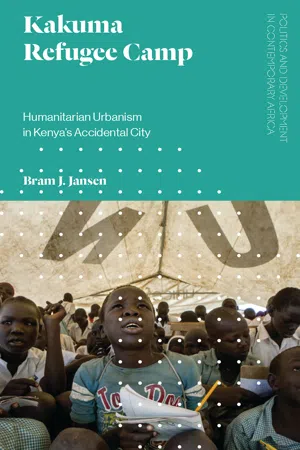
Kenya's Kakuma refugee camp is one of the world's largest, home to over 100,000 people drawn from across east and central Africa. Though notionally still a 'temporary' camp, it has become a permanent urban space in all but name with businesses, schools, a hospital and its own court system. Such places, Bram J. Jansen argues, should be recognised as 'accidental cities', a unique form of urbanization that has so far been overlooked by scholars.
Based on extensive ethnographic fieldwork, Jansen's book explores the dynamics of everyday life in such accidental cities. The result is a holistic socio-economic picture, moving beyond the conventional view of such spaces as transitory and desolate to demonstrate how their inhabitants can develop a permanent society and a distinctive identity. Crucially, the book offers important insights into one of the greatest challenges facing humanitarian and international development workers: how we might develop more effective strategies for managing refugee camps in the global South and beyond.
An original take on African urbanism, Kakuma Refugee Camp will appeal to practitioners and academics across the social sciences interested in social and economic issues increasingly at the heart of contemporary development.
- 288 pages
- English
- ePUB (mobile friendly)
- Available on iOS & Android
eBook - ePub
About this book
Information
1
Humanitarian urbanism
Humanitarian urbanism
Long-term refugee camps have been associated with cities and urbanization, yet this is accompanied by hesitation and restraint that highlight that these sites are not, or not yet, real cities or urban sites, and cannot be. The urban reference, then, is mostly used as a metaphor to capture the socio-economic processes that occur within the camp setting, such as emerging camp economies, or processes of social change, set against the material and service structures that organize and regulate life and space, such as food aid, healthcare and education. It is when it comes to the political that the comparison goes wrong. Moving beyond the metaphorical urban is problematic, because the camp remains a camp, even if its materiality changes, or its longevity endures, but no political decision to ‘uncamp’ follows. The camp is still a decision to locate people in a certain architecture of control, be that with barbed-wire fences or more or less open, but less visible, boundaries. Similarly, more elaborate service delivery, or building better and more innovative camp structures, may equally imply more elaborate bio-political control hidden within the language of humanitarian aid and refugee protection. Yet I will argue that within the ostensibly top-down camp structure, a micro-politics of disturbance, resistance and coping emerges that shows how people, although constrained by it, also escape, respond and thereby alter the architecture of control. Boundaries then blur in new local socio-spatial arrangements in which camp and non-camp become interrelated in various metaphorical and practical ways.
The reference to urbanity is thus not complete, for it sees the particular politics of the camp rather as a negation of the urban or as a confirmation of the camp. But I am interested in the middle ground. Can we capture the camp phenomenon as processes of restraint and initiative, of enabling and limiting factors, and of exclusion and inclusion, that both shape and are the result of camp governance? In what ways and to what effect are these binary categories transgressed? In this chapter I introduce another conceptual approach to understanding long-term protracted refugee camps by moving away from the debate on camps as comparable to cities as physical entities, to an understanding of these transgressions within the paradigm of humanitarian urbanism. This allows for studying the emergence of particular lifestyles, aesthetics, authority and social formations in the dynamic everyday environment of the long-term refugee camp.
The camp as an accidental city
The refugee camp is an ambiguous place. On the one hand, the camp represents a function of control in holding people in close proximity, preventing them from blending in or joining social life in regular towns and villages. On the other hand, the camp is a site of care, where people are protected from threats to their life with food, shelter and other amenities, but ostensibly in ways dictated by powerful humanitarian agencies and their donors. Camps as humanitarian measures have been criticized for this mix of custody, care and control (Minca 2015), perfected as bio-political spheres to manage the undesirables (Agier 2011).
Halfway through the first decade of the 2000s, the phenomenon of long-term refugee camps gained attention among scholars and aid actors because of the increasing duration of their existence and the growing amount of time refugees spent in them. As camps existed longer with this curious mix of custody, care and control, they came to represent what Jim Lewis in the New York Times described as ‘a sort of semi-sovereign archipelago spread out around the world, managed by the United Nations and sustained by NGOs. The people who live there are refugees, non-citizens confined to ad hoc cities, perhaps the purest form of a growing and global phenomenon: makeshift architecture, last-ditch living, emergency urbanism’.1
Similarly, Michel Agier viewed camps as both ‘the emblem of the social condition created by the coupling of war with humanitarian action, the site where it is constructed in the most elaborate manner, as a life kept at distance from the ordinary social and political world, and the experimentation of the large-scale segregations that are being established on a planetary scale’ (2002: 320). Refugees, in this view, are warehoused in a ‘non-place’ (Augé 2008), spaces of indistinction, and emergency constructions as ‘humanitarian bubbles’ (Weizman 2011: 60) that could be anywhere and nowhere, and are built and organized to remain that way. Closed off from mainstream society, relegated to the margin, refugee camps are ‘perfect materializations of a “fear of touching”, [their] structure and rationale functioning as an “urban condom”’ (Diken and Laustsen 2005: 87), and ‘warehouses’ (ECRE 2003) that serve to store redundant people as surplus humanity, or ‘wasted lives’, in Zygmunt Bauman’s terms (2004).
Refugees, subjected to this urban condom of encampment, are seen as excluded from essential rights and citizenship, and as a result subjected to the insecurities and degrading circumstances resulting from the conditions of camp life (Crisp 2000; Verdirame and Harrell-Bond 2005; Verdirame and Pobjoy 2013). Jacobsen notes, with regard to the culture of camps: ‘the anomic, alienated environment of camps coupled with the absence or breakdown of the rule of law in the camps often creates a climate of violence and intimidation’ (Jacobsen 2000: 11). Moreover, long-term refugee camps are thought to produce radicalization, which may lead to political instability in the long run if no solutions are found (Helton 2002; Lischer 2005; Muggah 2006). Similarly, camps have been heavily criticized as promoting dependency and effecting security threats and squandered resources among refugees and hosts alike (Loescher et al. 2008; UNHCR 2004a, 2008a).
However, an alternative literature has also emerged that seeks to grasp what social phenomena remain in the shadow of these frames that perceive the camp as an aberration, violation or problem. Wilde, for instance, referred to particular long-term camps not as sites of desperation but as ‘sophisticated polities, with market places, schools, hospitals, mosques, churches, running water, and decision making fora’, which he termed ‘development camps’ (1998: 108). Later, Agier (2002) suggested viewing the Dadaab camp of Kenya as a ‘camp-city’, also emphasizing, on top of all sorts of infrastructural amenities, the processes of economic development and social change. In a similar vein, Montclos and Kagwanja projected that the Kenyan camps could ‘eventually present features of a virtual city’, and referred to the camps as emerging urbanities – ‘as urban enclaves in a sparsely populated and economically underdeveloped part of Kenya’ (2000: 206).
Yet in these analyses there is this inbuilt notion of, or perhaps an excuse for, an unfinished or virtual urbanization. The camp remains a camp, which may show some signs of urban life and organization, but it is still the site of containment and bio-political regulation. Agier writes: ‘[t]he camp, then, is comparable to the city, and yet it cannot “reach it”. An economy that could exist since people show they are willing to work (and, for many of them, to remain where they are), a social division which adapts to the plurality of constraints, an occupation of space which, however precarious, gives meaning to an originally deserted place – everything is potential but nothing develops’ (2002: 336). It represents, in his words, ‘an incomplete, unfinished, form of urbanity’, and he asks himself, ‘why does it not manage to turn into a genuine space of urban sociability, an urbs, and from there to realize itself as a political space, a polis?’ (ibid.: 337). In a similar vein, Weizman notes about camps that ‘although in some of their features, such as density, scale, trade, services and social life, camps can approximate an urban environment, and sometimes might appear as a town, they do so without being proper political spaces: they are governed spaces, which lack the political capacity for self-government and cannot be considered a polis – a city’ (2011: 60).
But is that in fact the case? Designating the camp as a place without proper politics seems to do away with the contestations, habitation and history that become part of the camp itself. As several authors note that ‘the camp’ is now commonplace, and as a political structure has become part of our environment (Agier 2014; Diken and Laustsen 2005; Hailey 2009; Minca 2015), it simultaneously becomes pertinently clear that the question of what the camp is, and what it develops into, is relatively unknown (Turner 2015). The most recent projections on durable development interventions aim to integrate long-term refugee camps in their host regions, for instance in Kenya and the wider Horn of Africa. New long-term agendas indicate a departure from the previous policies based on crisis funding and short-term planning, and include a focus on social development and self-reliance strategies, and involve new technologies and the private sector. This shows that these places may indeed develop into more permanent features, perhaps even alternative durable solutions, yet not in predetermined ways. Rather, this development is organic and a reflection of the dialectic between bureaucratic and governmental programs and social processes and power struggles on the ground. Camps, in that sense, are experiments for both the governors, and the governed, and the people that criss-cross and alter these categories (Martin 2015).
This means that designating the camp-city as an improper political space seems presumptuous. Camps that exist for increasingly long durations develop as elaborate sites of dynamic humanitarian government, to which people relate in different ways and for various durations, and become part of global networks of mobility and economic relations. But how is this an improper political space? Or unfinished?
The question is whether these views are indeed capturing the actual social processes that take place in these camps, and their effects. How, then, to account for refugees’ role in the politicization of space, or the contestation and the emergence of new forms of power and public regulation (Newhouse 2015), or the emergency of pockets of authority that challenge official camp regulation (Turner 2011)? Or do labels such as improper, unfinished or virtual rather imply a predetermined vision of what the city should be, on a more ontological, methodological and normative level? In other words, can observers escape the paradigmatic contours and functions of the camp, the plight of victims of war, or the humanitarian imaginary (Smirl 2015), to see what lies beyond?
Turner noted with regard to Lukole camp in Tanzania: ‘in a sense the camp is like a super-compressed urbanization process, if it were not for the free food and the restrictions on movement and political and economic initiative, and if it were not for the temporary character of the camp’ (Turner 2001: 67). The initial reference to urbanization is stalled in the sense of the camp not overcoming what it was designed to be: a humanitarian governed setting. As with indefinite refugee existence in general, authors have used language that signifies an arrest or suspension, such as frozen transience (Agier 2011), limbo (Adelman 2008) or permanent temporariness (Picker and Pasquetti 2015), to indicate this ambiguous status of being in between. Picker and Pasquetti, for instance, see ‘camps as durable socio-spatial formations that displace and confine undesirable populations, suspending them in a distinct spatial, legal and temporal condition’ (2015: 681).
Other authors have responded to the paradigmatic notion of camps as a state of exception, and have explored alternative forms of inclusion and modes of governance, and the ways people exist in relation to that (Martin 2015; Oesch 2017). Everyday activities and engagement with aid facilities have contributed to the ways people structure lives into meaningful existence, as several authors argue, for instance, with regard to everyday experiences with education and schooling trajectories (Fresia and Von Känel 2015), entrepreneurship and economic activities (Oka 2011), and the organization of physical aspects of the lived environment (Holzer 2014). It is in relation to this materiality of the camp that increasingly architects also provide interesting analyses of camp life and its spatial organization and development (Dalal 2015; Hailey 2009; Herz 2012). These aspects, then, are not so much about the physical appearance of the camp, and its limitations, but rather about the ways in which people relate to and navigate through that camp environment – in other words, it is about the social.
This book follows and explores this social life in the camp, and rather than dismissing it as an urbanization that is not complete (can urbanization be complete anyway?) or real, it suggests that camps display particular forms of urban life, set in a context where elaborate humanitarian care and control meet resistance, negation and adaptation in refugees’ spatial and social ordering. Rather than urbanization per se, it is the lens of this particular humanitarian urbanism that allows us to understand the lives people live in the specific camp environment. Before we get there, however, let’s take a step back and start with the beginning.
The coming of people with long lower lips – a short history of Kakuma refugee camp
The Turkana in Kakuma town have a song about the coming of the people with ‘long lower lips’, the Dinka Bor from southern Sudan: ‘Hasima hasima lobotolo, Dinka Boro, erukut ka itokengye’. It means: ‘you, you with the long lower lips, Dinka Bor, you have come with your mothers’.2 At the beginning of 1992, approximately 12,000 mostly young Sudanese boys were brought from Lokichoggio on the Sudanese border to Kakuma. The previous year, they had wandered through the Sudan after having been expelled from Ethiopia, where they had stayed in Itang, Funyido or Dimma refugee camps in the Gambella region since 1986. The story of the ‘Lost Boys’ – as the group was named by journalists, after the young followers of Peter Pan – captures the imagination. When the war that started in Bor in 1983 reached the villages in various parts of southern Sudan, people started to flee towards Ethiopia. Here were the fabled camps that people, and rebels, spoke about, for here there would be education, food and safety. They would become fabled for a second reason, since education went hand in hand with military training. The groups of boys were simultaneously groups of young recruits taken in by the rebel movement. For young men, the Ethiopian camps were as much a place of enrollment in the rebel army as a place of refuge. In 1991 the Sudanese were expelled from their Ethiopian camps after the overthrow of Ethiopia’s Mengistu regime, and the refugees moved towards the Kenyan town of Lokichoggio on the Sudanese border, which had become the aid hub of the massive relief project Operation Lifeline Sudan (OLS), about a hundred kilometers north of Kakuma town.
The early 1990s saw a multitude of armed conflicts in the east and the Horn of Africa. Sudan had seen large-scale conflict since 1983, when the rebels of the Sudanese People’s Liberation Army (SPLA) waged war against the northern government that imposed sharia law upon a mostly non-Islamic people, while a multitude of armed groups were simultaneously fighting each other in multiple and shifting fashions (Deng 1995; Johnson 2007; Jok 2007). The governments of Somalia and Ethiopia were overthrown after years of civil war, and in the Great Lakes region Rwanda, Burundi, the Democratic Republic of Congo and Uganda simultaneously experienced a variety of rebel wars and localized conflicts that would increasingly lead to refugee movements as the 1990s progressed.
Kenya became the focus of diplomatic, military, relief and media efforts operating in...
Table of contents
- Cover
- About the Author
- Title
- Copyright
- Contents
- Acknowledgements
- Introduction
- 1. Humanitarian urbanism
- 2. The entitlement arena
- Intermission: Walking the camp
- 3. The camp as warscape
- 4. ‘Digging’ aid: the development of a refugee camp economy
- 5. Moving along: the camp as portal
- 6. There’s no way back to the village
- Conclusion
- Resources
- Notes
- Index
Trusted by 375,005 students
Access to over 1.5 million titles for a fair monthly price.
Study more efficiently using our study tools.
Frequently asked questions
Yes, you can cancel anytime from the Subscription tab in your account settings on the Perlego website. Your subscription will stay active until the end of your current billing period. Learn how to cancel your subscription
No, books cannot be downloaded as external files, such as PDFs, for use outside of Perlego. However, you can download books within the Perlego app for offline reading on mobile or tablet. Learn how to download books offline
Perlego offers two plans: Essential and Complete
- Essential is ideal for learners and professionals who enjoy exploring a wide range of subjects. Access the Essential Library with 800,000+ trusted titles and best-sellers across business, personal growth, and the humanities. Includes unlimited reading time and Standard Read Aloud voice.
- Complete: Perfect for advanced learners and researchers needing full, unrestricted access. Unlock 1.5M+ books across hundreds of subjects, including academic and specialized titles. The Complete Plan also includes advanced features like Premium Read Aloud and Research Assistant.
We are an online textbook subscription service, where you can get access to an entire online library for less than the price of a single book per month. With over 1.5 million books across 990+ topics, we’ve got you covered! Learn about our mission
Look out for the read-aloud symbol on your next book to see if you can listen to it. The read-aloud tool reads text aloud for you, highlighting the text as it is being read. You can pause it, speed it up and slow it down. Learn more about Read Aloud
Yes! You can use the Perlego app on both iOS and Android devices to read anytime, anywhere — even offline. Perfect for commutes or when you’re on the go.
Please note we cannot support devices running on iOS 13 and Android 7 or earlier. Learn more about using the app
Please note we cannot support devices running on iOS 13 and Android 7 or earlier. Learn more about using the app
Yes, you can access Kakuma Refugee Camp by Bram J. Jansen in PDF and/or ePUB format, as well as other popular books in Social Sciences & Human Rights. We have over 1.5 million books available in our catalogue for you to explore.