With a focus on the residents of three refugee camps, "Gabiam's nuanced study of Syria's Palestinian community is an engaging and informative read" (
Journal of Palestine Studies).
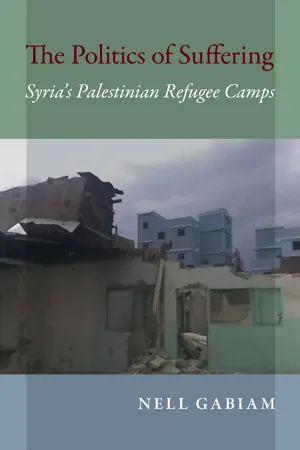
The Politics of Suffering examines the confluence of international aid, humanitarian relief, and economic development within the space of the Palestinian refugee camp. Nell Gabiam describes the interactions between UNRWA, the United Nations agency charged with providing assistance to Palestinians since the 1948 Arab-Israeli war, and residents of three camps in Syria. Over time, UNRWA's management of the camps reveals a shift from an emphasis on humanitarian aid to promotion of self-sufficiency and integration of refugees within their host society.
Gabiam's analysis captures two forces in tension within the camps: politics of suffering that serves to keep alive the discourse around the Palestinian right of return; and politics of citizenship expressed through development projects that seek to close the divide between the camp and the city. Gabiam also offers compelling insights into the plight of Palestinians before and during the Syrian war, which has led to devastation in the camps and massive displacement of their populations.
- 208 pages
- English
- ePUB (mobile friendly)
- Available on iOS & Android
eBook - ePub
About this book
Information
1Informal Citizens
Palestinian Refugees in Syria
IN MAY OF 2011, while in the United States, I decided to call Muna, with whom I had established a friendship during my fieldwork in Neirab and Ein el Tal. While I had called Muna periodically since returning to the United States, this time I was a little hesitant. The tide of uprisings across the Arab world, which had started in Tunisia in December 2010, had recently reached Syria and the Syrian government was blaming “foreign instigators” for the unrest it was facing. I was worried that, as an American, calling acquaintances in Syria during this tense time might make these acquaintances nervous or even put them at risk of special scrutiny (assuming that government officials were listening in on calls, something that was not unheard of).
I decided in the end that Muna was a good enough friend that she would understand I was just calling as I usually did to say hi. However, once I reached her, she was the one who unexpectedly brought up the unrest in the region. Not the unrest involving Syrians but that involving Palestinians, including herself. She asked me if I had heard that Palestinian refugees in various parts of the Middle East had marched to the Israeli border a few weeks earlier, on May 15, to demand that Israel acknowledge their right of return. She proudly announced to me that she, as well as many others in Neirab Camp, had participated in the march. I told her that I had indeed seen pictures of the protesters on the Al Jazeera news network. “Al Jazeera” had an unanticipated effect: “Kaẓāb! Kaẓāb! [liars! liars!],” she responded, raising her voice. “Don’t watch Al Jazeera; they’re all liars,” she continued, urging me to watch Al Manar, the Hizbullah-controlled satellite TV station instead.
I was well aware that Al Jazeera had been running news stories emphasizing the brutality of the Syrian government crackdown on protesters, while I suspected that Al Manar was airing stories that were much more sympathetic to and defensive of the Syrian regime. Indeed, it is no secret that Hizbullah is a longtime ally of the Syrian government. It has now officially entered the Syrian conflict, fighting on the side of the government against anti-Asad rebels. Choosing to be careful and not pursue a potentially sensitive conversation over the phone, I did not ask Muna to explain herself. At the end of our phone call, I was left with two possible interpretations. On the one hand, it was possible that Muna was expressing genuine support for the Syrian government; after all, the government has generally been welcoming and protective toward Palestinian refugees living on Syrian territory. In this sense, it is not surprising that the refugees would feel anxious about the current instability and the prospect of regime change. On the other hand, it was possible that Muna’s reaction to my mention of Al Jazeera, which had been airing news footage and stories that painted the Syrian government in a negative light, was a protective mechanism in case Syrian authorities were eavesdropping on our conversation.
Since the beginning of the Syrian war, Palestinians, as a collective, have managed to avoid being fully associated with one side or the other of the conflict. However, my conversation with Muna brings up the fact that there are real implications, should the violence continue to escalate, with regard to Palestinian refugees being seen as supporting either the Asad regime or the rebels. My conversation with Muna also brings up an interesting aspect of the relationship between Palestinian refugees and the Syrian government: Muna, as a Palestinian, could celebrate her participation in an event that was connected to the recent uprisings against various authoritarian regimes in the Arab world while implicitly expressing support for the Syrian government, which was a target of these uprisings. Because the political activism of the refugees is generally directed against Israel, which is also a Syrian foe, the refugees occupy an ambiguous position in Syria’s political landscape. Given their lack of formal citizenship, they can be seen as particularly vulnerable to any sort of government backlash against presumed anti-government rhetoric or activity, but the fact that their political activism is generally directed against Israel gives them a greater amount of political organization and expression than their Syrian counterparts have.
This ambiguity defies dominant assumptions about citizenship, assumptions that are grounded in a nation-state-centered understanding of citizenship and rights. While they are not citizens in the formal sense of the term, Palestinians in Syria not only have access to the overwhelming majority of social rights enjoyed by Syrian citizens but are also integrated into the country’s national imaginary through Syrian government rhetoric. This rhetoric not only considers Palestinians to be a part of Syria’s historical national imaginary but also sees Syrians and Palestinians as united through their struggle against a common enemy–usually identified as Israel but sometimes extending to Israel’s unequivocal ally, the United States, and Western imperialism more broadly. I begin my analysis of the Syro-Palestinian relationship by examining the relatively warm welcome that was extended by the Syrian government and people to Palestinian refugees, who were not seen as foreigners having crossed borders when they began arriving en masse as a result of the 1948 Arab–Israeli war.
A Warm Welcome in Syria
Of the roughly seven hundred and fifty thousand Palestinians who fled their homes or were expelled from them by Israeli forces during the 1948 Arab–Israeli war, approximately ninety to one hundred thousand sought refuge in Syria (Kodmani-Darwish 1997; Takkenberg 1998). Probably because of their urban origins, the first refugees settled in and around Damascus. At the time of my fieldwork, 70 percent of all Palestinians in Syria lived in the Damascus area (Kodmani-Darwish 1997), most of them in Yarmouk Camp. The rest, many of whom came from small northern Palestinian villages, were scattered in other camps or towns across the Syrian landscape.
By 2013, the number of registered Palestinian refugees had grown to 499,181.1 According to official UNRWA surveys taken before the Syrian war, only one-third lived in camps. This information is misleading, however, if one takes into account both official camps, which were specifically set up by UNRWA as humanitarian spaces, and unofficial camps, which were set up by the Syrian government to accommodate Palestinians who did not initially move to UNRWA-administered camps. Before the current war, Syria counted nine official and three unofficial camps.2 Among the latter are Ein el Tal and Yarmouk, two of the three refugee camps featured in this book. While in practice UNRWA does not distinguish between official and unofficial camps and provides services to both, it does not include the latter in its surveys of Palestinian camp populations. If unofficial camps are taken into account, it can be argued that the majority (more than two-thirds) of Palestinian refugees in Syria lived in camps before the current war.3
The hospitality of the Syrian government and people is often mentioned in interviews with first-generation refugees such as Abu Hosam, a major figure in UNRWA’s Neirab Rehabilitation Project. At the time of my fieldwork, Abu Hosam held the title of Neirab Project liaison officer, which meant that he was the main intermediary between the project team and the Neirab community. A retired UNRWA English teacher and a respected member of Neirab’s first generation of refugees, he is a striking and imposing figure who appears to be in his late sixties or early seventies and who is always dressed in a suit and tie. He once told me, while showing me a picture of himself as a young English teacher in Algeria in the 1970s, that his Algerian peers often compared his looks to French movie star Alain Delon.
I met Abu Hosam one morning in early June 2005 in his UNRWA office in Neirab. The walls of the office were graced with pictures and statistics about the Neirab Rehabilitation Project. This was the first place for any member of the Neirab community to come to ask questions, make suggestions, or articulate grievances. During my interview with him, Abu Hosam emphasized the hospitality that fleeing Palestinian refugees received from Syrians: “We were warmly welcomed in Syria and we were treated well. Some kind Syrian people distributed food, clothing, money, and so on. They were very kind” (interview, June 1, 2005).
The issue of Syrian hospitality arose during a Palestinian oral history project I was a part of in Yarmouk Camp in Damascus. One of the interviewees, who was in his eighties and lived in Yarmouk, emphasized the cordial manner in which he was received after abandoning his defeated Syrian-led Arab army unit in northern Palestine and fleeing to Syria in 1948. He referred to Syrians as “deep-rooted people” and added: “They don’t have racism and everyone knows that Palestine, Syria, Jordan, and Lebanon are one country. Colonization separated them” (interview, June 2005). While these comments are somewhat idealistic, it is historically accurate that present-day Syria, Israel/Palestine, Jordan, and Lebanon once constituted Bilād al-Sham, or Greater Syria, an area under the control of the Ottoman Empire:
While it was almost never politically united, this vast area–bounded by the Taurus mountains to the north, the Mediterranean to the west, the Euphrates to the east, and the Arabian desert to the south–was in the minds of its inhabitants a whole, homogeneous in culture, threaded with economic ties and was called for centuries Bilad al-Sham. Each of the main cities of the region had its own character and jealous particularity, and its constellation of leading families, but there was a sense in which Jerusalem and Jaffa, Sidon, Beirut and Tripoli, Damascus, Homs and Hama, Latakia, Aleppo and Alexandretta were all kin, and of all these Damascus was acknowledged to be the most important. (Seale 1988:14)
During World War I, allied forces, in anticipation of the defeat of the Ottoman Empire, which had taken the side of the central powers, were involved in two agreements that drastically altered the geopolitical landscape of Bilād al-Sham: The Sykes-Picot Agreement of 1916 and the Balfour Declaration of 1917. After the war and as a result of the Sykes-Picot agreement, signed by the British and the French, Palestine came under British control; the rest of Bilād al-Sham came under French control.4 The Balfour Declaration led to the establishment of a Jewish state in Palestine, to which the British had laid claim. The inhabitants of Bilād al-Sham had made clear their opposition to the various amputations and political restructurings imposed on their territory and had voiced their desire to be independent and undivided (Seale 1988). In 1919, a political party called the Syrian National Congress rejected the Sykes-Picot agreement and the Balfour Declaration “and demanded sovereign status for Syria-Palestine,” a demand that was greeted with overwhelming support by the inhabitants of the region (Seale 1988). Thus, Syrians and Palestinians historically share the national imaginary of Bilād al-Sham and the struggle to prevent its fragmentation, a fact that helps explain the relatively warm welcome the majority of Palestinian refugees received as they streamed into Syria during the period of 1947–1949.
Another development that helps explain the refugees’ friendly reception is the emergence of pan-Arab Ba‘thist ideology.5 Brought to prominence by a trio of schoolmasters, Zaki Al-Arsuzi (an Alawite), Michel Aflaq (an orthodox Christian), and Salah al-Din Bitar (a Sunni Muslim), ba‘thism emerged as a political force in 1940. Michel Aflaq, who would become the head of the Ba‘th Party, founded in 1947, argued that Arabs belonged to a single nation and were members of “an ancient race with many glorious achievements to its credit” (Seale 1988:30). However, because this nation had fallen into backwardness and had capitulated to foreign control, Aflaq sought to “rouse the Arabs from what he considered a living death”(Seale 1988:30). He summarized his plan of action in the slogan “Unity, Freedom, Socialism,” with freedom primarily conceived as “freedom from foreign domination whether military, political or cultural” (Seale 1988:31). Thus, the Ba‘thist ideology preached the reunification of the “Arab nation” and advocated eliminating obstacles impeding its progress toward a brighter future. Part of this mission was to eradicate the artificial borders imposed by Western imperialism (Hinnebusch 2001). When Syria came under Ba‘thist rule in 1963, it was perceived by adherents as a country at the vanguard of Arab unity and Arab liberation struggles across the Middle East. Palestine, especially as it used to constitute the southern part of Bilād al-Sham, easily fit into the Ba‘thist political imaginary and its goal of Arab reunification. Palestinian refugees in Syria, as victims of Western imperialism, were for their part “disproportionately attracted to the Ba‘th,” and many became members (Hinnebusch 2001:31).
At the same time, too much emphasis should not be placed on the role of Ba‘thist pan-Arab ideology, especially in various Syrian governments’ approach toward Palestinians. As mentioned previously, the Ba‘th Party came to power only in 1963. By 1949, Syrian authorities had already taken steps to provide relief and employment for Palestinian refugees (Brand 1988). More important, in 1956 the Syrian government, led by Shukri al-Kuwatli, took a major step with Law No. 260, which guaranteed refugees access to public education, employment, and health care (Brand 1988). Law No 260 remains the backbone of the refugees’ legal entitlements in Syria.
A fourth factor behind Syria’s welcoming of Palestinian refugees is that the refugees have never constituted more than 3 to 4 percent of the country’s population, unlike in Jordan and Lebanon, where they represent about 30 and 10 percent of the respective populations (Al Husseini and Bocco 2009). Contrary to Jordan and Lebanon, Syria generally did not see its refugees as a threat to Syrian employment or natural resources (Al Husseini and Bocco 2009; Kodmani-Darwish 1997; Takkenberg 1998). It also holds the distinction of being the only Arab country to have integrated Palestinian refugees into its army with the establishment of the Palestine Liberation Army (jaysh taḥrīr filasṭīn) in 1964 (Brand 1988). A 1988 study by anthropologist Laurie Brand argues that “the right to work and join labor unions, equal access to government services, including education, and the duty to serve in the army have combined with strong popular Arab nationalist sentiment in Syria to allow for a greater degree of socioeconomic and, in some cases, political integration than in any other Arab state but Jordan” (1988:624).
During my fieldwork, I noticed that relations between Palestinians and Syrians were generally cordial, and I never observed any acts of discrimination toward refugees by Syrian individuals. When I worked as an UNRWA volunteer, I was always amazed that I could not distinguish the few Syrian employees from their Palestinian counterparts. There was nothing in their dress, appearance, mannerisms, or interactions that gave me clues. I would only find out a particular employee was Syrian after being told. The one exception was a Christian Syrian employee who always wore a gold necklace with a sparkling cross around her neck. I rightly guessed she was Syrian, as I had never encountered a Christian Palestinian during my time in Syria (while there is a significant Christian Palestinian minority, the Palestinians who live in Syria are overwhelmingly Sunni Muslim). When I strolled around Damascus or Aleppo with Palestinian friends, Syrians often detected a Palestinian accent and asked the speaker if he or she was Palestinian, but otherwise there was nothing noteworthy about the interaction. It was also not unusual for my Palestinian friends and acquaintances to have close Syrian friends.
At the same time, there are some negative stereotypes of Palestinians among Syrians. For instance, some Syrian friends mentioned that Palestinians are commonly viewed as “untrustworthy” and as “troublemakers.” Some also seem to resent the fact that Palestinians are entitled to public-sector jobs...
Table of contents
- Cover
- Half title
- Title
- Copyright
- Dedication
- Contents
- Acknowledgments
- Note on Transliteration
- Introduction
- 1 Informal Citizens: Palestinian Refugees in Syria
- 2 From Humanitarianism to Development: UNRWA and Palestinian Refugees
- 3 Ṣumūd and Sustainability: Reinterpreting Development in Palestinian Refugee Camps
- 4 “Must We Live in Barracks to Convince People We Are Refugees?”: The Politics of Camp Improvement
- 5 “A Camp Is a Feeling Inside”: Urbanization and the Boundaries of Palestinian Refugee Identity
- Conclusion: Beyond Suffering and Victimhood
- Epilogue
- Notes
- References
- Index
Trusted by 375,005 students
Access to over 1.5 million titles for a fair monthly price.
Study more efficiently using our study tools.
Frequently asked questions
Yes, you can cancel anytime from the Subscription tab in your account settings on the Perlego website. Your subscription will stay active until the end of your current billing period. Learn how to cancel your subscription
No, books cannot be downloaded as external files, such as PDFs, for use outside of Perlego. However, you can download books within the Perlego app for offline reading on mobile or tablet. Learn how to download books offline
Perlego offers two plans: Essential and Complete
- Essential is ideal for learners and professionals who enjoy exploring a wide range of subjects. Access the Essential Library with 800,000+ trusted titles and best-sellers across business, personal growth, and the humanities. Includes unlimited reading time and Standard Read Aloud voice.
- Complete: Perfect for advanced learners and researchers needing full, unrestricted access. Unlock 1.5M+ books across hundreds of subjects, including academic and specialized titles. The Complete Plan also includes advanced features like Premium Read Aloud and Research Assistant.
We are an online textbook subscription service, where you can get access to an entire online library for less than the price of a single book per month. With over 1.5 million books across 990+ topics, we’ve got you covered! Learn about our mission
Look out for the read-aloud symbol on your next book to see if you can listen to it. The read-aloud tool reads text aloud for you, highlighting the text as it is being read. You can pause it, speed it up and slow it down. Learn more about Read Aloud
Yes! You can use the Perlego app on both iOS and Android devices to read anytime, anywhere — even offline. Perfect for commutes or when you’re on the go.
Please note we cannot support devices running on iOS 13 and Android 7 or earlier. Learn more about using the app
Please note we cannot support devices running on iOS 13 and Android 7 or earlier. Learn more about using the app
Yes, you can access The Politics of Suffering by Nell Gabiam in PDF and/or ePUB format, as well as other popular books in Social Sciences & Middle Eastern History. We have over 1.5 million books available in our catalogue for you to explore.