- 204 pages
- English
- ePUB (mobile friendly)
- Available on iOS & Android
eBook - ePub
About this book
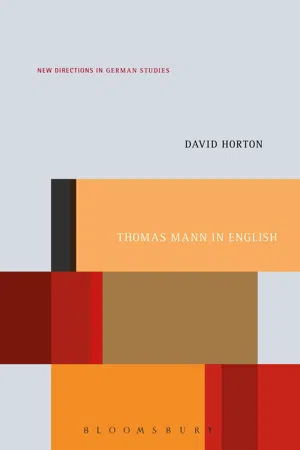
Thomas Mann owes his place in world literature to the dissemination of his works through translation. Indeed, it was the monumental success of the original English translations that earned him the title of 'the greatest living man of letters' during his years in American exile (1938-52). This book provides the first systematic exploration of the English versions, illustrating the vicissitudes of literary translation through a principled discussion of a major author. The study illuminates the contexts in which the translations were produced before exploring the transformations Mann's work has undergone in the process of transfer. An exemplary analysis of selected textual dimensions demonstrates the multiplicity of factors which impinge upon literary translation, leading far beyond the traditional preoccupation with issues of equivalence. Thomas Mann in English thus fills a gap both in translation studies, where Thomas Mann serves as a constant but ill-defined point of reference, and in literary studies, which has focused increasingly on the author's wider reception.
Information
New Directions in German Studies
Vol. 8
Series Editor:
Imke Meyer
Editorial Board:
Katherine Arens, Roswitha Burwick Richard Eldridge, Erika Fischer-Lichte, Catriona MacLeod, Jens Rieckmann, Stephan Schindler, Heidi Schlipphacke, Ulrich Schönherr, James A. Schultz, Silke-Maria Weineck, David Wellbery, Sabine Wilke, John Zilcosky.
New Directions in German Studies
Volumes in the series:
Improvisation as Art: Conceptual Challenges, Historical Perspectives
by Edgar Landgraf
The German Pícaro and Modernity: Between Underdog and Shape-Shifter
by Bernhard Malkmus
Citation and Precedent: Conjunctions and Disjunctions of German Law and Literature
by Thomas O. Beebee
Beyond Discontent: ‘Sublimation’ from Goethe to Lacan
by Eckart Goebel
From Kafka to Sebald: Modernism and Narrative Form
edited by Sabine Wilke
Image in Outline: Reading Lou Andreas-Salomé
by Gisela Brinker-Gabler
Out of Place: German Realism, Displacement and Modernity
by John B. Lyon
Vienna’s Dreams of Europe: Culture and Identity beyond the Nation-State
by Katherine Arens (forthcoming)
Thomas Mann
in English
in English
A Study in Literary Translation

Bloomsbury Academic
An imprint of Bloomsbury Publishing Plc
| 175 Fifth Avenue | 50 Bedford Square |
| New York | London |
| NY 10010 | WC1B 3DP |
| USA | UK |
www.bloomsbury.com
First published 2013
© David Horton, 2012
All rights reserved. No part of this publication may be reproduced or transmitted in any form or by any means, electronic or mechanical, including photocopying, recording, or any information storage or retrieval system, without prior permission in writing from the publishers.
No responsibility for loss caused to any individual or organization acting on or refraining from action as a result of the material in this publication can be accepted by Bloomsbury Academic or the author.
Library of Congress Cataloging-in-Publication Data
A catalog record for this book is available from the Library of Congress.
ISBN: 978-1-4411-6680-7
Typeset by Fakenham Prepress Solutions, Fakenham, Norfolk NR21 8NN
For Oliver
Contents
1 | Introduction: Thomas Mann in English |
2 | Translation and retranslation: The history of Thomas Mann’s works in English |
3 | Helen Tracy Lowe-Porter, Thomas Mann and the practice of translation |
4 | An exercise in translation comparison: Der Zauberberg |
5 | Transferring the paratextual: The translation of Thomas Mann’s titles |
6 | The translation of discourse forms: Speech and thought presentation in Buddenbrooks |
7 | Translating modes of address as an index of interpersonal dynamics |
8 | Syntactic form and literary meaning in translation |
9 | Conclusion |
Bibliography | |
Index |
Acknowledgements
I would like to thank all those who have generously found time to provide support during my work on this book. Among them, I am especially grateful to Jörn Albrecht, Jean Boase-Beier, Osman Durrani, Jeremy Munday and Ritchie Robertson, all of whom commented on parts of the study at various stages of its genesis, and to John E. Woods, who patiently answered questions concerning his (re)translations of Thomas Mann’s novels.
I am further indebted to staff at the Beinecke Rare Book and Manuscript Library, Yale University, who arranged access to unpublished documents relating to the genesis of the Lowe-Porter translations of Mann’s works; to Marc Kupietz at the Institut für deutsche Sprache, Mannheim, who provided me with statistical data from the electronic Thomas-Mann-Korpus held at the institute; and to Sarah Materna, Saarland University, who painstakingly carried out a large number of analyses on the texts which form the basis of the present study.
Finally, I would like to thank the editors at Edinburgh University Press for permission to reprint in Chapter 8 of the present study parts of my article ‘Linguistic structure, stylistic value and translation strategy: Introducing Thomas Mann’s Aschenbach in English’, first published in the journal Translation and Literature 19 (2010), 42–71.
Universität des Saarlandes, Saarbrücken
September 2012
1 Introduction: Thomas Mann in English
Introductory remarks
Thomas Mann’s elevation to the highest ranks of the international literary canon was the direct result of the dissemination of his works through the medium of translation. In the German-speaking world, Mann’s reputation was established early in his career by the resounding success of his first novel, Buddenbrooks (published in 1901). Over the following two decades, he produced no major novels. Instead, he devoted his literary energies mainly to short prose fiction, much of it highly regarded in Germany but at that stage virtually unknown elsewhere, and he spent the years 1915–18 formulating his monumental political treatise, Betrachtungen eines Unpolitischen (not translated into English until 1983). His only novel of that period, Königliche Hoheit (1909), met with a modest reception in the German-speaking world, where it was widely regarded as a somewhat trivial distraction after the weightier concerns and broader sweep of his debut work. It was also the first of his novels to appear in an English translation (Royal Highness in 1916, by A. Cecil Curtis), which was virtually ignored (Wagener 2001: 927).
Mann had to wait until 1924 for his next large-scale success. The publication of Der Zauberberg in that year cemented his reputation as a novelist in Germany, and it was Helen Tracy Lowe-Porter’s English translation of that work (1927) that brought him international fame, achieving something her translation of Buddenbrooks in 1924 had failed to do. The reception of The Magic Mountain was ‘grudging’ in England, as Lowe-Porter herself commented, but the novel was highly successful in America (Lowe-Porter 1966: 185; Wagener 2001: 929–30). Mann himself was delighted at the reception of ‘des in Amerika außerordentlich angesehenen und bewunderten Magic Mountain’ (diary entry of 27 June 1934; see also GW 11: 610). The international success of Der Zauberberg secured the attention of the Nobel Prize committee, which bestowed the award upon Mann in 1929 (the citation referred explicitly to Buddenbrooks). As Mandel writes in his essay on Lowe-Porter: ‘The rest is literary history’ (Mandel 1982: 31).
It is hardly surprising, given Mann’s status as an exile from 1933 onwards, that he took a great interest in the translation of his works. This interest is well documented in scores of letters and diary entries relating to versions in a variety of languages. It is, however, the English renditions that feature most centrally in the extensive records: Mann spent the years 1938–52 in the United States, and enjoyed a particularly long and fruitful partnership with his New York publisher Alfred A. Knopf and his ‘authorized’ American-English translator Helen Lowe-Porter. Throughout his lifetime, Mann’s intense interest in the English versions of his work was driven by his desire to establish and cultivate an international literary reputation, something that could only be achieved with the help of high-quality translations. He devoted much energy to this endeavour, intervening frequently in the translation process and systematically nurturing his public image (Adolphs 1990). At one juncture, he became directly involved in the choice of an ‘official’ English translator. Once that issue had been resolved, he provided extensive assistance and detailed comment over a period of some twenty-seven years. Although his response to the work of his regular English translator was always ambivalent and at times downright contradictory, it was her efforts – as he was very well aware – that gained him the ultimate accolade of ‘the greatest living man of letters’ (Vaget 2001a: 70). The hundreds of documents from Mann’s years of residence in the United States reveal just how hard he worked to ensure that his literary reputation could stand alongside his representative political role as the anti-fascist conscience of Germany. In this latter context, too, Lowe-Porter was instrumental, translating the vast majority of his dozens of essays and speeches on political and cultural issues.
At the same time, Mann’s concern with the English versions of his texts was motivated by material considerations. He had been financially independent from a relatively early age thanks to payments made from the estate of his father, who died in 1891, and he had received a generous allowance from his wealthy father-in-law following his marriage to Katia Pringsheim in 1905. However, his financial situation deteriorated significantly during the inflation of the early 1920s. In a letter to his German publisher Samuel Fischer on 1 September 1922, he commented that foreign income was indispensable to him during the period of high inflation (Reg 1: 341). Long before he had any inkling that he would one day settle in the United States, i.e. in the years 1922–5, he earned additional income by writing a series of cultural essays for the American magazine The Dial. Later, the fact that his German assets were seized – and his works banned and burned – by the National Socialists meant that foreign-language sales constituted the major part of his income. In fact, his financial success during his years in American exile was considerable. While none of his works sold more than 10,000 copies in Britain, sales in the US were very hig...
Table of contents
- New Directions in German Studies
Trusted by 375,005 students
Access to over 1.5 million titles for a fair monthly price.
Study more efficiently using our study tools.
Frequently asked questions
Yes, you can cancel anytime from the Subscription tab in your account settings on the Perlego website. Your subscription will stay active until the end of your current billing period. Learn how to cancel your subscription
No, books cannot be downloaded as external files, such as PDFs, for use outside of Perlego. However, you can download books within the Perlego app for offline reading on mobile or tablet. Learn how to download books offline
Perlego offers two plans: Essential and Complete
- Essential is ideal for learners and professionals who enjoy exploring a wide range of subjects. Access the Essential Library with 800,000+ trusted titles and best-sellers across business, personal growth, and the humanities. Includes unlimited reading time and Standard Read Aloud voice.
- Complete: Perfect for advanced learners and researchers needing full, unrestricted access. Unlock 1.5M+ books across hundreds of subjects, including academic and specialized titles. The Complete Plan also includes advanced features like Premium Read Aloud and Research Assistant.
We are an online textbook subscription service, where you can get access to an entire online library for less than the price of a single book per month. With over 1.5 million books across 990+ topics, we’ve got you covered! Learn about our mission
Look out for the read-aloud symbol on your next book to see if you can listen to it. The read-aloud tool reads text aloud for you, highlighting the text as it is being read. You can pause it, speed it up and slow it down. Learn more about Read Aloud
Yes! You can use the Perlego app on both iOS and Android devices to read anytime, anywhere — even offline. Perfect for commutes or when you’re on the go.
Please note we cannot support devices running on iOS 13 and Android 7 or earlier. Learn more about using the app
Please note we cannot support devices running on iOS 13 and Android 7 or earlier. Learn more about using the app
Yes, you can access Thomas Mann in English by David Horton in PDF and/or ePUB format, as well as other popular books in Literature & Translating & Interpreting. We have over 1.5 million books available in our catalogue for you to explore.