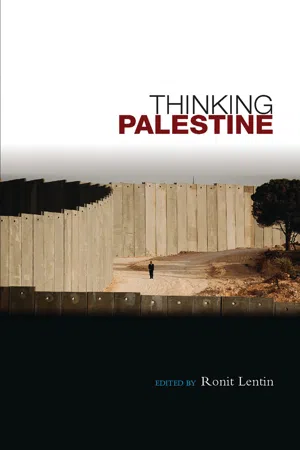
This book brings together an inter-disciplinary group of Palestinian, Israeli, American, British and Irish scholars who theorise 'the question of Palestine'. Critically committed to supporting the Palestinian quest for self determination, they present new theoretical ways of thinking about Palestine. These include the 'Palestinization' of ethnic and racial conflicts, the theorization of Palestine as camp, ghetto and prison, the tourist/activist gaze, the role of gendered resistance, the centrality of the memory of the 1948 Nakba (catastrophe) to the contemporary understanding of the conflict, and the historic roots of the contemporary discourse on Palestine.
The book offers a novel examination of how the Palestinian experience of being governed under what Giorgio Agamben names a 'state of exception' may be theorised as paradigmatic for new forms of global governance. An indispensable read for any serious scholar.
eBook - ePub
Thinking Palestine
About this book
Information
PART I
The Palestinianization of Race
1 Racial Palestinianization
Palestinians as a people, and Arabs more generally, regionally first emerged as a pan-national self-identification in modern terms in the earlier decades of the twentieth century as expressions of anti-colonial and autonomous sensibilities, interests, and commitments. The heterogeneity among Arabs living throughout the region sought a more cohering identity in the face of intensifying British and French colonization after World War One, the discovery of large holdings of oil, growing anti-colonial movements in Africa and Asia and ultimately the founding of Israel. The name ‘Palestine’ was reinvoked by the British in the early 1920s upon receiving a League of Nations mandate to rule over the territory after Ottoman imperial control in the late nineteenth century had folded it into the southern extension of Syria.
Thus British modernization, as Salim Tamari has pointed out (1999), transformed a complexly secular, cosmopolitan, broadly communitarian order under Ottoman rule – especially in cities such as Jerusalem and ports such as Jaffa and Haifa (but also more regionally in Beirut and Damascus) – into a more segregating, ethnoracially and religiously discrete and divided set of communities in contest with each other for resources, space, and political favour; in other words, classic colonial divide and rule, ethnoracially fuelled. This regional transformation of heterogeneity into the logos of an assertedly homogeneous ethnoracial ethnoraciality is what I trace here in the name of racial palestinianization.
Producing racial palestinianization
Israel was an anomaly at its founding, reflecting conflicting logics of world historical events between which its declarative moment was awkwardly wedged. On the one hand, it mimicked rather than properly mirrored the logics of independence fuelled by decolonizing movements, though perhaps curiously closer in some crucial ways to Pakistan than, say, to India or other decolonizing societies of the day. On the other hand, it embodied in potential, by the structural conditions of its very formation, some key features of what was coterminously emerging as the apartheid state. In what follows, I am less identifying Israel as representing the apartheid state as tracing the ways in which, in conception and practice, it has come not just to embody apartheid elements but to represent a novel form of the racial state more generally.
In the latter spirit, Palestinians were the indigenous inhabitants of Palestine. They were indigenous in the sense of being ‘found’ in the area, both by the nineteenth-century colonizing powers and by the increasing convergence of Zionist-inspired Jews in the territory after the Balfour Declaration of 1917, and especially in the wake of World War Two. Identified as the direct kin of biblical Philistines, Palestinians as a people were often seen as philistines as much in characterization as in scriptural name, conceived in the representational struggles as bloodthirsty and warmongering, constantly harassing modern-day Israelites, debauched and lacking in liberal culture. Terrorists, it seems, historically all the way down to the toe-nails of time, Goliath cut to size by David’s perennial craftiness and military prowess.
Israel came to be seen as an exemplary instance of what Michel Foucault, though in a different context, memorably has called ‘counter-history’ (2003), as a historical narrative of insurrection, against the grain, establishing itself in the face of formidable and threatening power directed against it. Israel is forged out of a ‘biblical history of servitude and exiles’, as a ‘history of insurrections’ against state-imposed or -sanctioned injustices. In this, Israel held out hope and the promise of justice. Its founding narration, in short, is a complex of the history of struggles (Foucault uses the term ‘race wars’ but it is clear from the examples he cites that he really has in mind group, even class, struggles) in which Jews were invariably the quintessential pariah, they who did not belong, but mixed with the civilizing European imperative, the white man’s burden, of what I have elsewhere characterized as ‘racial historicism’ (Goldberg 2002).
Moses Hess, important for introducing Engels to the socialist fold and one of the first to articulate the Zionist vision, implored ‘the Jewish race’ in 1862 to
be the bearers of civilization to peoples who are still inexperienced and their teachers in the European sciences, to which your race has contributed so much. … [Jews are to be] mediators between Europe and far Asia, opening the roads that lead to India and China – those unknown regions which must ultimately be thrown open to civilization… [Jewish] labour and industry [in Palestine] will turn the ancient soil into fruitful valleys, reclaiming it from the encroaching sands of the desert (Hess 1995 [1862]).
Theodor Herzl, the father figure of the Zionist social movement, concurred: ‘The immigration of Jews signifies an unhoped-for accession of strength for the land which is now so poor; in fact, for the whole Ottoman Empire’ (1997 [1897]). The Zionist vision for Israel, as Ella Shohat has remarked (2003), represents the modernizing imperative in a region seen as still marked by the biblical backwardness of its Arab inhabitants.
Israel, it is accordingly apparent, has been thought of – has thought of itself in part precisely – from its initiating modern conception explicitly as racially configured, as racially representative. And those insistent racial traces persist despite the post-Holocaust European repression of the use of race as social self-reference or -representation. In this, as much as any other modernizing state, Israel has been caught in the racemaking web of modernizing statehood. States assume their modernity, as I have argued in The Racial State (2002), through racial articulation. Israel is a modern racial state knotted with and in constitutive contrast to the pre-history of Palestinian antiquity, of its historicized racial immaturity. Israel represents modernization, progress, industry and industriousness, looking to the bright future, the civilizing mission of the best that has been thought and could be taught. Palestine represents the past, failed effort if effort at all, antique land still tilled by hand and the perennial failure of governance, a place constantly in the grip of its time past and passed. The larger relational condition, a state racially characterizing itself in its founding self-representation, is one in which the state of the latter, materially as much as metaphorically, is fuelled by the racially conceived, tinged (one might say singed) imposition of the former.
But this civilizing mission and self-determining drive thus initiated through Jews in the name of European civilization is one with a twist. Israel was forged, of course, in the fire and fury of all those migrations, the experiences of expulsions and exiles, arrivals and startings over, assimilations and abject evictions, wrongful convictions and threatened extinctions. The war of races in which the Jew is the hounded, the perennial foe and fugitive, becomes in Israel’s founding a protracted conflict in which the Jewish state, Herzl’s dream, is turned into oppressor, victimizer, and sovereign. Vulnerable, victim, and vanquished become pursuer, perpetrator, predator. The state is transformed, as Foucault says, into protector of the integrity, superiority, and more or less purity of the homogenizing group, what Foucault marks as ‘the race’. State sovereignty defends itself above all else so as to secure the group, its ethnoraciality, to protect its purity, perpetuity, and power, for which it takes itself to exist and which it seeks to represent.
Despite debatable stories of early Zionist settlers driven by socialist ideals of peaceful coexistence with local Arabs on land commonly tilled and towns cohabited, by the early 1970s Golda Meir could claim rhetorically that the Palestinian people did not exist. Romantic coexistence in these parts has always gone arm in arm with assertive claims to territorial and political sovereignty, on both sides of the conflict. In Israel’s triumphant War of Independence (what Palestinians characterize as al-nakba, their catastrophe), Israeli gains expanded the territory ceded it by the original 1947 UN Partition Resolution by almost one-third, widening its cartographic waistline, evicting 750,000 of the 850,000 or so Arabs living within enlarged Israel in order to ensure a Jewish majority. The moral qualms over eviction-driven expansion are well characterized in Israeli novelist Yizhar Smilansky’s short story depicting the Sartrean dilemma faced by a young soldier caught between executing evicted Arab villagers and contributing to securing Israel’s infant existence (1990). That dilemma seems now to have been resolved overwhelmingly in favour of the latter’s national prerogative.
In short, since the earliest Zionist settlement, and intensifying with the declaration of Israeli independence in 1948, a dominant faction of the Israeli political establishment has been committed not simply to denying Palestinian existence, but to making the claim true, acting in its name and on its terms. An Israeli military planning document, known as Plan D (or Plan Dalet), formulated in the run-up to Israel’s War of Independence in May–June 1948, sought ‘destruction of [Arab] villages by fire explosives and mining’ after the villages had been surrounded and searched, and resistance destroyed, and ‘expelling the population beyond the boundaries of the State’ (Benvenisti 2003; Pappe 2004; Pappe 2006).
Under Arafat, of course, Palestinians not only asserted a coherent identity, but sought to reciprocate that denial: the State of Israel does not, should not, exist. But however duplicitous and dirty-handed the Palestinian patriarch, and however rhetorically insistent concerning Israel’s denial and demise, it is a whole lot more difficult, it would seem, to activate denial of the existence of one whose semi-automatic is at your nose than it is to insist that a stateless people, a nation of refugees on its own land, has no rights. It is not that might makes right in this case; it is that might manufactures the conditions and parameters, the terms, of political, and by extension historical and representational possibility.
Meron Benvenisti (2003) reports that something like 200 Arab villages were abandoned in May 1948, and another 60 in June. By the time the dust had settled, nearly half a million Palestinians had been reduced to refugees, fleeing expanded Israel, never to be allowed to return. Israel came into being, came to be, by virtue both of Jews staring at their own individual and collective extinction and of Palestine’s constriction, if not cessation, at least of its realization, if not of its idea. The latter’s deathly denial, rationalized in the name of the former, is as much a part of Israel’s history as it is repressed, if not excised from, its official record. It is this tension between denial and repression that fuels Israel’s sense of Palestine, and so, also, of itself.
There is a sharp distinction, often lost, between the notion of self-hating Jew and that of self-critical Jew. To criticize Israel as a state formation, and the Israeli state and governmental policies as enacting particularly vicious expressions of humiliation, dehumanization, and degradation, as Judith Butler has pointed out (2003), emphatically counts as the latter without amounting to the former. To criticize the government of Israel and its policies, even to criticize the partial grounds on which that state was founded, is not to criticize Jews as such, nor is it to place Jews anywhere and everywhere at risk, notwithstanding the spike in antisemitic attacks in the likes of France. It is not even to place Jews in Israel at risk. Quite the contrary; it is to point out the way in which such policies and governmentality manifest the very insecurity they claim to undo.
That there remains always the possibility of an Israeli government that does not discriminate against its own Arab citizens and Palestinian non-citizens, as numerous courageous groups and individuals within Israel itself are working under very trying conditions to secure, means that criticism of Israeli state policy and actions need not be – and often is not – antisemitic. Likewise, to make out an argument for one non-ethnoracially configured state incorporating Jews and Palestinians, among others, is not to call for the demise of Jews or the dissolution of Jewry. There are even some radical Jewish Old Testament literalists who call for ending Israel as we know it in favour of reinscribing some originary biblical formation; and while we might call them crazy, I have never heard them characterized as antisemitic.
To put it thus implicates Jews qua Jewishness as much in the necessity of critiquing the injustices in which the Israeli state engages as the refusal to criticize. More pressingly, the insistence that there be no such critique implicates silent and silenced Jews anywhere in that state’s persistent injustices. This is a particularly knotted, if not inverted, expression of the traditional tensions between universalism and particularity, selfhood and alterity, strangeness and alienation.
As the self-anointed Chosen People, Jews are the objects at once of envy and scorn. Jews’ ‘right of return’ is magically drawn into a landscape apparently never abandoned, while the Palestinian ‘right of return’ is buried in the rubble of a landscape to which they assertedly never laid claim and from which they have recently been exorcized, their homes bulldozed away, their right to live, to be, in either Palestine or Israel always in question, under threat, uncertain, no matter how deep any ancestral, familial claim.
The ‘right of return’ presupposes a belonging, a longing to be, a sense of security in a common place uniquely and always ours, a security coterminously common and false. For if all Jews were indeed to avail of ‘return’ it would be easier today to wipe Israel out with one blast, and with it all Jews, than it could have been under the Final Solution. The project of homogeneity, the artifice, the labour to realize in its name a state of homogenized commonality, of familiality and familiarity, constitute coterminously the ultimate threat to the group’s existence.
Consequently, religious interest groups in Israel and other supporters elsewhere of a restrictively ethno-homogenous Israel are concerned to control the conception and administration of ‘the true and pure Jew’, a commitment logically not that far removed in the end from the likes of the De Rooij ‘one drop rule.’ This idea of Israel requires the ‘Palestinian problem’ to justify itself as the Jewish state, much as Germans required the racial logics of ‘the Jewish problem’ and America ‘the Negro problem’ to constitute themselves as self-projectedly homogeneous. In the face of its own increasingly radically Jewish heterogeneity – radically Jewish and radically heterogeneous – and so in the face of its own internal implosion, Israel seeks its familial artifice by projecting a threat within and purged to its shifting and shifted boundaries, at once within and without. From its earliest formative conception, a dominant order of Zionism articulated ‘the Jewish race’ as creating coherence, artificing initially discursive homogeneity of and for ‘the Jewish people’ in the face of a scattered and diffuse ‘nation’. At the risk of dramatic over-generalization, if homogeneity tends to humiliate, heterogeneity tends to humble.
Israelis thus now require the Philistine, as Sartre (1948) once said about the Jew himself in France: if he didn’t exist, he would have to be invented, as ind...
Table of contents
- Cover
- Title
- Copyright
- Contents
- Acknowledgements
- Introduction • Thinking Palestine
- Part I: The Palestinianization of Race
- Part II: Palestine: Biopolitics and States of Exception
- Part III: Palestine: Contested Representations
- Contributors
- Index
Trusted by 375,005 students
Access to over 1.5 million titles for a fair monthly price.
Study more efficiently using our study tools.
Frequently asked questions
Yes, you can cancel anytime from the Subscription tab in your account settings on the Perlego website. Your subscription will stay active until the end of your current billing period. Learn how to cancel your subscription
No, books cannot be downloaded as external files, such as PDFs, for use outside of Perlego. However, you can download books within the Perlego app for offline reading on mobile or tablet. Learn how to download books offline
Perlego offers two plans: Essential and Complete
- Essential is ideal for learners and professionals who enjoy exploring a wide range of subjects. Access the Essential Library with 800,000+ trusted titles and best-sellers across business, personal growth, and the humanities. Includes unlimited reading time and Standard Read Aloud voice.
- Complete: Perfect for advanced learners and researchers needing full, unrestricted access. Unlock 1.5M+ books across hundreds of subjects, including academic and specialized titles. The Complete Plan also includes advanced features like Premium Read Aloud and Research Assistant.
We are an online textbook subscription service, where you can get access to an entire online library for less than the price of a single book per month. With over 1.5 million books across 990+ topics, we’ve got you covered! Learn about our mission
Look out for the read-aloud symbol on your next book to see if you can listen to it. The read-aloud tool reads text aloud for you, highlighting the text as it is being read. You can pause it, speed it up and slow it down. Learn more about Read Aloud
Yes! You can use the Perlego app on both iOS and Android devices to read anytime, anywhere — even offline. Perfect for commutes or when you’re on the go.
Please note we cannot support devices running on iOS 13 and Android 7 or earlier. Learn more about using the app
Please note we cannot support devices running on iOS 13 and Android 7 or earlier. Learn more about using the app
Yes, you can access Thinking Palestine by Ronit Lentin in PDF and/or ePUB format, as well as other popular books in Politics & International Relations & International Relations. We have over 1.5 million books available in our catalogue for you to explore.