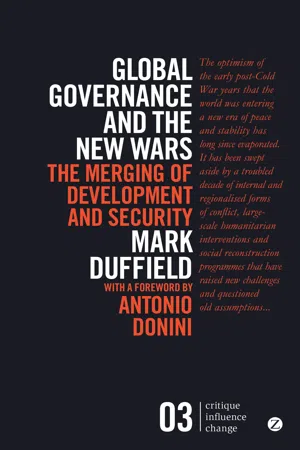
In this hugely influential book, originally published in 2001 but just as - if not more - relevant today, Mark Duffield shows how war has become an integral component of development discourse. Aid agencies have become increasingly involved in humanitarian assistance, conflict resolution and the social reconstruction of war-torn societies. Duffield explores the consequences of this growing merger of development and security, unravelling the nature of the new wars and the response of the international community, in particular the new systems of global governance that are emerging as a result.
An essential work for anyone studying, interested in, or working in development or international security.
- English
- ePUB (mobile friendly)
- Available on iOS & Android
eBook - ePub
About this book
Information
1
Introduction
The New Development—Security Terrain
The optimism of the early post-Cold War years that the world was entering a new era of peace and stability has long since evaporated. It has been swept aside by a troubled decade of internal and regionalised forms of conflict, large-scale humanitarian interventions and social reconstruction programmes that have raised new challenges and questioned old assumptions. During the mid-1990s the need to address the issue of conflict became a central concern within mainstream development policy. Once a specialised discipline within international and security studies, war and its effects are now an important part of development discourse. At the same time, development concerns have become increasingly important in relation to how security is understood. It is now generally accepted that international organisations should be aware of conflict and its effects and, where possible, gear their work towards conflict resolution and helping to rebuild war-torn societies in a way that will avert future violence. Such engagement is regarded as essential if development and stability are to prevail. These views are well represented in the policy statements of leading inter-governmental organisations;1 international financial institutions;2 donor governments;3 United Nations agencies;4 influential think-tanks;5 international NGOs;6 and even large private companies.7 At the same time, the literature on humanitarian assistance, conflict resolution and post-war reconstruction has burgeoned,8 new university departments and courses have sprung up, and practitioner training programmes have been established. Conflict-related NGOs have emerged, while existing NGOs have expanded their mandates. In addition, donor governments, international financial institutions (IFIs), intergovernmental organisations (IGOs) and the UN have all created specialist units and committees. Linking these developments, dedicated multidisciplinary and multisectoral fora and networks have multiplied.
This book is a critical reflection on the incorporation of war into development discourse. The shift in aid policy towards conflict resolution and societal reconstruction is analysed not merely as a technical system of support and assistance, but as part of an emerging system of global governance. In order to frame this approach, the introduction has two main parts. First, the changing nature of North–South relations is described in broad terms. In particular, it is argued that the capitalist world system is no longer a necessarily expansive or inclusive complex. Since the 1970s, formal trade, productive, financial and technological networks have been concentrating within and between the North American, Western European and East Asian regional systems at the expense of outlying areas. On the basis of raw materials and cheap labour alone, the inclusion of the South within the conventional global economy can no longer be taken for granted. The second part of the introduction builds on this reconfiguration and focuses particularly on its association with the reinterpretation of the nature of security. Today, security concerns are no longer encompassed solely by the danger of conventional interstate war. The threat of an excluded South fomenting international instability through conflict, criminal activity and terrorism is now part of a new security framework. Within this framework, underdevelopment has become dangerous. This reinterpretation is closely associated with a radicalisation of development. Indeed, the incorporation of conflict resolution and societal reconstruction within aid policy – amounting to a commitment to transform societies as a whole – embodies this radicalisation. Such a project, however, is beyond the capabilities or legitimacy of individual Northern governments. In this respect, the changing nature of North–South relations is synonymous with a shift from hierarchical and territorial relations of government to polyarchical, non-territorial and networked relations of governance. The radical agenda of social transformation is embodied within Northern strategic networks and complexes that are bringing together governments, NGOs, military establishments and private companies in new ways. Such complexes are themselves part of an emerging system of global liberal governance.
From a capitalist to a liberal world system
The nation state was a political project based upon a logic of expansion, inclusion and subordination. It was also closely associated with the growth of a capitalist world system. Until the 1970s, this system was widely perceived as a geographically expanding and spatially deepening universe (Wallerstein 1974). A broad consensus held that capitalism had grown over several hundred years from its European origins to span the globe by the end of the nineteenth century. Indeed, contrary to some of the current views on globalisation, a few writers have even argued that the world economy reached a peak of interdependence and openness in the early years of the twentieth century that has not been equalled since (Hirst and Thompson 1996). While such detail is contested, in capitalism’s seemingly inexorable forward march other social systems fell before it and, for better or worse, found themselves subordinated to its logic. Even the peripheral areas of the world system were valued for their raw materials and cheap labour and were typically incorporated through colonial or semi-colonial relations of tutelage (Rodney 1972). In the capitalist core areas, bureaucratic, juridical and territorially based state systems developed. Through the emergence of widening forms of legal, political and economic protection, state actors forged inclusive national identities from the disparate social groups that lay within state borders.9 On the basis of the growing competence of the nation state, citizens were expected to be loyal and defer to its normative structures and expectations (Derlugian 1996).
The 1970s are widely regarded as signalling a profound and historic change in the nature of the capitalist world system and with it the nation state. From this period, while market relations have continued to deepen in core areas, the future of capitalism as a globally expansive and inclusive system has been increasingly questioned (Hopkins and Wallerstein 1996). Contrary to popular views of globalisation which often portray capitalist relations as redoubling their penetration and interconnection of all parts of the globe (for examples see Waters 1995), the core regions of what could now be termed the liberal world system appear to be consolidating and strengthening the ties between them at the expense of outlying areas. In a review of the existing quantitative information, Hoogvelt (1997: 69–89) has argued that in broad terms the loci of economic power and influence in the world have remained remarkably stable for the past several hundred years. The one major exception is the relatively recent emergence of a number of East Asian countries to join Japan in confirming that region, together with the North American and Western European systems, as one of the core areas of an emerging global informational economy (Castells 1996).
If globalisation has a meaning in this context, it is the consolidation of several distinct but interrelated regionalised economic systems as the core of the formal international economy. Moreover, rather than continuing to expand in a spatial or geographical sense, the competitive financial, investment, trade and productive networks that link these regionalised systems have been thickening and deepening since the 1970s. Although there are, of course, many differences that separate them, these core regionalised systems of the global informational economy are here figuratively described as the ‘North’. Correspondingly, the areas formally outside or only partially or conditionally integrated into these regional networks are loosely referred to as the ‘South’. The inclusion of the South within the conventional economic flows and networks of the global economy – even when raw materials and cheap labour are available, even as unequal and exploited subjects – can no longer, as in the past, be taken for granted.
The architecture of the global economy features an asymmetrically interdependent world, organised around three major economic regions and increasingly polarized along an axis of opposition between productive, information-rich, affluent areas, and impoverished areas, economically devalued and socially excluded. (Castells 1996: 145)
In the case of Africa, for example – with the exception of South Africa and, beyond it, a certain number of prized raw materials, niche tropical products and adventure tourism – commercial investment has collapsed since the 1970s. In much of the former Soviet Union a similar lack of interest exists, as evidenced by relatively low levels of Western investment in all fields except energy and a number of valuable raw materials. Manuel Castells (1996, 1998) has argued that global capitalism no longer operates on the basis of expansion and incorporation but on a new logic of consolidation and exclusion (see also Hirst and Thompson 1996: 68–9).
There are numerous instances of the logic of exclusion informing North–South relations, including the increasing restriction of immigration from the South since the 1970s and the hardening of the international refugee regime (UNHCR 1995). Indeed, the present refugee regime can best be described as one of return rather than asylum. Although some views of globalisation stress interconnection and integration, the movement of poor people from the South to the North, and even across international boundaries in the South itself, is becoming more difficult and contested. Writing in a similar vein, Robert Cox has argued that the irrelevance of much of the world’s population in relation to the formal global economy is manifest in the shift from attempts to promote economic development in the South ‘in favour of what can be called global poor relief and riot control’ (Cox 1995: 41). Restriction, in many cases, has been matched by a system concordance geared to attempting to develop methods of population containment. During the first half of the 1990s, for example, a key response to the new wars of the post-Cold War era was the emergence of system-wide UN humanitarian operations. Largely through negotiating access with warring parties, in Africa and the Balkans, for example, aid agencies developed the means of providing humanitarian assistance directly to populations within their countries and areas of origin (Duffield 1997). Such operations, together with related ‘safe area’ policies, had the effect of encouraging war-affected populations, with varying degrees of success, to remain within conflict zones and to avoid crossing international borders.
The idea of exclusion, however, should not be understood too literally. As well as a closing of doors or severing of relationships, exclusion is also a subordinating social relationship embodied in new relations of connection, interaction and interdependence. In other words, the concept of exclusion encompasses both new types of restriction and emergent and subordinating forms of North–South integration.
The ambivalence of Southern exclusion
Political economy has largely understood Southern exclusion in terms of the ambivalence of its present economic position within the global economy. On the one hand, evidence suggests that the South has been increasingly isolated and excluded by the dominant networks of the conventional global informational economy. Many traditional primary products are no longer required or are too low-priced for commercial exploitation, investment is risky, the available workforce lacks appropriate skills and education, markets are extremely narrow, telecommunications inadequate, politics unpredictable, governments ineffective, and so on. Regarding much of Africa, Castells has argued that liberal economic reform has revealed its ‘structural irrelevance’ for the new informational economy (Castells 1996: 135). At the same time, however, formal economic exclusion is not synonymous with a void, far from it. The South has effectively reintegrated itself into the liberal world system through the spread and deepening of all types of parallel and shadow transborder activity (Bayart et al. 1999). This represents the site of new and expansive forms of local–global networking and innovative patterns of extra-legal and non-formal North–South integration.
Not only does exclusion imply both isolation and subordinating forms of interaction, the terms North and South also require some qualification. They are no longer regarded as relating to just spatial or geographical realities. They are now as much social as they are territorial.10 Under the impact of market deregulation and the increased ease with which finance, investment and production can cross borders, although North–South distinctions are still geographically concentrated, they also reflect important non-territorial social modalities. While the gap in per capita income between Northern and Southern countries has been widening for generations (Hoogvelt 1997; UNDP 1996), similar gaps between the richest and poorest sections of the population in the North have also grown. Castells (1996: 145) describes as ‘an enduring architecture and variable geometry’ this qualified consolidation of historic North–South geographic divisions, accompanied at the same time by a growing non-territorial fluidity of the social modalities involved. Thus, within the networks and flows of the global economy, the North now has a ‘variable geometry’ of pockets of impoverishment, redundant skills and social exclusion, just as within ‘the enduring architecture’ of the South even the poorest countries usually have small sections of the workforce connected to high-value global networks. Indeed, such connections are important in understanding the new wars. They reflect the points at which the control of markets and populations, together with their selective integration into the networks of global governance, are often contested.
In studying the new wars, one is largely reliant on the contribution of political economy and anthropology. However, the literature has yet to make up its mind. Indeed, much of the work on global political economy avoids any serious analysis of the South.11 Moreover, in relation to political economy, where the South is discussed, there is a major division between viewing the new wars as social regression or, in contrast, as systems of social transformation. That is, there is a distinction between seeing conflict in terms of having causes that lead mechanically to forms of breakdown, as opposed to sites of innovation and reordering resulting in the creation of new types of legitimacy and authority. This contrast, moreover, relates not only to political economy. It is a generic division that characterises the literature on the new wars in general. Most donor governments and aid agencies, for example, tend to see conflict as a form of social regression. For political economy, while its analysis of the exclusionary logic within global liberal governance contains a number of useful insights, much of this work has not translated into a credible theory of the new wars. Manuel Castells, a key figure in the analysis and documentation of the changing global political economy, well illustrates this failure. There is a risk in arguing that the new system logic results in the exclusion of the South from the dominant networks of the global economy, which it appears to do. The danger is to overstate the case and follow through with an implied void of scarcity that, it is assumed, leads to growing resource competition, breakdown, criminalisation and chaos. For Castells, the declining investment in Africa has led to a heightened competition for control of the remaining resources, including the state:
[B]ecause tribal and ethnic networks were the safest bet for people’s support, the fight to control the state … was organised around ethnic cleavages, reviving centuries-old hatred and prejudice: genocidal tendencies and widespread banditry are rooted in the political economy of Africa’s disconnection from the new global economy. (Castells ...
Table of contents
- Cover
- About The Author
- Title
- Copyright
- Dedication
- Contents
- Acknowledgements
- List of abbreviations
- Foreword
- Preface to the critique influence change edition
- 1. Introduction: The New Development–Security Terrain
- 2. The Merging of Development and Security
- 3. Strategic Complexes and Global Governance
- 4. The New Humanitarianism
- 5. Global Governance and the Causes of Conflict
- 6. The Growth of Transborder Shadow Economies
- 7. Non-Liberal Political Complexes and the New Wars
- 8. Internal Displacement and the New Humanitarianism: Displacement and Complicity in Sudan (Part 1)
- 9. Aid and Social Subjugation: Displacement and Complicity in Sudan (Part 2)
- 10. Conclusion: Global Governance, Moral Responsibility and Complexity – Internal Displacement and the New Humanitarianism
- Bibliography
- Index
Trusted by 375,005 students
Access to over 1.5 million titles for a fair monthly price.
Study more efficiently using our study tools.
Frequently asked questions
Yes, you can cancel anytime from the Subscription tab in your account settings on the Perlego website. Your subscription will stay active until the end of your current billing period. Learn how to cancel your subscription
No, books cannot be downloaded as external files, such as PDFs, for use outside of Perlego. However, you can download books within the Perlego app for offline reading on mobile or tablet. Learn how to download books offline
We are an online textbook subscription service, where you can get access to an entire online library for less than the price of a single book per month. With over 1.5 million books across 990+ topics, we’ve got you covered! Learn about our mission
Look out for the read-aloud symbol on your next book to see if you can listen to it. The read-aloud tool reads text aloud for you, highlighting the text as it is being read. You can pause it, speed it up and slow it down. Learn more about Read Aloud
Yes! You can use the Perlego app on both iOS and Android devices to read anytime, anywhere — even offline. Perfect for commutes or when you’re on the go.
Please note we cannot support devices running on iOS 13 and Android 7 or earlier. Learn more about using the app
Please note we cannot support devices running on iOS 13 and Android 7 or earlier. Learn more about using the app
Yes, you can access Global Governance and the New Wars by Mark Duffield in PDF and/or ePUB format, as well as other popular books in Politics & International Relations & International Relations. We have over 1.5 million books available in our catalogue for you to explore.