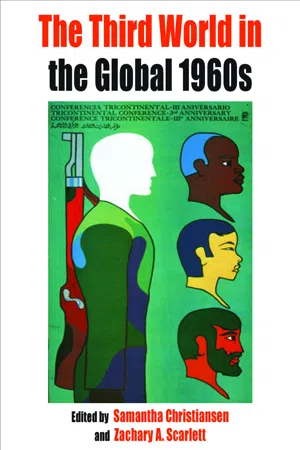
Decades after the massive student protest movements that consumed much of the world, the 1960s remain a significant subject of scholarly inquiry. While important work has been done regarding radical activism in the United States and Western Europe, events in what is today known as the Global South—Asia, Africa, and Latin America—have yet to receive the attention they deserve. This volume inserts the Third World into the study of the 1960s by examining the local and international articulations of youth protest in various geographical, social, and cultural arenas. Rejecting the notion that the Third World existed on the periphery, it situates the events of the 1960s in a more inclusive context, building a richer, more nuanced understanding of the era that better reflects the dynamism of the period.
eBook - ePub
The Third World in the Global 1960s
- 242 pages
- English
- ePUB (mobile friendly)
- Available on iOS & Android
eBook - ePub
The Third World in the Global 1960s
About this book
Trusted by 375,005 students
Access to over 1.5 million titles for a fair monthly price.
Study more efficiently using our study tools.
Information
Crossing Borders: The Idea of the Third World and the Global 1960s
Chapter 1
A Shared Space of Imagination, Communication, and Action
Perspectives on the History of the “Third World”
Does the Third World still exist? Stating the growing empirical diversity of the societies grouped together under this overall label, economists and political scientists have repeatedly proclaimed the “end of the Third World” since the 1970s.1 In the 1980s, the Third World concept came under attack from a theoretical perspective: Post-structuralist critics condemned it as an essentialist and, indeed, Eurocentric approach, confronting it with what they described as a multiplicity of margins outside the realm of Western modernity.2 In 1989–1991, the end of the Cold War and the collapse of the socialist Second World seemed to finalize the doubts that social scientists had been raising for years as to the empirical and theoretical validity of a world view dividing the globe into three parts for analytical—but also for economic, political, military, and ideological—purposes. Since the 1990s, new dynamics of global interconnectedness and the triumph of the new paradigm “globalization” have furthered the decline of the three-worlds concept. The term Third World itself may even disappear from usage altogether. Thus, a better way to put the question, and, indeed, the central enquiry of this chapter is: What was the Third World?3
Given the paramount importance of the cosmology of the three worlds for the second part of the twentieth century, comparatively little historical research has been done on the genealogy of the concept and its myriad effects on political, social, and cultural representations and actions.4 This is particularly true in regard to the history of “1968” and the counter-hegemonic movements of the “long” 1960s5 all over the world.6 The connection between “1968” and the Third World is still frequently reduced to the impact of the Vietnam War for Western protest movements in the 1960s. Although extensive and important work has been done on this aspect, I would like to emphasize several aspects that have sometimes been neglected. First, this war was perceived by contemporary 68ers as being part of a larger Third World problematic shaped by the confrontation of “imperialism” and “anti-imperialism.” Second, representations as well as techniques of protest used by the Western opposition to the Vietnam War were only partly new, while on the other hand dating back to the Algerian war, the Cuban revolution, and other founding experiences of Third Worldism in the 1960s. Third, the Vietnam War set aside, “1968” was also taking place in various Third World countries ranging from Senegal to Mexico, China, India, Turkey, and many others, thus turning 1968 in a global phenomenon.
For many of the protesters of the 1960s—as will be argued in this chapter—the Third World was essential: the concept allowed for a radical critique of existing systems of power and representations while permitting them at the same time to elaborate equally radical alternatives. The Third World stimulated the transnational mobilization of protest movements. It had profound effects on worldviews and self-images of intellectuals and activists. To begin with, this chapter provides an overview of the making of the “Third World” in the social sciences and political discourse of the long 1960s. More specifically, it will address the situation in France, where the concept was invented in 1952, established as a scientific paradigm in 1956, and, around 1960, turned into a highly politicized symbol in the context of post-war consumer capitalism, the Cold War, and the process of decolonization, especially the Algerian war. It will be argued that this symbol spread globally and created a space of imagination, communication, and action shared by, but at the same time specifically divided between, the First and the Third Worlds, thus producing its fundamental ambivalence.
The Making of the Third World: Consumer Capitalism, Cold War, and Decolonization
Given the centrality of notions like “development” or “progress” for the idea of the Third World, the concept’s history in a broader sense must be traced back at least as far as the eighteenth century. While Christian notions of a teleological history of salvation lingered on, they merged with a developmentalist paradigm emerging in scientific discourses and new time concepts emanating from the socioeconomic and cultural upheavals caused by the Industrial Revolution. Together, these strands shaped the idea of constant material und immaterial “progress” in natural and human history.7 As for the latter, progress and “civilization” were thought to be originating in the rationality of “the West”8 and its specifically “modern”9 societies, but at the same time were ascribed universal validity. Hence, the duty of Western civilization seemed to be spreading its particular mode of societal organization to the rest of the world. In the course of the nineteenth century, this “White Man’s Burden” or “civilizing mission” was foundational for the legitimatory discourse of European colonialism in Asia and Africa.10 After the First World War, Europeans warranted their ongoing colonial rule in these territories (as well as the mandate system of the League of Nations) under the heading of their mise en valeur, or development.11 While Europeans, as a result, had firmly established the belief in development by the mid twentieth century, the related concept of “underdevelopment” brought forth in the aftermath of the inaugural address of US President Harry S. Truman in January 1949 was a terminological innovation. This powerful innovation induced a set of semantic shifts as well as new institutions and practices that shaped the transition from European colonial rule to the US-dominated, post-colonial “development age” of the subsequent decades.12
The new signal term underdevelopment was also the starting point in the invention of the Third World. When, in 1952, economist and demographer Alfred Sauvy (1898–1990)13 created the term tiers monde in an article entitled “Trois mondes, une planète” in the French magazine L’Observateur,14 he referred to the underdeveloped countries outside either of the camps of the Cold War. In defining the Third World for the first time in history, Sauvy thus combined the recently established notion of underdevelopment as socioeconomic backwardness plus demographic pressure with a geopolitical argument: The competition between the developed societies in the capitalist First and the socialist Second World, Sauvy thought, was centered on, shaped by, and even originated in the existence of a Third World.15 Although it was underdeveloped, and although it was ignored, exploited, and disdained like the Third Estate had been on the eve of the French Revolution, the Third World held a central place in contemporary world politics. Like the Third Estate some 160 years earlier, the Third World was striving for recognition and power. It constituted—and that was Sauvy’s equally central and predictive claim—a potentially revolutionary force.16 By relating the upcoming non- or even anti-European revolutions of the Third World to the French and Western histories of enlightenment and progress, Sauvy, a liberal Republican himself, endowed the project of Third World emancipation and development—which he thought were inseparable—with a historical legitimacy that stemmed from a European, indeed Eurocentric, worldview. The resulting ambivalence was to mark durably the concept of the Third World.
Sauvy, the head of the French Institut National d’Études Démographiques (INED) between 1945 and 1962, had invented a new geopolitical space, a new world; his close collaborator at the Institute, anthropologist, sociologist, and Africanist Georges Balandier (born in 1920) was to transform Sauvy’s journalistic catchphrase into a paradigm of the emerging “modern” social sciences. In 1956, Balandier edited the first book ever to have the Third World on its cover: the contributions in Le “tiers monde”: Sous-développement et développement displayed a multidisciplinary approach.17 Economists, political scientists, sociologists, ethnologists, geographers, demographers, and historians were explaining the past, present, and future of what they understood to be the underdeveloped world. Adding a third criterion to the economic and geopolitical features identified by Sauvy (insufficient development and a neither-nor position in the Cold War), they stressed a historical commonality of underdeveloped societies. All of them, so went the argument, were still or had been until recently colonized by European powers. None of the contributors, actually, used the term tiers monde, but since Balandier published their articles under this overall heading, they nevertheless effectively contributed to the discursive institutionalization of the concept. One step further in setting up this new discourse was the launching of the review Tiers Monde by the French Institut d’Étude du Développement Économique et Social (IEDES) in 1960.18 While books bearing tiers monde in their title became more and more frequent in France since 1961,19 from 1963 onward, the French term was translated first into English, German, or Swedish,20 then into possibly every other language of the contemporary world. Quickly, the rather off-the-cuff invention of a French professor had become a global success story.
But what made the idea of the Third World so attractive? In the eyes of contemporaries, the concept had great plausibility, since it allowed conceptualizing three parallel, but also partly interdependent economic, geopolitical, and historical reconfigurations of the post-war world. The first of these changes was the emergence of a US-dominated economic world system whose center of gravity was the “Atlantic integration” of Western nations.21 Their economies benefited above all others from the rapidly growing quantity of international trade. Until the oil crisis of 1973–1974, the West experienced a “golden age,” characterized by three decades of unprecedented growth creating enormously prosperous societies of mass consumerism.22 This overabundance contrasted all the more dramatically with what simultaneously came to be perceived as the dreadful misery of two thirds of the global population; by contrast to the happy few in the First and the competing Second World, material conditions, societal organization, and the people of the Third World were now looked upon as being essentially poor and underdeveloped.23 Thus constructing their need for development—a perception soon to be shared by many Africans, Asians, and Latin Americans themselves—the Third World became an object and actor of Cold War rivalries. While trying to export theories and practices of “modernization”24 and development, the First and Second Worlds strived to prove the superiority of their respective societies and, by doing so, create allegiances in the new Third World and its “young nations.”
In addition to the developed/underdeveloped divide, the Cold War, then, became the second important frame in defining global politics and Third World characteristics. Despite what many people had been hoping for, the forceful anti-Hitler coalition, resting for a large part on the economic strength of the US and the human potential of the USSR, was definitely over by 1947. The old allies had become superpowers fighting each other by every means possible—every means except open warfare in direct confrontation, which was, with regard to the destructive potential of nuclear weapons on both sides of the iron curtain, no longer an option. Washington, DC, and Moscow became the defining centers of their respective political, economic, and military “camps” in a bipolar world. But bipolarity was not total, and many territories did not want to conform to the East-West dichotomy and its Cold War. Rather, they constituted a third space of global politics, a Third World acting on the two superpowers as well as experiencing enticements and pressures from them—often resulting in dreadfully hot proxy wars.25
The third reconfiguration of the global post-war era reflected in the concept of the Third World was decolonization. The Second World War had accelerated the end of Empire, leading to the formation of new nation-states in the former colonies. The decolonization of Asia—with the exception of ...
Table of contents
- Cover Page
- Title Page
- Copyright Page
- Contents
- Preface to the Paperback Edition
- Foreword: The Third World in 1968
- Introduction
- Part I. Crossing Borders: The Idea of the Third World and the Global 1960s
- Part II. Fresh Battles in Old Struggles: New Voices and Modes of Expression
- Part III. Unfinished Business: Challenging the State’s Revolution
- Bibliography
- Notes on Contributors
- Index
Frequently asked questions
Yes, you can cancel anytime from the Subscription tab in your account settings on the Perlego website. Your subscription will stay active until the end of your current billing period. Learn how to cancel your subscription
No, books cannot be downloaded as external files, such as PDFs, for use outside of Perlego. However, you can download books within the Perlego app for offline reading on mobile or tablet. Learn how to download books offline
Perlego offers two plans: Essential and Complete
- Essential is ideal for learners and professionals who enjoy exploring a wide range of subjects. Access the Essential Library with 800,000+ trusted titles and best-sellers across business, personal growth, and the humanities. Includes unlimited reading time and Standard Read Aloud voice.
- Complete: Perfect for advanced learners and researchers needing full, unrestricted access. Unlock 1.5M+ books across hundreds of subjects, including academic and specialized titles. The Complete Plan also includes advanced features like Premium Read Aloud and Research Assistant.
We are an online textbook subscription service, where you can get access to an entire online library for less than the price of a single book per month. With over 1.5 million books across 990+ topics, we’ve got you covered! Learn about our mission
Look out for the read-aloud symbol on your next book to see if you can listen to it. The read-aloud tool reads text aloud for you, highlighting the text as it is being read. You can pause it, speed it up and slow it down. Learn more about Read Aloud
Yes! You can use the Perlego app on both iOS and Android devices to read anytime, anywhere — even offline. Perfect for commutes or when you’re on the go.
Please note we cannot support devices running on iOS 13 and Android 7 or earlier. Learn more about using the app
Please note we cannot support devices running on iOS 13 and Android 7 or earlier. Learn more about using the app
Yes, you can access The Third World in the Global 1960s by Samantha Christiansen, Zachary Scarlett, Samantha Christiansen,Zachary Scarlett in PDF and/or ePUB format, as well as other popular books in History & 20th Century History. We have over 1.5 million books available in our catalogue for you to explore.