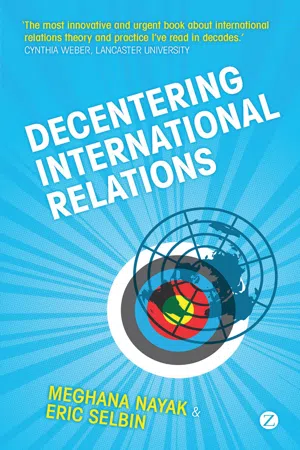
Decentering International Relations seeks to actively confront, resist, and rewrite International Relations (IR), a heavily politicized field that is deeply centered in the North/West and privileges certain perspectives, pedagogies, and practices. Is it possible to break the chain of signifiers that always leads IR studies back to the US and its European allies?
Through engagement with a variety of theories (ranging beyond the usual 'mainstream' versus 'critical/alternative' binary), and conversations with scholars, activists, and students, the authors invite the reader to participate in an accessible yet provocative experiment to decentre the North/West when we learn, study and do IR. In particular, they examine how the pressing issues of 'human rights', 'globalization', 'peace and security', and 'indigeneity' are simultaneously normative inventions meant to sustain particular power structures and sites for insurgent and subversive attempts to live IR at the margins.
Selbin and Nayak have written a remarkable and provocative re-envisioning of a globally important subject.
- English
- ePUB (mobile friendly)
- Available on iOS & Android
eBook - ePub
Decentering International Relations
About this book
Information
Chapter One / Introduction
Us, Them, Over There
‘What they really need is education.’
‘So, what can we do to help?’
‘We shouldn’t impose our way of life on them, especially when they’re not ready and don’t want it. Some people just aren’t used to democracy and freedom.’
‘They should take care of their own problems; we have enough of our own.’
‘The US is not the world’s policeman.’
‘They hate our way of life and everything about us.’
No doubt, comments like these are quite familiar to the reader. You may have heard them in a classroom, at work, during a dinner conversation, or while watching a news program. Have you noticed how quickly a conversation about some issue in the world shifts to what ‘we’ should do (or not do) about ‘them,’ living ‘over there’? We lose the nuances of the situation in question and start debating whether the US should ‘stay out of it’ or ‘go in’ because only it is capable of doing so. We are confident that our information is solid, intentions good, motives pure, and capability to engender change evident. In this book, we claim that we impoverish our understanding of the world by always beginning from – or inserting, referencing, gesturing towards – the US. In this way we treat the US/the North/the West as actors and all beyond this reference point as mere issues to be figured out or theorized by ‘us.’ We rely upon concepts and theories that lead us back to an ‘us–them–over there’ frame that seems to recycle endlessly.
When we teach or learn International Relations (IR), we are purportedly attempting to understand for whom power works and how, with the added dimension of where power resides. Thus, the outsized role the US has come to play in world affairs cannot (and should not) be ignored. At the same time, it is a common mistake to read the US as some omnipotent potentate endowed with particular gravitas and uniquely equipped to understand and solve the problems of the world and its population at every level from the local to the global. The world’s people do not greet their day wondering what it is ‘we’ think or what it is ‘we’ want them to do. And, surely, there must be a way to speak about those directly affected by US hegemonic power without lapsing into multiple, barely substantiated presumptions. While the US has had a disproportionate role in shaping certain processes and situations for some hundred years now, the myriad possibilities of global politics are not delimited by US actions or power.
This book claims that IR – as a body of knowledge and set of discourses, as a discipline/field of study in which we participate as scholars, theorists, and students, and as a field of ‘practical’ political decisions and structures1 – is ‘centered.’ This centering has four main attributes. First, IR focuses primarily on and legitimizes the actions and decisions of the US and the global North/West. Second, IR privileges certain political projects, such as neoliberal economic policies, state-centrism, and Northern/Western liberal democracy.2 Third, IR legitimizes the most privileged socio-political players and institutions, in both the Global North/West and the Global South,3 to produce knowledge and make decisions about the rest of the world, thus replicating or maintaining certain unequal power relationships. Finally, IR examines certain understandings of political concepts (such as sovereignty) and particular narratives that can elide, distort, or completely miss multiple ways of understanding and living in the world. Why do our studies, questions, policies, and research always start and end this way – in the center, in the North/West?
When we say ‘North/West,’ we mean primarily the US, but also Great Britain, ‘Western’ European countries, and, depending on context, limited others.4 It is not always entirely clear, beyond geography, what makes these places ‘Western,’ but countries, people, scholars, and institutions ensconced in the Global North/West represent themselves as ‘universal,’ developed, and civilized – erasing how they got into privileged military, economic, socio-cultural, diplomatic, and political relationships with the so-called Third World/Global South.5 Think of the ‘center’ as the nucleus: this is where decisions are made, discourses are legitimized, and people and entities are put in positions to further entrench the most privileged ways of thinking about the world.
How do you see the ‘centers’ of power operating? Who is in your ‘we,’ and who is (most) decidedly not? Even when you say ‘we’ should hold ‘our’ government accountable for ‘our’ foreign policy because ‘our’ taxes are paying for unpopular wars, have you asked yourself what benefits you derive from being a part of this ‘we’? Do you ever wonder if the peasants, farmers, oppressed women, child soldiers, sick and dying, poor – or others you study, categorize, and write about – are sitting around somewhere wondering about you, ready to compile a list of recommendations about what to do about you and your problems? If you are a student or scholar of IR, or any discipline that explores global politics, if you are part of a governmental or nongovernmental organization with an international focus, if you practice international law or engage in international commerce, or if you are an activist involved in various global issues, we would like you, with us, to question what we have been taught, by whom, and how, and the effects of what we study and do. Even if you believe you have nothing to do with IR theories, scholarship, professors, or organizations, they have something to do with you; and the way you think, live, and act in the world matters fundamentally.
We are articulating the thorny recognition that IR, as we practice, teach, learn, and fund it, is more likely to reinforce domination than to encourage discussion and dissent; despite our very real desires, this is the case no matter how good anyone’s intentions are (a point to which we will return).What kind of way is this to think about, to ‘do,’ IR? And, what can and should we do about it? As two professors of political science located in the US, we have found that it is often difficult to teach, learn, and speak about IR in any other way. We return to our offices after class, wondering whether we offered adequate challenges to, and rethinking of, the usual ways of doing IR. So this book emerged out of a seemingly simple question: given how Northern/Western scholars, practitioners, analysts, discourses, concepts, and political projects dominate IR (the discipline, the body of knowledge, the practical politics), is it possible to decenter IR, to decenter the US and the Global North?
Fundamentally, we want to make three points which frame our response. First, we wish to recognize the narrative(s) that have dominated and hence disciplined the field of IR. In other words, we examine the ‘story of IR.’
Second, the notion of decentering is more than simply a matter of semantics or an abstract game, more than an opposition to or the flip side of centering. We aim to call out the ‘centeredness’ of IR, whether that means the focus on the North/West, and the US in particular, as the center of the world, the role of certain institutions, universities, scholars, and practitioners in creating ‘knowledge’ about ‘Others,’ or the material effects of power relationships on people’s daily lives. A centered IR erases how we got here, and privileges sovereignty, hierarchy, and certain kinds of power over intersubjectivity, agency, identity, engagement, responsibility, and accountability (Agathangelou and Ling, 2004: 44). To decenter IR from its Northern/Western anchors requires us to challenge the politics, concepts, and practices that enable certain narratives of IR to be central; decentering is also a way to put forth and participate in other kinds of narratives and politics that have different ‘starting’ points. In particular, this book focuses on how the specific, pressing issues of indigeneity, human rights, globalization, and peace and security are simultaneously normative inventions/categories meant to sustain (and even extend) particular power structures and sites for insurgent and subversive attempts to live IR at the margins.
Third, we articulate a set of questions we believe are or should be critical for decentering IR’s narratives. We explore what it means for us, as the authors, to join conversations ‘at the margins’ of IR. In effect, to decenter IR is to start with the possibility of a world that operates and is shaped in ways that are fundamentally different from what we ‘know.’ We aim to recognize our privileges as loss and our marginality as power, and to connect with people who are remaking their worlds.
The Story of IR
Critical IR theories, varied as they may be, generally challenge the world as ‘given,’ thus tracing and revealing power structures that are accepted as natural and inevitable. A significant number of critical IR scholars have argued that IR perpetuates and legitimizes particular ‘stories’ or narratives, so what follows might be familiar to you. In story of IR as it is told, the fifteenth century heralded the advent of the ‘Age of Discovery’ (or ‘Exploration’), when ‘the Europeans’ (hardly, it merits note, a monolithic crowd) began to set out principally by water for more distant lands. ‘Western Europe’ (primarily Portugal, Spain, France, Great Britain, and the Netherlands, and eventually by extension some of the ‘white’ settler regimes) stood as the repository of knowledge, wisdom, and vision, and it set out to ‘discover’ a wider world. Generously, as the story unfolds, in return for little more than raw materials and some traded goods, these Christian Europeans brought civilization to the benighted in the disordered, and hence discordant, morass.
The world beyond (sometimes just outside, such as Russia, or even within, as with Ireland) Europe’s still ill-defined borders cried out, the Europeans believed, for the order and rigor they, with the best interests of all human beings at heart, could provide. In this era, states were still in formation, and territorial sovereignty as an organizing principle partly aimed to deal with religious differences and to prevent the intervention of the Pope, Holy Roman Emperor, and various others into the emerging state’s internal affairs. But from early on sovereignty and the modern state system were also deployed to mark a difference from and to discipline and control the colonized world (Anghie, 2005). Whatever violence, atrocities, or oppression occurred during colonialism receive no mention in the story, or pale in comparison to the achievements of industrialization and civilization. As Krishna (2001) reveals in his examination of encounters between Europe and Africa, Spain and Mexico, and Great Britain and India, IR discourse misrepresents, simplifies, and deeply distorts the importance of these dramatically lopsided interactions.
Certainly, colonization presaged the Age of the Enlightenment and the concomitant self-styled and self-anointed onus for the North/West, the ‘white man’s burden,’6 which would increasingly be the framework for the liberalism and rationalism that defined the nineteenth century. As the story continues, it marks the twentieth century, however specified,7 by a number of great calamities and innumerable tragedies produced by human actions. Eventually a US protagonist emerged, having ‘matured’ during its experiences in World War Two, ready to take on Great Britain’s abandoned role of hegemon – abandoned, it is worth noting, after defeat and rejection. This ‘great’ war apparently deeply shaped the world we live in and profoundly framed and ineluctably structured the rise of a field of study known as International Relations. As decolonization increased the number of sovereign states, the US and its mainly European allies increasingly created and institutionalized regimes of ‘global governance,’ so as to manage the conflict with and within the so-called developing world. Of course, not all countries and regions decolonized in the same way or at the same pace – we may compare, for example, South America and South Asia, or question whether indigenous peoples experienced decolonization. The post-Soviet and southeastern European states that gained independence in the 1990s present a further challenge, having had different experiences from each other, from decolonized countries, and in relationship to Russia.
But the story continues nonetheless: the locus of knowledge (and, indeed, ‘truth’) is firmly entrenched in the North/West; the scholars, policy makers, and practitioners who are charged with the creation, protection, and ‘dissemination’ of that knowledge are lodged in, represent, or are somehow tied to the North/West. The story lets some of us – and only some of us – be storytellers (of this story or close iterations) and come up with ways to help the rest of the world ‘catch up,’ even though ‘we’ know that it really cannot and will not. The story, it should be noted, deftly interweaves pragmatic politics and the discipline/field/ discourses of IR. For too long, this story has bluntly or subtly driven our understanding of ‘international,’ of ‘relations,’ and of what constitutes legitimate knowledge worthy of our attention. It is a story with a Euro- and Anglocentric chronology of discovery and enlightenment (colonialism), the ‘world’ wars, pre- and post-Cold War (which was often quite hot in parts of the world far removed from the primary antagonists), and pre- and post-9/11, as if all of the world is similarly shaped by these events and singularly obsessed with joining the ‘march of progress’ and being on the ‘right’ side of history.
Agathangelou and Ling discuss how IR
comes to resemble a colonial household … seek[ing] to stave off … ‘disorder’ [‘anarchy’; ‘local traditions of thinking, doing, and being’] by imposing ‘order.’ But the House does so by appropriating the knowledge, resources, and labor of racialized, sexualized Others for its own benefit and pleasure while announcing itself as the sole producer-father of our world. Others qualify as ‘innocent’ children, wards, or servants at best, or ‘unteachable’ barbarians at worst. (2004: 21)
This ‘House’ of IR,8 as Agathangelou and Ling call it, is not o...
Table of contents
- Cover
- About the Authors
- Title
- Copyright
- Contents
- Acknowledgments
- 1. Introduction
- 2. Indigeneity
- 3. Human Rights
- 4. Globalization
- 5. Peace and Security
- 6. Conclusion
- Notes
- References
- Index
Trusted by 375,005 students
Access to over 1.5 million titles for a fair monthly price.
Study more efficiently using our study tools.
Frequently asked questions
Yes, you can cancel anytime from the Subscription tab in your account settings on the Perlego website. Your subscription will stay active until the end of your current billing period. Learn how to cancel your subscription
No, books cannot be downloaded as external files, such as PDFs, for use outside of Perlego. However, you can download books within the Perlego app for offline reading on mobile or tablet. Learn how to download books offline
Perlego offers two plans: Essential and Complete
- Essential is ideal for learners and professionals who enjoy exploring a wide range of subjects. Access the Essential Library with 800,000+ trusted titles and best-sellers across business, personal growth, and the humanities. Includes unlimited reading time and Standard Read Aloud voice.
- Complete: Perfect for advanced learners and researchers needing full, unrestricted access. Unlock 1.5M+ books across hundreds of subjects, including academic and specialized titles. The Complete Plan also includes advanced features like Premium Read Aloud and Research Assistant.
We are an online textbook subscription service, where you can get access to an entire online library for less than the price of a single book per month. With over 1.5 million books across 990+ topics, we’ve got you covered! Learn about our mission
Look out for the read-aloud symbol on your next book to see if you can listen to it. The read-aloud tool reads text aloud for you, highlighting the text as it is being read. You can pause it, speed it up and slow it down. Learn more about Read Aloud
Yes! You can use the Perlego app on both iOS and Android devices to read anytime, anywhere — even offline. Perfect for commutes or when you’re on the go.
Please note we cannot support devices running on iOS 13 and Android 7 or earlier. Learn more about using the app
Please note we cannot support devices running on iOS 13 and Android 7 or earlier. Learn more about using the app
Yes, you can access Decentering International Relations by Doctor Meghana Nayak,Professor Eric Selbin in PDF and/or ePUB format, as well as other popular books in Politics & International Relations & International Relations. We have over 1.5 million books available in our catalogue for you to explore.