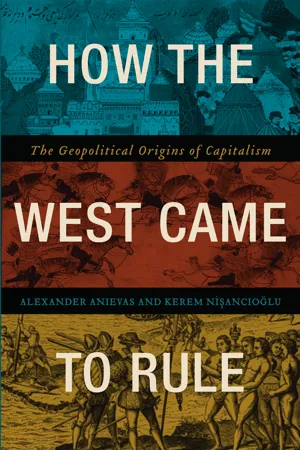
*Winner of International Studies Association (ISA)'s International Political Sociology Best Book Prize for 2017* *Winner of British International Studies Association (BISA)'s International Political Economy Working Group Book Prize of 2016* *Shortlisted for the ISA Book Prize* Mainstream historical accounts of the development of capitalism describe a process which is fundamentally European - a system that was born in the mills and factories of England or under the guillotines of the French Revolution. In this groundbreaking book, a very different story is told. How the West Came to Rule offers a interdisciplinary and international historical account of the origins of capitalism. It argues that contrary to the dominant wisdom, capitalism's origins should not be understood as a development confined to the geographically and culturally sealed borders of Europe, but the outcome of a wider array of global processes in which non-European societies played a decisive role. Through an outline of the uneven histories of Mongolian expansion, New World discoveries, Ottoman-Habsburg rivalry, the development of the Asian colonies and bourgeois revolutions, Alexander Anievas and Kerem Nisancioglu provide an account of how these diverse events and processes came together to produce capitalism.
eBook - ePub
How the West Came to Rule
The Geopolitical Origins of Capitalism
- 400 pages
- English
- ePUB (mobile friendly)
- Available on iOS & Android
eBook - ePub
About this book
Information
CHAPTER 1
The Transition Debate:
Theories and Critique
Theories and Critique
In order to examine the object of our investigation in its integrity, free from all disturbing subsidiary circumstances, we must treat the whole world as one nation, and assume that capitalist production is everywhere established and has possessed itself of every branch of industry.
Karl Marx, 18671
… events strikingly analogous but taking place in different historic surroundings led to totally different results. By studying each of these forms of evolution separately and then comparing them one can easily find the clue to this phenomenon, but one will never arrive there by the universal passport of a general historico-philosophical theory, the supreme virtue of which consists in being super-historical.
Karl Marx, 18772
Introduction
In this chapter, we critically assess a number of influential Marxist-inspired theorisations of the transition to capitalism. We focus on such Marxist-inspired perspectives not because they exhaust the range of possible approaches to theorising the transition or because we think other perspectives have nothing to offer. Rather, we centre our attention on them because the Marxist tradition has arguably examined and debated the subject of capitalism’s genesis more than any other social theoretical tradition. For these reasons, our critical examination of other important perspectives to capitalism’s origins is in later chapters – Smithian approaches in Chapter 5, new institutionalism in Chapter 7, and neo-Weberian historical sociology and the California School in Chapter 8.
The chapter is divided into three sections. The first section examines World-Systems approaches to the origins of capitalism, particularly through an engagement with the works of its most influential representative and ‘founder’, Immanuel Wallerstein. While highlighting the important contributions that World-System Theory (WST) has made to the study of capitalism’s genesis over the longue durée, we nonetheless argue that this approach – especially Wallerstein’s rendition of it – remains hamstrung by two particularly debilitating problems: the unwitting reproduction of Eurocentrism that erases non-European agency; and the inability to provide a sufficiently historicised conception of capitalism.
The next section investigates the ‘Brenner thesis’ and the theoretical apparatus (Political Marxism) that Robert Brenner’s works on the transition to capitalism have engendered. We focus on three particularly problematic and interconnected issues in their theorisation of capitalism’s inception: first, their commitment to a methodologically internalist and concomitant Eurocentric (or Anglo-centric) analysis of the origins of capitalism; second, the resulting deficiencies in their examination of the relationship between the making of capitalism and geopolitics; and third, their highly abstract and minimalist conception of capitalism.
In the third section, we consider the merits and problems of postcolonialism. The inclusion of postcolonial studies in our overview of the different approaches within the transition debate might seem unusual given that postcolonial scholars have predominantly focused on the experiences of modernity outside – and subsequent to – the emergence of capitalism in Europe. The existence of capitalism is then something largely taken for granted by postcolonial studies – a point that we argue limits their ability to fully ‘provincialise’ Europe. We nonetheless also draw out the important methodological and theoretical contributions postcolonialism offers in the study of capitalism’s origins – contributions that we seek to take up and further develop in the chapters that follow.
The ‘Commercialisation Model’ Revisited: World-Systems Analysis and the Transition to Capitalism
The Making of the Modern World-System: The Wallerstein Thesis
The most systematic exposition of WST can be found in the works of Immanuel Wallerstein, who sought to bring together longue durée history writing with the anti-hegemonic politics of the 1960s Third World movements. From dependency theorists Wallerstein took the importance of colonisation in order to explain unequal regional differentiation between the capitalist core and periphery. From Sweezy and Braudel came the emphasis on the ‘world-system’ as the unit of analysis, and relatedly the importance of trade and exchange.3 Finally, Wallerstein emphasised the historical specificity of the crisis of feudalism and the collapse of world empires as a precondition for the emergence of the capitalist world-system. This was because Wallerstein was additionally concerned with how to denaturalise capitalism, and so explore the possibility of its eventual demise.4 At the heart of this project was then establishing the historical specificity of capitalism by:
reopen[ing] the question of how and when the capitalist world-economy was created in the first place; why the transition took place in feudal Europe and not elsewhere; why it took place when it did and not earlier or later [and]; why earlier attempts of transition failed.5
The specificity of the capitalist world-system is explained through a negative comparison with the social form that preceded it, world empires. The latter were integrated systems of political rule which controlled and exploited differentiated communities on a regional and sometimes inter-regional basis. According to Wallerstein, world empires restricted economic development because large state bureaucracies would absorb surpluses appropriated from agrarian production, hindering or precluding the accumulation of capital and (re)investment in production.6 The collapse of world empires was a precondition for the emergence of capitalism, for it released profit-seeking commercial activities from the fetters of overarching imperial states. Now unrestrained, production would be ‘constantly expanded as long as further production is profitable’, and capitalists would ‘constantly innovate new ways of producing things that expand their profit margin’.7 Consequently, trade tended towards constant expansion and subsumption – ‘an expansion of the geographical size of the world in question’8 – which created a capitalist world economy by progressively ‘incorporating’ greater proportions of economic activity into its own ‘logic’. This subsumption of ‘non-capitalist zones’ into the capitalist world-system took place ‘through colonization, conquest, or economic and political domination’.9
At the heart of this expansion was an ever-increasing regional specialisation and a world division of labour.10 From this perspective, Wallerstein distinguished the emergence of the world-system via overseas expansion from the freeing of labour, deriving the latter from the former.11 That is, the world-system is capitalist not because it involves the systematic exploitation of formally free wage-labour throughout its regions, but rather because it is characterised by different societies’ integration into a transnational network of market exchanges and trade.12 Wallerstein effectively denies the necessity of the wage-labour side of the capital relation for his definition of capitalism itself, writing for example that:
The point is that the ‘relations of production’ that define a system are the ‘relations of production’ of the whole system, and the system at this point in time is the European world-economy. Free labor is indeed a defining feature of capitalism, but not free labor throughout the productive enterprises. Free labor is the form of labor control used for skilled work in core countries whereas coerced labor is used for less skilled work in peripheral areas. The combination thereof is the essence of capitalism.13
It is only with the capitalist world-system that we find different localities integrated into a single but differentiated world-system – a unified division of labour distinguished along the hierarchical axes of core, semi-periphery and periphery.14 This unequal relationship is the sine qua non of capitalism for Wallerstein, in which differences between core (Western) and peripheral (non-Western) states determine the transfer of surplus from the latter to the former. This allowed for the observation that just as the core was experiencing an extensive freeing of labour, it was also siphoning off, via unequal exchange, huge amounts of surplus from unfree, coerced labour in the periphery, leaving the periphery in a permanent condition of developmental ‘backwardness’.
Hence, part of the value of WST is to situate capitalist exploitation in this broader – international – grid of power and economic relations, beyond the singular act of an individual wage-labourer being exploited within the unit of production.15 As such, the importance of international hierarchy, exploitation, and more broadly unequal power relations, is revealed. And by distinguishing this world-system from preceding world empires, Wallerstein’s approach usefully emphasises the historical specificity and transience of such a hierarchical, exploitative system. These two elements – historical specificity and global hierarchies – can most certainly be considered the potential primary strengths of WST. However, on both counts WST ultimately fails to deliver. As we shall see, its identification of historical specificity is ill defined, to the point of missing it, and core–periphery relations are circumscribed by a problematic Eurocentrism that elides ‘peripheral agency’. We now turn to these criticisms in further detail.
The Problem of Eurocentrism
One of the benefits of Wallerstein’s emphasis on the world-system as the appropriate unit of analysis is that it has necessitated the study of societies outside of Europe. WST is prolific in this regard, with applications as diverse as the Ottoman Empire16 and Turkey,17 Africa,18 South Asia,19 East Asia20 and Latin America.21 But, for all of Wallerstein’s emphasis on the world-system as the unit of analysis, we find within his version of WST a pervasive internalism which underpins some unfortunate – if not intentional22 – Eurocentric assumptions.
First and foremost, the operative concepts in WST such as ‘division of labour’ and ‘specialization’ are derived from an internalist classical social theory par excellence, Adam Smith’s The Wealth of Nations.23 These are then extrapolated in an unmediated fashion onto the international scale without considering how it might refashion such concepts. Falling prey to the ‘fallacy of the domestic analogy’,24 WST leaves the distinct determinations arising from the coexistence and interaction of a multiplicity of differentiated societies (‘the international’) untheorised as their own unique domain of social interactions.25 Instead, these intersocietal determinations are functionally subsumed under the overriding operative logic of a singularly conceived world-system.26
This inside-out method is replicated in WST’s study of history. Despite the high degree of emphasis on exogenous, global factors, WST cannot get away from an ontologically singular Eurocentric ‘logic of immanence’.27 Consequently, Wallerstein reproduces the typically Eurocentric view that the transition from feudalism to capitalism took place uniquely and autonomously within the clearly demarcated spatial confines of Europe.28 Although Asian empires displayed signs of potential development towards capitalism,29 it was the crisis of feudalism in Europe between 1300 and 1450 ‘whose resolution was the historic emergence of a capitalist world-economy located in that particular geographical arena’.30
World history subsequently became about how this European creation spread outwards and ‘eventually expanded to cover the entire globe, eliminating in the process all remaining redistributive world-economies and reciprocal mini-systems’.31 In short, social transformations from the 16th century onwards are understood in the Eurocentric terms of linear developmentalism, in which European social forms are transmitted to ‘the East’. In this approach, we find a typically Eurocentric distinction between an atavistic and despotic East and a capitalist West, now recast as periphery and core respectively. In this schema, ‘the West’ is once again presented ‘as the pioneering creator of modernity’, and ‘the East’ as ‘a regressive and unexceptional entity that is incapable of capitalist self-generation’;32 an undifferentiated, passive transmitter of surplus to the core. This leads to a double ‘elision of Eastern agency’.33 ‘Eastern’ elites are seen to voluntarily follow ‘Western dictates in order to better secure their own material reproduction within the capitalist world-system’.34 Meanwhile, non-Western forms of resistance are either overlooked or seen to unintentionally and passively reproduce the capitalist world-system.35
This latter issue is especially striking given Marx’s theorisation of the distinct processes of subsumption through which capitalism could expand. For Marx, subsumption involved the possession, subordination and subsequent transformation of the labour process into a form compatible with capital’s tendency to self-valorisation. The two chief moments of this process – formal and real subsumption – refer specifically to instances of confrontation with extant labour processes. Formal subsumption denotes capital taking hold of pre-existing forms of production, leaving them intact, and extracting surplus from the labour process as it is given. Real su...
Table of contents
- Cover
- Title Page
- Copyright
- Contents
- List of figures
- Acknowledgements
- Dedication
- Introduction
- 1 The Transition Debate: Theories and Critique
- 2 Rethinking the Origins of Capitalism: The Theory of Uneven and Combined Development
- 3 The Long Thirteenth Century: Structural Crisis, Conjunctural Catastrophe
- 4 The Ottoman–Habsburg Rivalry over the Long Sixteenth Century
- 5 The Atlantic Sources of European Capitalism, Territorial Sovereignty and the Modern Self
- 6 The ‘Classical’ Bourgeois Revolutions in the History of Uneven and Combined Development
- 7 Combined Encounters: Dutch Colonisation in Southeast Asia and the Contradictions of ‘Free Labour’
- 8 Origins of the Great Divergence over the Longue Durée
- Conclusion
- Note
- Index
Trusted by 375,005 students
Access to over 1.5 million titles for a fair monthly price.
Study more efficiently using our study tools.
Frequently asked questions
Yes, you can cancel anytime from the Subscription tab in your account settings on the Perlego website. Your subscription will stay active until the end of your current billing period. Learn how to cancel your subscription
No, books cannot be downloaded as external files, such as PDFs, for use outside of Perlego. However, you can download books within the Perlego app for offline reading on mobile or tablet. Learn how to download books offline
Perlego offers two plans: Essential and Complete
- Essential is ideal for learners and professionals who enjoy exploring a wide range of subjects. Access the Essential Library with 800,000+ trusted titles and best-sellers across business, personal growth, and the humanities. Includes unlimited reading time and Standard Read Aloud voice.
- Complete: Perfect for advanced learners and researchers needing full, unrestricted access. Unlock 1.5M+ books across hundreds of subjects, including academic and specialized titles. The Complete Plan also includes advanced features like Premium Read Aloud and Research Assistant.
We are an online textbook subscription service, where you can get access to an entire online library for less than the price of a single book per month. With over 1.5 million books across 990+ topics, we’ve got you covered! Learn about our mission
Look out for the read-aloud symbol on your next book to see if you can listen to it. The read-aloud tool reads text aloud for you, highlighting the text as it is being read. You can pause it, speed it up and slow it down. Learn more about Read Aloud
Yes! You can use the Perlego app on both iOS and Android devices to read anytime, anywhere — even offline. Perfect for commutes or when you’re on the go.
Please note we cannot support devices running on iOS 13 and Android 7 or earlier. Learn more about using the app
Please note we cannot support devices running on iOS 13 and Android 7 or earlier. Learn more about using the app
Yes, you can access How the West Came to Rule by Alexander Anievas, Kerem Nişancıoğlu in PDF and/or ePUB format, as well as other popular books in Politics & International Relations & Political Ideologies. We have over 1.5 million books available in our catalogue for you to explore.