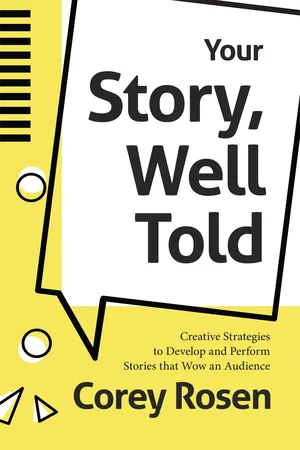
Your Story, Well Told
eBook - ePub

Your Story, Well Told

Creative Strategies to Develop and Perform Stories that Wow an Audience (How To Sell Yourself)

  1. English
  2. ePUB (mobile friendly)
  3. Available on iOS & Android
eBook - ePub

Your Story, Well Told

Creative Strategies to Develop and Perform Stories that Wow an Audience (How To Sell Yourself)

About this book

So You've Got a Story to Sell

"Corey Rosen's book is a great resource. I know I will return to it again and again for ideas, inspiration, and entertainment." ? Samantha Harris, cohost ofDancing with the StarsandEntertainment Tonightand author of Your Healthiest Healthy

2021 International Book Awards finalist in Self-Help: Motivational
#1 New Release in Speech and Public Speaking

Learn the art of telling stories and make the sale, land the client, propose a toast, or impress a date. Corey Rosen is an Emmy-award winning writer and actor with years of experience as a skilled story telling coach. His book is Jam-packed with some of the best story telling strategies out there.

Telling stories well is a skill we all need. We've all got stories to tell?but how do you make your story the best? Inhis book, Moth veteran and master teacher Corey Rosen inspires you to tell your story. Using the best storytelling techniques from improvisational theatre, Rosen designs an accessible guide for all ages and skill levels. Crafted to help ordinary people tell extraordinary stories, this laugh out loud handbook covers everything from how to tell a good story to going off script.

Learn how to sell yourself through the art of telling stories. The best story telling uses improvisation to enthrall, entertain, and keep audiences on edge. Laugh along with tales of performance triumphs (and disasters) and explore ways to tell your story with confidence and spontaneity. From brainstorming and development to performance and memorization techniques, learn how to tell a good story with:

  • A variety of structures and editing approaches to bring out your best story
  • Improv exercises to stimulate creativity without feeling foolish
  • Quick and easy lessons on building stories
  • Resources for putting on a showcase to tell your story

If you're ready to sell the story straight or enjoyed books like Stories That Stick, Long Story Short, or Storyworthy, you'll loveY our Story, Well Told.

Frequently asked questions

Yes, you can cancel anytime from the Subscription tab in your account settings on the Perlego website. Your subscription will stay active until the end of your current billing period. Learn how to cancel your subscription.
No, books cannot be downloaded as external files, such as PDFs, for use outside of Perlego. However, you can download books within the Perlego app for offline reading on mobile or tablet. Learn more here.
Perlego offers two plans: Essential and Complete
  • Essential is ideal for learners and professionals who enjoy exploring a wide range of subjects. Access the Essential Library with 800,000+ trusted titles and best-sellers across business, personal growth, and the humanities. Includes unlimited reading time and Standard Read Aloud voice.
  • Complete: Perfect for advanced learners and researchers needing full, unrestricted access. Unlock 1.4M+ books across hundreds of subjects, including academic and specialized titles. The Complete Plan also includes advanced features like Premium Read Aloud and Research Assistant.
Both plans are available with monthly, semester, or annual billing cycles.
We are an online textbook subscription service, where you can get access to an entire online library for less than the price of a single book per month. With over 1 million books across 1000+ topics, we’ve got you covered! Learn more here.
Look out for the read-aloud symbol on your next book to see if you can listen to it. The read-aloud tool reads text aloud for you, highlighting the text as it is being read. You can pause it, speed it up and slow it down. Learn more here.
Yes! You can use the Perlego app on both iOS or Android devices to read anytime, anywhere — even offline. Perfect for commutes or when you’re on the go.
Please note we cannot support devices running on iOS 13 and Android 7 or earlier. Learn more about using the app.
Yes, you can access Your Story, Well Told by Corey Rosen in PDF and/or ePUB format, as well as other popular books in Personal Development & Marketing. We have over one million books available in our catalogue for you to explore.

Information

Chapter 2
What Is a Story?
How Do We Define a Story?
stoĀ·ry1 stĆ“rē/ Noun
1.An account of imaginary or real people and events told for entertainment. Synonyms: tale, narrative, account, anecdote.
2.An account of past events in someone’s life or in the evolution of something. ā€œThe story of modern farming.ā€
Ok. But what’s a STORY (really)? Is it just the accounting of an event and people for entertainment? Of course not. Relating an account of ā€œwhat happenedā€ in someone’s life of the evolution of something might be defined as a story, but it sure doesn’t feel like one.
When my son, Henry, recollected the events on the day his dad was punched in the face in Chapter 1, he’s not telling us a story. He’s recollecting a memory without meaning or perspective. He’s relating it as one would to their inherited audience: your family, close friends, etc. People in our inherited audience get a pass when they relate these memories. They’re in the tribe. We give them credit and fill in the gaps. We put some of our own meaning onto their stories and draw connections that don’t work when the circle expands.
When Henry told his version of what happened that day, it was an expression—not a story. And in my mind, it’s perfect. It’s what a twelve-year-old felt about an incident he witnessed, just as an adult may relate an event as they witnessed it to their best friend. It’s engaging, and it’s as detailed as it needs to be to function as their impression of the incident…but it’s not a story, not yet!
You don’t have a story until you’ve made it a story. Similar to how someone who is funny is often told, ā€œyou should do stand-up!ā€ Stand-up, like storytelling, is a craft.
A story differentiates something that ā€œhappenedā€ in one very important way—something or someone changed because of it. Or was changed in light of it. In a dramatic or subtle way, the world was altered after the events described in ā€œwhat happened.ā€ This could be an inward change (I never looked at her the same way again). This could be an outward change (I quit the job, changed careers, and never looked back). This change could affect your private world (I know my daughter is growing up). Or this change could affect the planet (Thanks to this discovery, 60,000 people are now being delivered clean water per day).
Getting from ā€œthe ideaā€ to ā€œthe storyā€ is not always clear. What we think of as ā€œthe storyā€ might be the dictionary definition of a story (accounting the events as you remember them).
Here are some other writers’ definitions of what storytelling is all about:
ā€œA Story is a chain of events that…seems to begin at one place and to end at a very different place, without any essential interruption in its progress.ā€
—Randall Jarrell (Randall Jarrell’s Book of Stories: An Anthology)
ā€œA tale shall accomplish something and arrive somewhere.ā€
—Mark Twain (The Mark Twain Collection: His Novels, Short Stories, Speeches, and Letters)
A ā€œnarrativeā€ describes what happened. A ā€œstoryā€ is told for a reason, taking a narrative’s sequence of events to a higher level that can reveal or reflect on that sequence’s significance.
What Do Stories Have in Common?
Let’s look at some story examples we’ve already explored to see what they have in common:
•The Punch in the Face Story
•The Broken Star Wars Toy Story
•The Student Council Election Story
Characters:
•All of these stories feature distinctive characters
–The angry driver
–The Star Wars-loving child
–The scared first grader
•All of these stories also include peripheral characters:
–The onlookers, school administrators, and other children
–The eBay auction seller
–Ms. Cruz, the kindergarten teacher
Conflict:
•Inward forces of conflict:
–Am I teaching...

Table of contents

  1. Copyright
  2. Table of Contents
  3. Foreword
  4. Introduction
  5. Why Storytelling
  6. What Is a Story?
  7. The Improvisor’s Mindset
  8. The Idea Mill
  9. Giving and Receiving Feedback
  10. Color and Advance
  11. Sticky Stories
  12. What the Story Is Really About
  13. Remembering Your Story
  14. Beginning and Ending
  15. Storytelling Shows
  16. Storytelling Resources
  17. Afterword
  18. Acknowledgments
  19. About the Author