![]()
I
Primary Shapes and Dynamic Composition
Principles for the development of a complete mind. Study the science of art. Study the art of science. Develop your senses—especially learn how to see. Realize that everything connects to everything else.
Leonardo da Vinci (1452–1519)
In the following chapters we’ll explore what are arguably the most effective design tools we have for shaping the aesthetic experience of a video game: primary shapes and dynamic composition. Our goal is to find a universal design language that is understood by individuals from all corners of the industry—including developers, academics, and consumers—and one that encompasses gaming’s unique element of interactivity.
Three Primary Shapes
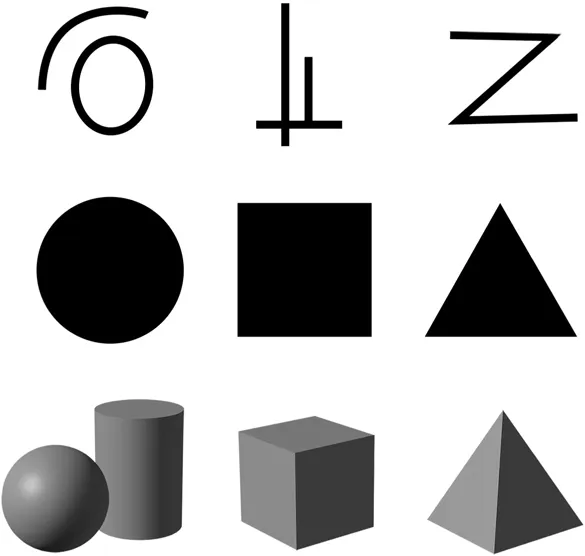
At the core of this language are the three primary shapes—the circle, square, and triangle—which can also be represented as lines (curved, straight, and angular lines) and forms (the Platonic solids: spheres and cylinders, boxes, and pyramids). For simplicity, I will refer to them collectively as primary shapes unless a specific reference is necessary (Figure SI.1).
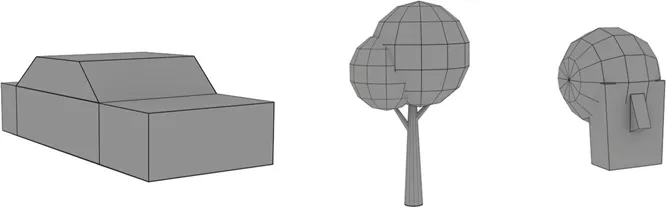
The ancient Greek philosophers who invented the Platonic solids believed these forms constituted nature’s building blocks and referred to them as the roots of all things. And rightly so! If you’re a 3D artist you’ll recognize these forms from modeling software applications like Blender, Maya, 3ds Max, and Cinema 4D, where they are generally referred to as primitives. Primitives are used as the basis for the development of an infinite variety of complex 3D objects. The process of modeling such objects always starts with the artist picking a primary shape that best approximates the final form before it’s cut, stretched, extruded, and hewn into shape. For instance, a complex tree may start out as a combination of simple spheres and cylinders; box forms can be used to block-in a car; and the human head is often conceptualized as a combination of sphere and box forms (Figure SI.2).
Primary Shapes and Emotional Themes
What is especially interesting about primary shapes is that each corresponds to a particular set of high-level emotional themes that have remained constant through-out art history.
Picture the three primary forms—the sphere, box form, and pyramid—placed on a table. Now imagine shaking that table. The round sphere would roll around, thus demonstrating its dynamic properties. The balanced cube and pyramid would remain in place. Now imagine if somebody threw the sphere and pyramid toward you for you to catch. You’d instinctively hesitate to catch the pyramid, even if you knew it wouldn’t harm you, based on your learned automatic response to sharp objects, in contrast to soft and round shapes. Each of these objects can be interchanged with something that resembles the basic form—such as oranges, ancient Greek columns (that remain standing to this day!), and a thorny plant (Figure SI.3).
Why we associate these shapes with their corresponding themes has to do with our real-life experiences and the sense of touch. Touch is the first sensory system that fetuses develop in the womb over a year before the sense of sight becomes active and fully mature. Much of what we interpret about the world around us during childhood is learned through our touch senses. By feeling objects and comparing textures we quickly develop a mental shorthand for assessing the general characteristics of objects based on our tactile experiences. These learned instincts to primary shapes are part of humankind’s survival mechanism. Paul Eckman, the renowned psychologist and expert on nonverbal communication, calls such phenomena species-constant learning because these are experiences that are consistent across all cultures. Sharp, triangular shapes are the most eye-catching because our survival instincts evolved to keep a wary lookout for anything that is potentially harmful to our well-being.
Although the number of themes may appear fairly limited, they are sufficiently broad to fit most aesthetic concepts that you’ll encounter in life and art. This flexibility also ensures that each member of the development team—programmers, writers, artists, musicians, and game designers—can interpret them using their particular area of expertise. This versatility will become fundamental to the storytelling techniques we’ll explore in subsequent chapters.
Irrespective of the design discipline, circle, square, and triangle shape concepts can be found embedded in every design discipline, although it’s worth noting that their presence is often a subconscious solution to an artist’s or designer’s idea. Study the images in Figure SI.4 and imagine switching the shape concepts for each object. You’ll find that the aesthetic impression for each object becomes completely at odds with what the designers likely intended. For example, would the circular Disney logo look as family-friendly if it featured the triangular font of thrash metal band, Anthrax? Would London’s National Gallery or the Range Rover still project stability, safety, and sophistication if their balanced vertical and horizontal lines were replaced with circles? Would the Lamborghini lose its aggressive edge if it were designed with the rounded forms of the Volkswagen Beetle? While pathways create visual impressions as well as inspire us to walk, and thus feel, a particular way: from winding pathways in parks and places of relaxation, straight pathways for utilitarian journeys, and zigzagging pathways that we might associate with a treacherous trail on a steep mountain pass. It is no wonder that the philosopher, Plato (ca. 427–347 BC) stated, “Geometry is knowledge of the eternally existent.”
The Shape Spectrum and Dynamic Composition
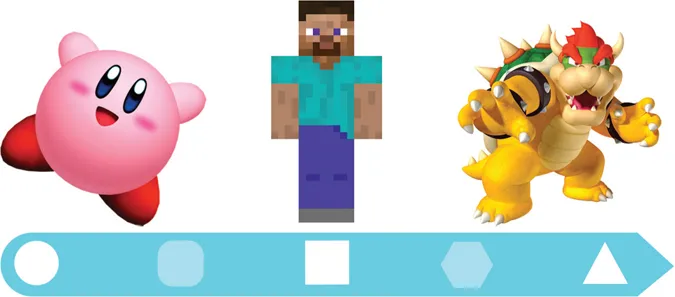
The emotional value of video game elements—including visual and nonvisual elements—are likewise influenced by the shape concept to which they are aligned. The consistency with which the circle, square, and triangle can be used to express certain themes allows us to orientate the primary shapes along a shape spectrum (Figure SI.5). Functioning much like a musical scale, the shape spectrum is a comparative analysis tool for assessing and manipulating the aesthetic alignment of individual design elements. Each shape can be used to amplify or subvert the emotional themes of a narrative.
Our shape spectrum works hand-in-hand with dynamic composition. “Composition” refers to the act of combining parts or elements to form a whole. In video game terms this refers to the component parts of a video game that occur at any one moment in an interactive experience. “Dynamic composition” implies that these gameplay snapshots can be varied from moment to moment to serve the aesthetic requirements of the story.
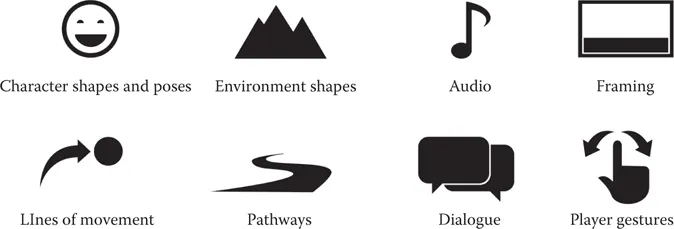
Unlike with traditional art forms, interactivity means that player actions are closely bound to the visual and artistic experience and must also be considered in the context of composition even though they occur outside the frame. The eight elements of dynamic composition include character shapes and poses, lines of movement, environment shapes, pathways, dialogue, framing, audio, and player gestures (Figure SI.6). An important consideration for video game design is that each element of dynamic composition is pervasive—meaning that it is consistently present during gameplay—to ensure that players are always aware of it despite a constantly changing viewpoint within the game world.
The Eight Elements of Dynamic Composition
Character Shapes and Poses
Lines of Movement
Environment Shapes
Pathways
Dialogue
Framing
Audio
Player Gestures
You can think of dynamic composition as the fundamental elements needed for the whiteboxing stage of development—the preliminary prototype stage where key game elements are blocke...