1
An Archaeology of Rituals
Silvana A. Rosenfeld and Stefanie L. Bautista
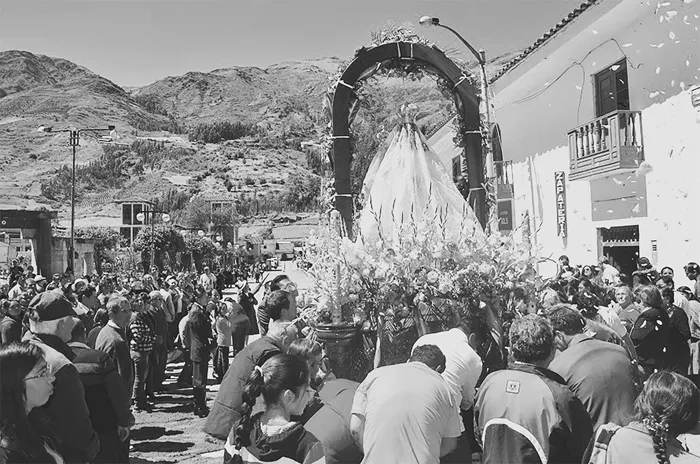
Every July 16, the people from the small town of Chavín de Huántar in Ancash, Peru, celebrate the Virgen del Carmen festival. A clear fusion between Catholic and Andean beliefs, the Virgen del Carmen celebration is a well-organized event that involves the entire community. Typically, two sponsors (mayordomos) are in charge of organizing the festivities, which include the procession of the Virgen (figure 1.1), a mass at the local church, a live music band, a potluck meal, and bullfighting. To prepare for this event, the community is divided to partake in particular activities, such as preparing chicha (a traditional alcoholic corn beverage), baking special breads, and sacrificing pigs and chickens for consumption. Some of the classic Andean principles of reciprocity, community, and duality can be seen during this celebration (Murra 1975; Rostworowski de Diez Canseco 2001). Locals and visitors clearly enjoy these days of praying, dancing, eating, drinking, and fireworks.
The Virgen del Carmen festival coincides with the beginning of the harvest season, the most important time in the agricultural cycle for farming communities. The celebrations, however, also renew ties with Catholic figures by attending mass, praying, and participating in the colorful procession while also strengthening relationships among local townspeople who must work together in preparing the food (e.g., meat, bread, and alcohol) for public consumption. Ethnographic and ethnohistoric studies have shown that the interplay of customary and collective actions among humans and between humans and non-humans or supernatural agents, through the ritual mixture of Catholicism and indigenous practices, has been central to many communities in both South America and Mesoamerica (e.g., Nutini 1988; Rostworowski de Diez Canseco 1992). This volume seeks to highlight, from different archaeological perspectives and contexts across the Andes, how ritual affected or was affected by the diverse groups of peoples in this region.
The practice of ritual across time has long fascinated anthropologists, as it can highlight some of the most integral, emotive, and elaborative practices of human life. The study of ritual can demonstrate the interconnections among the various aspects of society, such as religion, politics, and economy. Though ritual has long been important to anthropologists (e.g., Bastien 1978; Bolton 1979; Flores Ochoa 1977; Geertz 1973; Rappaport 1999; Turner 1967), archaeologists have only more recently recognized the importance of studying ritual and its role in past societies (e.g., Bauer and Stanish 2001; Benson and Cook 2001; Insoll 2004; Kyriakidis 2007). Ritual is now considered a major component in the development of some ancient sociopolitical systems, as it aided in their creation, maintenance, and change (DeMarrais, Castillo, and Earle 1996; Marcus and Flannery 2004; Moore 1996; Pauketat et al. 2002).
While there have been discussions of how different archaeological frameworks have approached the ideological dimensions of ritual (e.g., Hodder and Hutson 2003; Insoll 2004), a pertinent debate has also taken place over whether the practice of ritual is distinguishable from other everyday activities in the material record (e.g., Berggren and Stutz 2010). Whereas ritual can be very much interrelated with other everyday practices, it is clear that rituals can be studied from an archaeological perspective. The formal repetition of rituals can create patterns that materialize in the archaeological record, which archaeologists can trace using a variety of methods.
In the Andean region of South America, evidence of ritual activity can be seen in early Peruvian prehispanic sites such as Kotosh in the northern highlands of Huánuco. Beginning circa 2500 BC, the people of Kotosh built enclosed rooms with a central sunken space and a formal hearth to burn offerings. The walls of these rooms were usually plastered with fine clay and contained niches and reliefs (Izumi and Terada 1972). Kotosh residents then buried these rooms and constructed new temples over the interred structures. This practice of architectural renovation was key in the development of early Andean societies, as it served to integrate small communities during the relative absence of a centralized authority (Onuki, this volume). The numerous studies about ritual in the ancient Andes published since 2000 (e.g., Albarracin-Jordan, Capriles, and Miller 2014 ; Arkush 2005; Cutright, López-Hurtado, and Martin 2010; Dillehay 2004; Gamboa Velasquez 2015; Inomata and Coben 2006; Isbell and Groleau 2010; Jennings and Bowser 2009; Kantner and Vaughn 2012; Knobloch 2000; Moore 2005; Rick 2008; Rosenfeld 2012; Tantaleán et al. 2016; Swenson and Warner 2012; Tung 2007; Vaughn 2004) attest to the significance of ritual in the development of many past societies. All of these studies show the fruitfulness of studying ritual in various Andean archaeological contexts.
In the past few years, influential books have been published about Andean ritual that focus on a particular archaeological locality and time period, such as Inka (Meddens et al. 2014) and coloni...