In contemporary culture, existing audiovisual recordings are constantly reused and repurposed for various ends, raising questions regarding the ethics of such appropriations, particularly when the recording depicts actual people and events. Every reuse of a preexisting recording is, on some level, a misuse in that it was not intended or at least anticipated by the original maker, but not all misuses are necessarily unethical. In fact, there are many instances of productive misuse that seem justified. At the same time, there are other instances in which the misuse shades into abuse. Documentary scholars have long engaged with the question of the ethical responsibility of documentary makers in relation to their subjects. But what happens when this responsibility is set at a remove, when the recording already exists for the taking and repurposing? Reuse, Misuse and Abuse surveys a range of contemporary films and videos that appropriate preexisting footage and attempts to theorize their ethical implications.
eBook - ePub
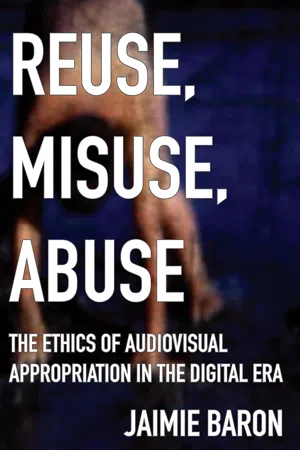
Reuse, Misuse, Abuse
The Ethics of Audiovisual Appropriation in the Digital Era
- English
- ePUB (mobile friendly)
- Available on iOS & Android
eBook - ePub
About this book
Information
Publisher
Rutgers University PressYear
2020Print ISBN
9780813599267
9780813599274
eBook ISBN
9780813599281
Table of contents
- Cover
- Title Page
- Copyright
- Dedication
- Contents
- Introduction: Theorizing Misuse
- 1. (Re)exposing Intimate Traces
- 2. Speaking through Others
- 3. Dislocating the Hegemonic Gaze
- 4. Reframing the Perpetrator’s Gaze
- 5. Abusing Images
- Filmography
- Acknowledgments
- Notes
- Bibliography
- Index
- About the Author
Trusted by 375,005 students
Access to over 1.5 million titles for a fair monthly price.
Study more efficiently using our study tools.
Frequently asked questions
Yes, you can cancel anytime from the Subscription tab in your account settings on the Perlego website. Your subscription will stay active until the end of your current billing period. Learn how to cancel your subscription
No, books cannot be downloaded as external files, such as PDFs, for use outside of Perlego. However, you can download books within the Perlego app for offline reading on mobile or tablet. Learn how to download books offline
Perlego offers two plans: Essential and Complete
- Essential is ideal for learners and professionals who enjoy exploring a wide range of subjects. Access the Essential Library with 800,000+ trusted titles and best-sellers across business, personal growth, and the humanities. Includes unlimited reading time and Standard Read Aloud voice.
- Complete: Perfect for advanced learners and researchers needing full, unrestricted access. Unlock 1.5M+ books across hundreds of subjects, including academic and specialized titles. The Complete Plan also includes advanced features like Premium Read Aloud and Research Assistant.
We are an online textbook subscription service, where you can get access to an entire online library for less than the price of a single book per month. With over 1.5 million books across 990+ topics, we’ve got you covered! Learn about our mission
Look out for the read-aloud symbol on your next book to see if you can listen to it. The read-aloud tool reads text aloud for you, highlighting the text as it is being read. You can pause it, speed it up and slow it down. Learn more about Read Aloud
Yes! You can use the Perlego app on both iOS and Android devices to read anytime, anywhere — even offline. Perfect for commutes or when you’re on the go.
Please note we cannot support devices running on iOS 13 and Android 7 or earlier. Learn more about using the app
Please note we cannot support devices running on iOS 13 and Android 7 or earlier. Learn more about using the app
Yes, you can access Reuse, Misuse, Abuse by Jaimie Baron in PDF and/or ePUB format, as well as other popular books in Social Sciences & Art Theory & Criticism. We have over 1.5 million books available in our catalogue for you to explore.