Unlock your potential with the latest neuroscientific insights and succeed as a leader in complex business environments.
As understanding of neuroscience increases, it is better understood how scientific insights can be applied to develop and enhance leadership. Neuroscience for Leaders captures the most up-to-date and important findings in neuroscience and links these to the business world. This guide offers a simple framework to put these principles into practice to make better decisions, take the right actions and find faster solutions.
Now in its second edition, this book presents a comprehensive approach to leading people and organizations based on academic research. The authors' 'Brain Adaptive Leadership' approach offers a step-by-step guide to enhancing the way leaders think, understanding and nurturing emotions, shaping automated brain responses and developing dynamic relationships. Examples, activities and practical suggestions are all designed to be clear and engaging. Neuroscience for Leaders is the essential guide for leaders who are ready to gain the business advantage scientifically.
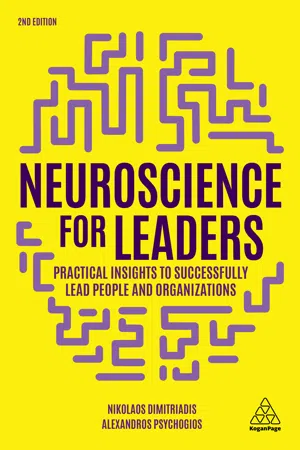
eBook - ePub
Neuroscience for Leaders
Practical Insights to Successfully Lead People and Organizations
- English
- ePUB (mobile friendly)
- Available on iOS & Android
eBook - ePub
Neuroscience for Leaders
Practical Insights to Successfully Lead People and Organizations
About this book
Information
Index
3D+3L approach, perceiving own emotions 126–28
Aaron, AP 126
ABC (authority/barometer/consistency), creating organizational values 32
abstract conceptual thinking
decision making without motivation to act 186–87
evolution 231–32
self-control 31
Achor, Simon 164
Ackerman, JM 207
action, feedback loops 277, 278
active listening 139
active/passive engagement in enquiry 66–67
adaptability, in a complex and unpredictable world 7–8
adaptive leadership style 10
adaptive unconscious 187–88
admiration, persuasion 271
adrenaline 35–36
adults, theory of mind compared to children 234–35
affect, Russell’s circumplex model of 134
affects/affective neuroscience see emotions
affordable loss, versus return on investment 105
aggression/aggressiveness
amygdala 70, 274
corporate culture 62–63
emotional combinations 157, 160
questioning 66
agreeableness, personality testing 159
AI see artificial intelligence
alert response, dealing with negative emotions 152
alpha waves 86–87
altruism 82, 226
Amaya, KA 202
American Psychological Association (APA) 45, 162
amygdala 6, 70–71
hijacking of executive brain functions 70, 71, 123
interconnectedness of brain sections 44
negative emotions and avoidance motivation 119
quieted when risk is low 104
role in arousal system 134
role in social behaviour 250–51
slow recovery from adversity 121
stimulated by feeling trapped or frightened 274
suppressing social intuition 123
theory of mind 233
trust regulation 250
analytical thinking see neocortex; rational and analytical thinking; thinking (Pillar 1)
anger
amygdala reactions 71, 250
anxious mood effects 131
as basic emotion 149–50, 151, 159
belonging to approach and avoidance systems 120
dealing with negative emotions 71, 152
emotion combinations 157, 160
opposite of fear 156
anguish 149
anticip...
Table of contents
- Praise for This New Edition
- Neuroscience for Leaders
- Contents
- List of Figures
- List of Tables
- Acknowledgements
- About the authors
- Introduction
- Thinking
- 01 Powerful brain, powerful leader
- 02 Clear mind, strong direction
- 03 Higher performance, more followers
- Emotions
- 04 More emotion, better decisions
- 05 Right emotion, right action
- Brain automations
- 06 Gut reaction, faster solution
- Relations
- 07 More connected, more successful
- 08 Brain communication, better persuasion
- Concluding remarks
- ue Epilogue
- Index
- Copyright Page
Trusted by 375,005 students
Access to over 1.5 million titles for a fair monthly price.
Study more efficiently using our study tools.
Frequently asked questions
Yes, you can cancel anytime from the Subscription tab in your account settings on the Perlego website. Your subscription will stay active until the end of your current billing period. Learn how to cancel your subscription
No, books cannot be downloaded as external files, such as PDFs, for use outside of Perlego. However, you can download books within the Perlego app for offline reading on mobile or tablet. Learn how to download books offline
Perlego offers two plans: Essential and Complete
- Essential is ideal for learners and professionals who enjoy exploring a wide range of subjects. Access the Essential Library with 800,000+ trusted titles and best-sellers across business, personal growth, and the humanities. Includes unlimited reading time and Standard Read Aloud voice.
- Complete: Perfect for advanced learners and researchers needing full, unrestricted access. Unlock 1.5M+ books across hundreds of subjects, including academic and specialized titles. The Complete Plan also includes advanced features like Premium Read Aloud and Research Assistant.
We are an online textbook subscription service, where you can get access to an entire online library for less than the price of a single book per month. With over 1.5 million books across 990+ topics, we’ve got you covered! Learn about our mission
Look out for the read-aloud symbol on your next book to see if you can listen to it. The read-aloud tool reads text aloud for you, highlighting the text as it is being read. You can pause it, speed it up and slow it down. Learn more about Read Aloud
Yes! You can use the Perlego app on both iOS and Android devices to read anytime, anywhere — even offline. Perfect for commutes or when you’re on the go.
Please note we cannot support devices running on iOS 13 and Android 7 or earlier. Learn more about using the app
Please note we cannot support devices running on iOS 13 and Android 7 or earlier. Learn more about using the app
Yes, you can access Neuroscience for Leaders by Nikolaos Dimitriadis,Alexandros Psychogios in PDF and/or ePUB format, as well as other popular books in Negocios y empresa & Liderazgo. We have over 1.5 million books available in our catalogue for you to explore.