The dramatic changes that have taken place both in global society and in the church have implications for how the church does missions in the twenty-first century. These trends include the rise of postmodernism, the spiritual decline in the West and the advance of the gospel in the rest of the world, and the impact of technology on society and missions.
The Changing Face of World Missions is for the mission-minded church leader or lay person who wants to understand these trends. Each chapter identifies and evaluates a trend, examines it in light of Scripture, and proposes a practical response. Important terms are defined, and sidebars help readers think through the issues on their own.
eBook - ePub
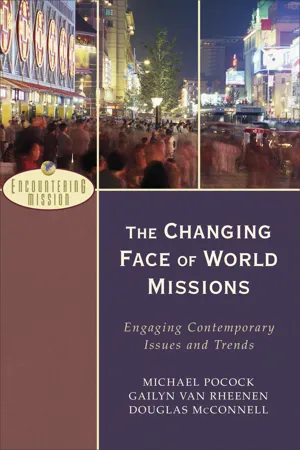
The Changing Face of World Missions (Encountering Mission)
Engaging Contemporary Issues and Trends
- 392 pages
- English
- ePUB (mobile friendly)
- Available on iOS & Android
eBook - ePub
The Changing Face of World Missions (Encountering Mission)
Engaging Contemporary Issues and Trends
About this book
Trusted by 375,005 students
Access to over 1.5 million titles for a fair monthly price.
Study more efficiently using our study tools.
Information
Topic
Theology & ReligionSubtopic
Christian MinistryPART1
The Global Context
1
Globalization
New York’s in New Delhi, Manila’s in Los Angeles
Whether you look at the label on your shirt (from Guatemala), your shoes (from China), your watch (from Taiwan), or the newest English-language issue of the World Evangelical Alliance’s (WEA) Connections (printed in India), it is clear that you are wearing, using, and thinking on a global scale. But as we do with computers, we can use this entire system with only minimal understanding of its makeup. Life is fast paced, highly scheduled. Most of us do not have time to learn how to program computers; we only need things to work for us.
That is the level at which many of us think about globalization. We may have heard the term. We may be generally aware that products we use are made all over the world and that we seem to hear very quickly about events a continent away. Ethnically diverse people address us on television news programs. Some of us are aware that a Japanese cello player, YoYoMa, is one of the most famous musicians in the world, even though his expertise is on a Western musical instrument. Some will remember that Ravi Shankar introduced Indian musical themes to the Beatles and taught them to play the sitar. If you are a Generation X or Millennial reader, you are more likely to know that singer Nora Jones, raised in Texas, is Shankar’s daughter.
Global interaction has intensified. The dynamics behind globalization, its meaning, and its implication for missions need to be understood by everyone involved in living for Christ and making him known in our global context. We need to ask some serious questions. What is globalization? Is globalization new? Does globalization matter? Is it good or bad? Must there be winners and losers in globalization? Does globalization have a life of its own? Where is God in this entire process? For missionaries and other cross-cultural workers, the application question is crucial: In what ways does globalization make cross-cultural service different?
IDENTIFYING THE TREND: WHAT IS GLOBALIZATION?
Thomas Friedman, who gave the world a great, fast-paced reader on globalization in The Lexus and the Olive Tree (1999), says in a later work:
Globalization involves the integration of free markets, nation-states and information technologies to a degree never before witnessed, in a way that is enabling individuals, corporations and countries to reach around the world further, faster and cheaper than ever. . . . Globalization means the spread of free-market capitalism to virtually every country in the world. (Friedman 2000, 7)
John Powell maintains that globalism, used in a sense very close to globalization, “refers to the process in which goods and services, including capital, move more freely within and among nations. As globalism advances, national boundaries become more and more porous, and to some extent, less and less relevant” (Powell and Udayakumar 2000).
Powell and Friedman both focus on economics or the market to define globalization. Many writers give the impression that globalization is essentially a movement from the West to extend its influence worldwide through the free-market economy. But globalization is not a one-way street, nor does it relate solely to economics. Malcolm Waters, an Australian, captures the idea that globalization lifts restraints on interaction at every level. He calls it “a social process in which the constraints of geography on economic, political, social and cultural arrangements recede, in which people become increasingly aware that they are receding and in which people act accordingly” (2001, 5).
Globalization began with the emergence of empires marked by expansion and the control of large territories by single cultures or civilizations. The Roman and Greek empires spread far beyond their points of origin, taking their ideas, innovations, and systems of governance with them. Islamic faith and culture spread widely around the Mediterranean world after AD 732, and the Mongol Empire spread from Mongolia into China and across Asia to Vienna by 1241 (Moffett 1998, 407). In South America, the Incas established an empire covering what today are several nation-states, and the Spanish, English, and French became dynamic catalysts for the spread of commerce, culture, and religion over extended areas of the world from 1500 onward.
Historically, empires expanded outward from the center. Over the course of history, centers have included Athens, Rome, Beijing, Cuzco, Seville, and London. There was some interaction when people at the center of an empire received input from those on the periphery. Many spices and condiments, for example, were unknown in Europe until the dark chapter in church history known as the Crusades brought Europeans into contact with the Middle East. Gunpowder and paper-making technologies reached Europe from China in the fourteenth century. Tomatoes, tobacco, and potatoes became common staples in Europe following the colonization of the Americas after 1500. There was, however, markedly less cultural, philosophical, or religious movement from the peripheries to the centers of civilization until the modern era.
Taken as a whole, globalization is a trend of accelerating, compressed interaction between peoples, cultures, governments and transnational companies. It is a heightened multi-directional flow of ideas, material goods, symbols and power facilitated by the Internet and other communication, technologies, and travel.
Michael Pocock (see Waters 2001, 20; Robertson 2000, 53)
In 1969, human beings first stood on the moon. As the American and Russian space programs progressed, we saw for the first time photographs of the entire planet. Seeing earth in this way reinforced the idea that we are all on a single globe. The possibility of a change in perspective occurred. Indicative of this was the coining of new terms in the 1960s such as global village (McLuhan 1964). The general use of the word global began in the 1960s, although it is much older in origin. The term was still relatively rare in literature in the early 1990s but is much more common in the new millennium. For example, in 1993, the Library of Congress listed 34 volumes with globalization in the title; by 2000, the number had risen to 284 (Waters 2001, 2).
The reality is that globalization has developed over centuries as people have engaged in trade, conquest, and religious expansion. Globalization has progressed in fits and starts. The rapid expansion of peoples and ideas, followed by stagnation or reaction, has been going on throughout human history. The more modern version of globalization has been linked to the appearance of capitalism and especially to the recent mobility of capital. The world has reached near total and instantaneous interconnectivity since the emergence of the Internet in the 1990s. “All arguments accept that there has been a sudden acceleration of globalization in recent years” (Tiplady 2003b, 4).
More than a fad, this is a fundamental transformation to a new reality likened by Robert Schreiter to the emergence of feudalism, the creation of modern nation-states, or the ending of the colonial era (1990, 29). Globalization is both dynamic and developing as an enduring reality in which nation-states and geographical distance are less relevant than ever. As such, it merits serious consideration for the implications it has for Christianity and world missions.
EVALUATING THE TREND: HOW SIGNIFICANT IS GLOBALIZATION?
There is scarcely a Christian organization, alliance, or individual writer in the new millennium who discounts the reality of globalization. This applies to Catholics such as Robert Schreiter (1990), Protestants such as Max Stackhouse (2000), evangelicals such as Bob Goudzwaard (2001), and organizations such as the World Evangelical Alliance (WEA), which in June 2003 held an international consultation titled “The Impact of Globalization on World Mission.”
Globalization matters because it fundamentally changes the contexts in which we minister, the way people and cultures perceive each other, how people think, and the means available to reach them. We cannot dismiss the effects of globalization on ourselves as communicators of the gospel message.
Michael Pocock
The discussion that follows looks at four interrelated aspects of globalization and evaluates their impact on ministry today: world migration, air travel, the Internet, and the free-market economic system.
World Migration
Widespread and rapid migrations have the potential to make geographical and nation-state issues seem almost irrelevant. During the last twenty years of the twentieth century, the vision of missions to unreached people was focused on the 10/40 Window. Such a vision expressed the idea that mission efforts needed to be focused on the peoples living between 10 degrees and 40 degrees north of the equator and from the west coast of Africa to the eastern limits of Asia.
This was a helpful concept, but it did not take into account the fact that millions of people from the 10/40 Window have migrated outside it. Six million Muslims live in the United States, but only 30 percent of them are American born. Over 1 million Muslims live in the United Kingdom, and an additional 3.4 million live in Germany. Within the 10/40 Window, people of various religions and nationalities work outside their own nation. Patrick Johnstone notes that the expatriate population of the United Arab Emirates is 82 percent. Many of these people are from 10/40 Window nations (Johnstone and Mandryk 2001, 650). Similar figures are also true of Saudi Arabia (Johnstone and Mandryk 2001, 647) and Kuwait (Johnstone and Mandryk 2001, 270). The expatriate populations in these countries illustrate that even when people do not live among their people groups in their traditional homes, it is often possible to live among them somewhere else. Those who migrate for work also travel back and forth to their home areas. The boundaries imposed by geographic distances simply do not mean what they once did (George 2003b, 18–22).
Migration brings non-Christians into areas more strongly Christian and more open to evangelism and religious change. A Hindu Indian in England or a Muslim Turk in Germany may not face ostracism from the community, loss of employment, and family violence if he or she converts to Christianity. Migration also brings vibrant Christians from Africa or the Caribbean to post-Christian areas of Europe. Church planters in Europe can often find Christian immigrants there who understand what the church planter is trying to do and are willing to become part of the nucleus of newly forming churches.
Air Travel
An important dynamic of globalization is rapid air travel. Nowhere in the world is more than thirty hours from where you presently sit. If you have a bank account, a computer, a television, and a job, you are in the top 30 percent of the world’s population and are considered “connected” in the process of globalization. For those who are connected, travel is relatively affordable, and opportunities exist to influence and be influenced by other cultures around the globe. Those who are connected can learn about countries more prosperous or stable than their own and have the means of getting there. Often they choose to leave their home countries to live elsewhere. On the other side are the disconnected, those left behind who are increasingly poorer and less prepared for employment.
Fast and affordable travel has revolutionized the mission scene, bringing millions of people we would otherwise never meet into close proximity. It has also made nonresidential and short-term missions possible. More North American church people than ever before have seen other cultures, learned directly from nationals overseas or on their U.S. campuses and jobs, and become more aware of global contexts simply because air travel has made the world smaller.
The Internet
Instantaneous information exchange facilitated by the Internet is a prominent feature of globalization. This exploded in the 1990s. Anyone from Azerbaijan to Zimbabwe can set up a Hotmail account and join the Internet at a village cybercafe—even those who cannot afford a computer. In fact, as with public transportation systems, cybercafes are far more numerous in majority world areas, where there is less computer ownership than in North America.
The Internet greatly facilitates any investigative or learning process. The possibilities are almost limitless. In the field of Christian missions, interested people can educate themselves about a people or a nation-state. Just as easily, those who are being studied can in turn investigate those researching them. People can sit at a laptop and learn about Bhutan and the Bhutanese. Anyone who is connected can learn what Christian researchers are saying about a given people group in Operation World (Johnstone and Mandryk 2001; see http://www.gmi.org/ow), The World Christian Encyclopedia (Barrett, Kurian, and Johnson 2001; see http://www.worldchristiandatabase.org/wcd), or on websites such as the Joshua Project (http://www.joshuaproject.org), Global Mapping International (http://www.gmi.org), and MisLinks (http://www.mislinks.org).
Mission organizations must both reckon with and capitalize on the near total interconnectivity of a globalized world. The question is, Should agencies list the people groups they wish to reach on their websites so that interested people can pray for them? Should they say where their personnel are working or express their plans for the future? They can, but do they really want the entire world to know? It would be difficult for mission planners and practitioners to survive without the Internet and electronic interconnectivity, but they are also limited by it. Opposition has been mounted against Christian workers based on what anti-Christian extremists have learned about the plans of agencies from the agencies’ websites.
Yet the Internet has also made it possible for interested non-Christians to investigate Christianity or the Bible, asking questions and receiving answers, all without exposing themselves to risk if they live in sensitive circumstances. Evangelism, discipleship, and leadership training are more available at a distance than ever before. The Internet reduces barriers of distance, occupation, and funding.
The Free-Market Economic System
Multinational or transnational corporations (TNCs) have burgeoned as the major economic phenomenon of globalization. Forty thousand corporations operate across national boundaries (Anderson and Cava-nagh 2000, 1). At $7.1 trillion, the combined sales of the top 200 TNCs is larger than the combined gross domestic product of 181 nations ($6.9 trillion; Anderson and Cavanagh 2000, 2). Although free-m...
Table of contents
- COVER PAGE
- TITLE PAGE
- COPYRIGHT PAGE
- CONTENTS
- PREFACE
- INTRODUCTION
- PART 1: THE GLOBAL CONTEXT
- PART 2: THE MISSIONAL CONTEXT
- PART 3: THE STRATEGIC CONTEXT
- REFERENCE LIST
- CONTRIBUTING AUTHORS
Frequently asked questions
Yes, you can cancel anytime from the Subscription tab in your account settings on the Perlego website. Your subscription will stay active until the end of your current billing period. Learn how to cancel your subscription
No, books cannot be downloaded as external files, such as PDFs, for use outside of Perlego. However, you can download books within the Perlego app for offline reading on mobile or tablet. Learn how to download books offline
Perlego offers two plans: Essential and Complete
- Essential is ideal for learners and professionals who enjoy exploring a wide range of subjects. Access the Essential Library with 800,000+ trusted titles and best-sellers across business, personal growth, and the humanities. Includes unlimited reading time and Standard Read Aloud voice.
- Complete: Perfect for advanced learners and researchers needing full, unrestricted access. Unlock 1.5M+ books across hundreds of subjects, including academic and specialized titles. The Complete Plan also includes advanced features like Premium Read Aloud and Research Assistant.
We are an online textbook subscription service, where you can get access to an entire online library for less than the price of a single book per month. With over 1.5 million books across 990+ topics, we’ve got you covered! Learn about our mission
Look out for the read-aloud symbol on your next book to see if you can listen to it. The read-aloud tool reads text aloud for you, highlighting the text as it is being read. You can pause it, speed it up and slow it down. Learn more about Read Aloud
Yes! You can use the Perlego app on both iOS and Android devices to read anytime, anywhere — even offline. Perfect for commutes or when you’re on the go.
Please note we cannot support devices running on iOS 13 and Android 7 or earlier. Learn more about using the app
Please note we cannot support devices running on iOS 13 and Android 7 or earlier. Learn more about using the app
Yes, you can access The Changing Face of World Missions (Encountering Mission) by Michael Pocock,Gailyn Van Rheenen,Douglas McConnell, Moreau, A. Scott, A. Scott Moreau in PDF and/or ePUB format, as well as other popular books in Theology & Religion & Christian Ministry. We have over 1.5 million books available in our catalogue for you to explore.