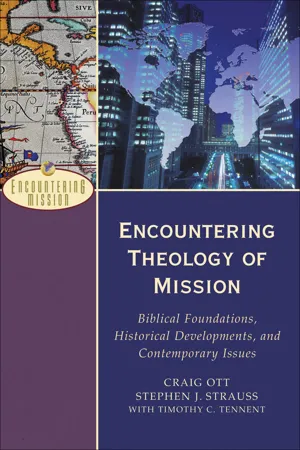
This fresh, comprehensive text fills a need for an up-to-date theology of mission. It offers creative approaches to answering some of the most pressing questions in theology of mission and missionary practice today. The authors, who are leading mission experts, discuss biblical theology of mission, provide historical overviews of the development of various viewpoints, and address theologically current issues in global mission from an evangelical perspective. This readable yet thorough text integrates current views of the kingdom of God and holistic mission with traditional views of evangelism and church planting. It also brings theology of mission into conversation with ecclesiology and eschatology. Topics covered include contextualization, the missionary vocation, church and mission, and theology of religions. Sidebars and case studies enable readers to see how theology of mission touches real-life mission practice.
The Bible is from start to finish a missionary book, for it is the story of God himself reaching into human history to reconcile a fallen and rebellious humanity to himself and to reestablish his reign over all creation. In this sense God is a missionary God—a God who sends his emissaries, messengers, and ultimately his Son as agents in this story of salvation. This salvation will ultimately reach out to include persons of every people, nation, tribe, and tongue. It is God’s initiative, and it is God who receives all glory. At first he sends primarily angels and prophets, after which he forms a people, Israel, to be sent as a witness to his righteousness and glory amid the nations. The story climaxes with the sending of his Son to purchase salvation and defeat evil at the cross. But the story then continues with the sending of a new people of God in the power of his Spirit, the church, to become his instruments and as signs of his kingdom. The story will conclude triumphantly with the return of Christ, the ultimate establishment of his kingdom, the final defeat of evil, and the universal confession that Christ is Lord.
In chapters 1 and 2, on the Bible and mission, we focus primarily on God’s plan for the nations. In later chapters we examine other biblical themes of mission. Only a few representative biblical texts can be examined. We refer readers to the fine studies of Köstenberger and O’Brien (2001), Larkin and Williams (1998), Glasser (Glasser et al. 2003), C. J. H. Wright (2006), and others for detailed examinations of this topic. As a starting point for a broader theology of mission, we must seek to capture something of the wonder and excitement of the grand panorama, even if we cannot climb every pinnacle or pause at every outlook point. We must grasp the importance, the centrality, and the glory of God’s plan for the nations. What is more, we must discern our privileged location in salvation history and the role God has assigned us to play in it.
There are many themes of mission that can be investigated in a biblical theology of mission. In Salvation to the Ends of the Earth: A BiblicalTheology of Mission, Andreas J. Köstenberger and Peter T. O’Brien examine the scriptural teaching on mission, expecting to see “an underlying logic and unity in the biblical message on this subject. For Scripture is united by one primary pervading purpose: the tracing of God’s unfolding plan of redemption” (2001, 20). However, they give relatively little attention to other possible themes. Arthur F. Glasser (Glasser et al. 2003) sees the kingdom of God as the uniting theme of mission in the Bible. Others trace themes such as unity and plurality (Legrand 1990) or the universal and the particular (Bauckham 2003). These themes are not mutually exclusive but reflect different nuances and emphases unfolding various dimensions of the biblical message. Because of the great diversity in the Bible itself with its many narratives, literary genres, and historical and cultural contexts, one must be cautious about reducing the rich diversity of the Bible too narrowly to a single theme or motif. Yet within this diversity broad unifying contours stand out.
For our purposes this chapter and the next one will focus primarily on the theme of God’s relationship to the nations in the unfolding of salvation history. This chapter begins with an overview and then an examination of the Old Testament. In the next chapter, we will move to the teaching of the New Testament. What will be immediately apparent is that mission does not begin with the Great Commission at the end of the Gospels in the New Testament. Rather, God’s plan for the nations is a theme running throughout the entire Bible. In the Old Testament this theme emerges from time to time in significant places, remaining an underlying motif in God’s election of Israel and the unfolding of salvation history. In the New Testament God’s plan for the nations bursts into full realization.
GOD AND THE NATIONS IN SALVATION HISTORICAL OVERVIEW
Where is history headed in respect to God’s purposes and, in particular, to God’s relationship to the nations? At creation all is good, and there is harmony between God and among God’s creatures (Gen. 1–2). As sin enters, the relationships of God’s creatures with God and those between men and women become estranged. Creation itself is impacted by the results of human rebellion against God’s reign, and the consequences are devastating (Gen. 3). But at the consummation, when God brings history to a close, his reign will be fully restored over men and women, over all nations (Ps. 96:10, 13; Isa. 2:4; Rev. 19:15), and over creation (Rom. 8:19–22), and his kingdom will be established in glory as the heavenly voices proclaim: “The kingdom of the world has become the kingdom of our Lord and of his Christ, and he will reign for ever and ever” (Rev. 11:15b; cf. 12:10).
In this time between creation and consummation, God is at work in the story of redemption, drawing peoples from all nations to himself and reestablishing his reign. Not only will the nations be brought into submission to the reign of the messianic king, but John’s vision in the book of Revelation gives us a further glimpse of what God’s completed plan for the nations will look like. First, we see that the work of redemption by the Lamb of God has been proclaimed and received by people from all nations and from every background:
And they sang a new song:
“You are worthy to take the scroll
and to open its seals,
because you were slain,
and with your blood you purchased men for God
from every tribe and language and people and nation.
You have made them to be a kingdom and priests to serve our God,
and they will reign on the earth.” (Rev. 5:9–10)
Shortly thereafter a similar vision of heavenly worship is described:
After this I looked and there before me was a great multitude that no one could count, from every nation, tribe, people and language, standing before the throne and in front of the Lamb. They were wearing white robes and were holding palm branches in their hands. And they cried out in a loud voice:
“Salvation belongs to our God,
who sits on the throne,
and to the Lamb.” (Rev. 7:9–10)
These verses pile up the terms to describe the variety of peoples who will be included in the eschatological worship of God: nation, tribe, people, and language. However humans might be socially categorized, representatives from every group will be included. In the words of Charles H. H. Scobie, the biblical canon from Genesis 11 (describing the scattering of the nations) to Revelation (describing the gathering of the nations) “forms a grand envelope structure framing the entire story of Scripture” (1992, 285). We now trace the biblical story of God’s accomplishing this grand goal in the Old Testament.
BEGINNINGS AND THE ORIGIN OF THE NATIONS
As we have noted, at creation there was perfect harmony between God and humanity. Adam and Eve’s sin was a matter of distrusting God’s goodness and rebelling against his loving authority over their lives. If the purpose of man and woman is to love and glorify God, the heart of sin is the rejection of such a relationship with God. If the kingdom of God consists in essence of living under God’s righteous and loving reign, then sin is the rebellion against that reign. The immediate result is shame as Adam and Eve’s eyes are opened. They attempt to hide from God (Gen. 3:7–8). And here already the story of God’s mission begins.
God takes the initiative in restoring the broken relationship in several ways. First, God himself searches for Adam and Eve: “But the LORD God called to the man, ‘Where are you?’” (Gen. 3:9). These haunting words reveal the heart of God: he seeks lost men and women. He does not leave them hiding. He does not immediately execute the death sentence. He seeks them out, calls them to account, and speaks with them.
Second, God pronounces a series of curses (Gen. 3:14–19). Yet embedded in these curses is a promise, the so-called protoevangelium, a veiled pre–announcement of the gospel. To the serpent he says: “And I will put enmity between you and the woman, and between your offspring and hers; he will crush your head, and you will strike his heel” (Gen. 3:15). One day a descendent of Eve, though injured himself, will ultimately defeat Satan and the evil that he represents.
Third, before banishing them from Paradise, God provides them with clothes made of skins, not of fig leaves (Gen. 3:21, cf. v. 7). The covering of their shame comes through the shedding of blood, provided for by God himself. This is a foreshadowing of God’s ultimate provision to cover our sin with the shed blood of his Son.
The devastating effects of sin become evident in the ensuing chapters of Genesis, climaxing in the destruction of all but Noah and his family in Genesis 6–9. But not long after Noah emerges from the ark, having entered a new covenant with God, sin is painfully manifested in a hideous act of sensuality (Gen. 9:20–27).
Chapter 11 of Genesis opens with the unity of humankind: “Now the whole world had one language and a common speech.” But this episode ends with the failure of human religion, typified in the Tower of Babel, the confusion of languages, and the scattering of the peoples throughout the earth (Gen. 11:7–9). The unity of the human family is shattered and ethnic rivalries soon develop.
The utter failure of human efforts to restore the broken relationship with God and overcome the effects of sin is manifest in these opening narratives. But just at this point when all appears most dismal and hopeless—sin reigning, humanity in disarray, and the nations scattered—God reveals his plan for the nations, a plan to be realized through the creation of a kingdom people.
THE CREATION OF A KINGDOM PEOPLE
The Patriarchs: The Promise of Blessing to the Nations
Following the primal history of the scattering of the peoples and the table of nations in Genesis 11 comes the call of Abram in Genesis 12, “God’s response to the problem of the nations of humanity” (C. Wright 1996, 39). Whereas Genesis 1–11 describes a universal history of God’s dealing with humankind and humanity’s efforts leading to disaster, Genesis 12 begins God’s particular call of a man to become the father of a people of God’s special choosing, leading to blessing. Much of the remainder of the Old Testament is the story of God’s dealing with this chosen people. But embedded in this particular call is also a universal intention that includes all nations. This theme will resurface repeatedly in the unfolding of God’s dealings with Israel.
Here we encounter one of the most significant promises in scripture relating to salvation history and God’s plan for the nations. Genesis 12:1–3 reads:
The LORD had said to Abram, “Leave your country, your people and your father’s household and go to the land I will show you.
“I will make you into a great nation
and I will bless you;
I will make your name great,
and you will be a blessing.
I will bless those who bless you,
and whoever curses you I will curse;
and all peoples on earth
will be blessed through you.”1
On the one hand, God singles out Abram (later to be renamed Abraham), whom he will uniquely bless and from whom he will create a great nation.
This is God’s particular call. Yet with this particular call is also a universal intention: through Abraham God will bring blessing to all families of the earth. “Families” comes from the Hebrew term
, which can also mean nation, tribe, or species. This last phrase is the climax and ultimate intent of the promise. God’s blessing on Abraham is not for Abraham alone. The promise is repeated to Abraham, then later to Isaac and Jacob in Genesis 18:18; 22:18; 26:3–4; 28:14, using in the first three passages the Hebrew term gôy (in place of
), which normally refers to non-Jewish people or nations.
The statement that those who bless Abram will be blessed and those who curse him will be cursed indicates that Abram (and his descendents) will be God’s particular representative and mediator of grace. How one responds to him reflects how one responds to God. One must pause to ponder the magnitude of this statement: The curse or the blessing of all people hinges on their relationship to Abraham and his descendents. But the emphasis clearly lies with the blessing in the final phrase, predicting blessing to the nations as an assured fact.
Just how this blessing is to be experienced by the nations is not yet revealed. But as the promise to Abraham is repeated in Genesis 22:18, we are given a hint: “Through your offspring all nations on earth will be blessed, because you have obeyed me.” The New Testament interprets this passage as a reference to Christ. Peter quotes it in Acts 3:25, then Paul in Galatians 3:13–16:
Christ redeemed us from the curse of the law by becoming a curse for us, for it is written: “Cursed is everyone who is hung on a tree.” He redeemed us in order that the blessing given to Abraham might come to the Gentiles through Christ Jesus, so that by faith we might receive the promise of the Spirit.
Brothers, let me take an example from everyday life. Just as no one can set aside or add to a human covenant that has been duly established, so it is in this case. The promises were spoken to Abraham and to his seed. The Scripture does not say “and to seeds,” meaning many people, but “and to your seed,” meaning one person, who is Christ.
From Abraham will come the nation Israel, and from the nation Israel will come the Messiah, whose redeeming death and resurrection will be the source of blessing for people of all nations. Through Christ people of every nation partake in the Abrahamic blessing.
Though the blessing to the nations will reemerge in the Old Testament writings only occasionally, that fact does not diminish the profound significance of the teaching. Here the very purpose of Abraham’s (and thereby Israel’s) calling is linked to the well-being of the...
Table of contents
COVER
ALSO IN THE ENCOUNTERING MISSIONS SERIES
TITLE PAGE
COPYRIGHT PAGE
CONTENTS
PREFACE
ABBREVIATIONS
INTRODUCTION
PART 1: BIBLICAL FOUNDATIONS OF MISSION
PART 2: MOTIVES AND MEANS FOR MISSION
PART 3: MISSION IN LOCAL AND GLOBAL CONTEXT
REFERENCES
BACK COVER
Trusted by 375,005 students
Access to over 1.5 million titles for a fair monthly price.
Study more efficiently using our study tools.
Frequently asked questions
Yes, you can cancel anytime from the Subscription tab in your account settings on the Perlego website. Your subscription will stay active until the end of your current billing period. Learn how to cancel your subscription
No, books cannot be downloaded as external files, such as PDFs, for use outside of Perlego. However, you can download books within the Perlego app for offline reading on mobile or tablet. Learn how to download books offline
Perlego offers two plans: Essential and Complete
Essential is ideal for learners and professionals who enjoy exploring a wide range of subjects. Access the Essential Library with 800,000+ trusted titles and best-sellers across business, personal growth, and the humanities. Includes unlimited reading time and Standard Read Aloud voice.
Complete: Perfect for advanced learners and researchers needing full, unrestricted access. Unlock 1.5M+ books across hundreds of subjects, including academic and specialized titles. The Complete Plan also includes advanced features like Premium Read Aloud and Research Assistant.
Both plans are available with monthly, semester, or annual billing cycles.
We are an online textbook subscription service, where you can get access to an entire online library for less than the price of a single book per month. With over 1.5 million books across 990+ topics, we’ve got you covered! Learn about our mission
Look out for the read-aloud symbol on your next book to see if you can listen to it. The read-aloud tool reads text aloud for you, highlighting the text as it is being read. You can pause it, speed it up and slow it down. Learn more about Read Aloud
Yes! You can use the Perlego app on both iOS and Android devices to read anytime, anywhere — even offline. Perfect for commutes or when you’re on the go. Please note we cannot support devices running on iOS 13 and Android 7 or earlier. Learn more about using the app
Yes, you can access Encountering Theology of Mission (Encountering Mission) by Craig Ott,Stephen J. Strauss,Timothy C. Tennent, Moreau, A. Scott, A. Scott Moreau in PDF and/or ePUB format, as well as other popular books in Theology & Religion & Christian Ministry. We have over 1.5 million books available in our catalogue for you to explore.