- 146 pages
- English
- ePUB (mobile friendly)
- Available on iOS & Android
eBook - ePub
About this book
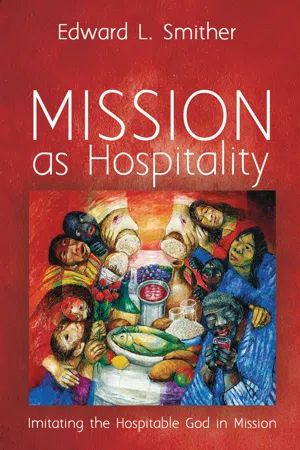
God is a missionary God. God is also hospitable in his nature. He makes his enemies friends and invites them to intimate communion. The mission of God in Scripture often occurs through hospitality when God's people encounter the not-yet people of God at table or in hospitable environments and invite them to believe. This motif of mission as hospitality plays out through the Old and New Testament Scriptures, and through the Eucharist. It can also be observed through the witness of monks and contemporary missionaries who embraced a hospitable approach to mission. For the church to participate in God's mission today, a vision to win, conquer, or change the world should be exchanged for a conviction to welcome the stranger and make room for others while proclaiming the gospel--that is, to imitate the hospitable God in mission.
Information
Topic
Theology & ReligionSubtopic
Christian Church3
Mission as Hospitality at the Lord’s Table
In the Eucharist (also known as Communion or the Lord’s Supper), the worshiper is invited to a table.126 Partaking of the bread and wine, believers remember the Lord’s miraculous provision of manna in the wilderness, reflect on Christ’s broken body and shed blood for the forgiveness of sins, and look forward to the Messianic Banquet to come.127 At the Lord’s Table, the gospel story—the suffering, death, burial, and resurrection of Christ—is dramatically retold. One of two sacraments given to the church, the Eucharist is a central element of Christian worship.
In this chapter, we probe further into Christ’s hospitality in mission by reviewing the Last Supper narratives in the Gospels as well as other New Testament and early Christian teaching on the Lord’s Table. We explore the meaning of the Eucharist and consider Christ as our host at the table, nourishing his body, the church, with his presence. Finally, in reflecting on the Eucharistic liturgy, we explore how mission occurs at the Lord’s Table and how the church is sent from the table to make disciples of all peoples.
The Last Supper
From Passover to Last Supper
On the night before his death, the Lord hosted his disciples at a fellowship meal remembered by the Gospel writers as the Last Supper. McGowan insightfully notes, “The term ‘Last Supper’ implies a whole series of previous suppers. The first Christians remembered not just the last but many meals of Jesus as models for their own eating.”128 The Supper reminds us that Jesus ate with his disciples on many occasions.129 O’Loughlin asserts that “the table seems to have been his classroom in discipleship.”130 Since Jesus was in the habit of practicing missional hospitality in the Gospels, this meal was not an innovative act but functioned as a crescendo to his earthly ministry.
Each of the Synoptic Gospel writers claimed that the Last Supper was a Passover celebration (Mark 14:12; Matt 26:17; Luke 22:7–8). Mark wrote: “On the first day of the Festival of Unleavened Bread, when it was customary to sacrifice the Passover lamb, Jesus’ disciples asked him, ‘Where do you want us to go and make preparations for you to eat the Passover?’” Though some scholars have questioned the timing of the meal (Jesus was arrested and suffered during the Passover, so his Last Supper preceded it), other scholars maintain that the Last Supper was a Passover Feast moved up a couple of days.131
Because it was a Passover meal, the Last Supper held deep theological significance. At the table, Jesus remembered God saving the enslaved Israelites in Egypt who had covered their homes with the blood of an unblemished lamb. This was followed by God’s mighty act of delivering the Israelites from slavery in Egypt, particularly through the miraculous Red Sea crossing. At the cross, Jesus, the spotless Lamb of God, shed his blood, covering the sins of those who believe and delivering them from the bondage of sin and the evil one. Marshall notes: “Jesus took the Passover meal and proceeded to give a new significance to it as a meal whose repetition by his followers would enable them to remember him.”132 A symbol of salvation history past and present, Jesus’ Last Supper with his disciples becomes the model meal for the Eucharist.133
Though John remembers Jesus having an upper room meal (John 13–17), he does not describe a Last Supper as the Synoptic writers do.134 However, earlier in the Gospel, John does capture Jesus in a synagogue in Capernaum teaching about the significance of his body and blood:
Very truly I tell you, unless you eat the flesh of the Son of Man and drink his blood, you have no life in you. Whoever eats my flesh and drinks my blood has eternal life, and I will raise them up at the last day. For my flesh is real food and my blood is real drink. Whoever eats...
Table of contents
- Title Page
- Acknowledgments
- Introduction
- Mission as Hospitality in the Old Testament
- Mission as Hospitality in the New Testament
- Mission as Hospitality at the Lord’s Table
- Mission as Hospitality in the Work of Missionary Monks
- Mission as Hospitality: Contemporary Models
- Mission as Hospitality: Reflections and Practice
- Bibliography
Trusted by 375,005 students
Access to over 1.5 million titles for a fair monthly price.
Study more efficiently using our study tools.
Frequently asked questions
Yes, you can cancel anytime from the Subscription tab in your account settings on the Perlego website. Your subscription will stay active until the end of your current billing period. Learn how to cancel your subscription
No, books cannot be downloaded as external files, such as PDFs, for use outside of Perlego. However, you can download books within the Perlego app for offline reading on mobile or tablet. Learn how to download books offline
Perlego offers two plans: Essential and Complete
- Essential is ideal for learners and professionals who enjoy exploring a wide range of subjects. Access the Essential Library with 800,000+ trusted titles and best-sellers across business, personal growth, and the humanities. Includes unlimited reading time and Standard Read Aloud voice.
- Complete: Perfect for advanced learners and researchers needing full, unrestricted access. Unlock 1.5M+ books across hundreds of subjects, including academic and specialized titles. The Complete Plan also includes advanced features like Premium Read Aloud and Research Assistant.
We are an online textbook subscription service, where you can get access to an entire online library for less than the price of a single book per month. With over 1.5 million books across 990+ topics, we’ve got you covered! Learn about our mission
Look out for the read-aloud symbol on your next book to see if you can listen to it. The read-aloud tool reads text aloud for you, highlighting the text as it is being read. You can pause it, speed it up and slow it down. Learn more about Read Aloud
Yes! You can use the Perlego app on both iOS and Android devices to read anytime, anywhere — even offline. Perfect for commutes or when you’re on the go.
Please note we cannot support devices running on iOS 13 and Android 7 or earlier. Learn more about using the app
Please note we cannot support devices running on iOS 13 and Android 7 or earlier. Learn more about using the app
Yes, you can access Mission as Hospitality by Edward L. Smither in PDF and/or ePUB format, as well as other popular books in Theology & Religion & Christian Church. We have over 1.5 million books available in our catalogue for you to explore.