- 418 pages
- English
- ePUB (mobile friendly)
- Available on iOS & Android
eBook - ePub
About this book
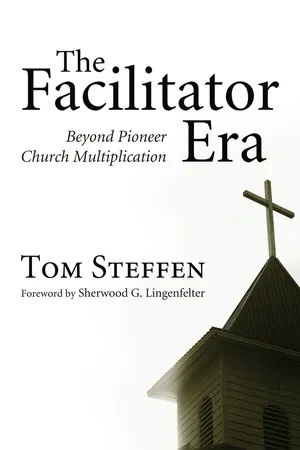
Some time ago, Ralph Winter brilliantly identified three eras of modern missions: Era 1: William Carey focused on the coastlands; Era 2: Hudson Taylor focused on the inlands; Era 3: Donald McGavran and Cameron Townsend focused on unreached peoples. With all the fast and furious changes swirling around us today in twenty-first century missions, have we entered a Fourth Era? If so, who are the people primarily involved? How are they selected? How are they trained? How long do they serve? Has the Third Era ministry focus--reaching the unreached--changed? If so, to what? Are there any successful case studies out there? Have McGavran and Townsend passed the baton to a new leader(s)? If so, to whom? This book seeks to answer these and related questions.
Contributors:
Dr. Ben Beckner
Dr. Monroe Brewer
Dr. Don Finley
Mike Griffis
Dr. Gary Hipp, MD
Jerry Hogshead
Kaikou Maisu
Judy Manna
Kenn Oke
Dr. A. Sue Russell
Dr. Robert Strauss
Peter Swann
Bryan Thomas
Diane Thomas
Dr. Mike Wilson
Dr. Sherwood G. Lingenfelter
Information
Topic
Theology & ReligionSubtopic
Christian MinistryPart One
Facilitation in History and Theory
Week 1
What Do the Books Say?
“This is so disappointing,” complained Bill glumly as he placed his laptop on the large, dark mahogany desk. “We finally get to meet with Dr. Nobley and he’s called away for an emergency meeting. Sure hope he makes it back before we have to leave.”
“Well, let’s make the best of it,” countered Bev as she walked toward the bookcases, ponytail swaying. “He said we could peruse the books on church planting. Here they are. Wow, two whole shelves of books on church planting! Where do we start, Mr. Organizer?”
For the next two hours, the couple surveyed the titles, read through the tables of contents, and began to stack the books according to emphasis. They made a separate stack for books that they were unsure how to categorize. As they were trying to figure out what to do with them, the door opened, and in walked Dr. Nobley, casually-dressed and carrying three cups of steaming coffee from their favorite shop.
“So sorry about that,” apologized Dr. Nobley. “Maybe this coffee will help make up for it a little. Seems I can’t get out of meetings even in the summer.”
He set the coffees down on the table amid the neatly-organized stacks of books, which were marked with yellow sticky-notes. “Ah! I see you’ve created a number of different categories for the books on church planting. All those stacks look like the skyline of New York. What have you two discovered in my absence?”
* * *
“We’ve tried to categorize the books under various emphases, but we’re not sure where some of them fit,” replied Bill as he pointed to one stack. “This stack falls under cross-cultural urban church planting.”
1. Harvie Conn’s Planting and Growing Urban Churches: From Dream to Reality
2. Viv Gregg’s Cry of the Urban Poor
3. Roger Greenway’s Cities: Missions’ New Frontier
4. Roger Greenway’s Discipling the City
5. Ed Silvoso’s That None Should Perish: How to Reach Entire Cities for Christ Through Prayer Evangelism
6. Keith Hinton’s Growing Churches Singapore Style: Ministry in an Urban Context
7. John Fuder and Noel Castellanos’s A Heart for the Community: New Models for Urban and Suburban Ministry.
“Well done,” said Dr. Nobley. “Roger Greenway, who taught at Westminster Theological Seminary before he retired, has pioneered the field of urban church planting. Before the late 1970s, most church planting took place in peasant and tribal areas. Conn’s book provides a valuable collection of signature articles formerly published in the now-defunct journal, Urban Mission. A great contribution! Hinton and Silvoso take a macro approach to reach a city for Christ, and Silvoso is open to the use of all the spiritual gifts to do it. Fuder and Castellanos consider appropriate ministries for those many city dwellers moving to the suburbs.”
* * *
Bev chimed in, “We found another grouping, too: planting churches through house churches and cell groups. Take a look at this pile.”
1. Robert Banks’s Paul’s Idea of Community: The Early House Churches in Their Historical Setting
2. Robert and Julia Banks’s The Church Comes Home: A New Base for Community and Mission
3. Ralph Neighbour’s Where Do We Go from Here? A Guidebook for the Cell Group Church
4. Del Birkey’s The House Church: A Model for Renewing the Church
5. Wolfgang Simson’s Houses That Change the World
6. J. D. Payne’s Missional House Churches: Reaching Their Communities with the Gospel
7. Paul Yonggi Cho’s Successful Home Cell Groups.
“A very strong house church movement is happening today in the United States and abroad,” contended Dr. Nobley as he sipped his coffee. “Some, like Neighbour, claim that the house church is God’s only true biblical model for a community of faith, not the institutional church. Banks and Birkey provide a scholarly overview of the topic, and Payne will update you on the house church movement in the United States. Cho’s book presents an Asian perspective from Korea, home to most of the biggest Protestant churches in the world, including Yoido Full Gospel Church, where he pastors. The house church seems to fare best in urban settings and, of necessity, in countries hostile to the gospel.
“And the next stack?” Professor Nobley asked.
* * *
“Actually we made another category—North American church planting—with two groupings: Anglo and multiethnic,” continued Bev with a hand resting on each stack. “There may be some cross-cultural application. Here’s what we included in the Anglo grouping.”
1. Paul Becker and Mark Williams’s The Dynamic Daughter Church Planting Handbook
2. Charles Chaney’s Church Planting at the End of the Twentieth Century
3. Robert Logan and Neil Cole’s Beyond Church Planting (a workbook with audio CDs)
4. Rick Warren’s The Purpose Driven Church
5. Aubrey Malphurs’s Planting Growing Churches for the 21st Century: A Comprehensive Guide for New Churches and Those Desiring Renewal
6. C. P. Wagner’s Church Planting for a Greater Harvest.
“What a list!” remarked the professor as he scratched his head. “Logan and Cole, top church-planting consultants in the United States, give the practitioner a theologically sound, principle-based, well-thought-out, step-by-step approach to multiplying disciples, leaders, churches, and movements. They want you to plant a movement, not start a church. While some who tried their materials cross-culturally have not always found them applicable, avoid these books at your own peril.
“Warren’s book has sold more copies than any other book in history in the area of church growth, and Wagner’s book has one of the most quoted lines: ‘Planting new churches is the most effective evangelistic methodology known under heaven.’”1
“One other collection we placed under the Anglo group were the books that focused on the missional church,” added Bill. “Here they are.”
1. Ed Stetzer’s Planting Missional Churches: Planting A Church That’s Biblically Sound and Reaching People in Culture
2. David Fitch’s The Great Giveaway: Reclaiming the Mission of the Church from Big Business, Parachurch Organizations, Psychotherapy, Consumer Capitalism, and Other Modern Maladies
3. Bob Roberts’s The Multiplying Church: The New Math for Starting New Churches
4. John Lukasse’s Churches with Roots: Planting Churches in Post-Christian Europe.
“If the house church movement is a reaction to the traditional institutional church in the United States,” interjected Dr. Nobley, “the missional church, with its strong ties to post-modernity, is a reaction to modernity’s influence on the traditional church. Just look at the sub-title of Fitch’s book: Reclaiming the Mission of the Church from Big Business, Parachurch Organizations, Psychotherapy, Consumer Capitalism, and Other Modern Maladies. You could add Alan Hirsch’s The Forgotten Ways: Reactivating the Missional Church to the pile, but I don’t have it here because someone borrowed it.
“Contextualization is at the center of the concerns of those within the missional movement, even though their critics would say that some—not all!—who emphasize contextualization have abandoned good theology in the process. Be careful in your own judgment,” Professor Nobley warned. “The movement for contextualization is not monolithic, and it’s a moving target methodologically and theologically.
“Anyway, what did you include in multiethnic church planting?”
With coffee in hand, Bill made his way around the table to the multiet...
Table of contents
- Title Page
- Foreword
- Preface
- Acknowledgments
- The Backstory
- Part 1: Facilitation in History and Theory
- Part 2: Facilitation in Practice
- Part 3: Facilitation as Praxis
- Bibliography
- Contributors
Trusted by 375,005 students
Access to over 1.5 million titles for a fair monthly price.
Study more efficiently using our study tools.
Frequently asked questions
Yes, you can cancel anytime from the Subscription tab in your account settings on the Perlego website. Your subscription will stay active until the end of your current billing period. Learn how to cancel your subscription
No, books cannot be downloaded as external files, such as PDFs, for use outside of Perlego. However, you can download books within the Perlego app for offline reading on mobile or tablet. Learn how to download books offline
Perlego offers two plans: Essential and Complete
- Essential is ideal for learners and professionals who enjoy exploring a wide range of subjects. Access the Essential Library with 800,000+ trusted titles and best-sellers across business, personal growth, and the humanities. Includes unlimited reading time and Standard Read Aloud voice.
- Complete: Perfect for advanced learners and researchers needing full, unrestricted access. Unlock 1.5M+ books across hundreds of subjects, including academic and specialized titles. The Complete Plan also includes advanced features like Premium Read Aloud and Research Assistant.
We are an online textbook subscription service, where you can get access to an entire online library for less than the price of a single book per month. With over 1.5 million books across 990+ topics, we’ve got you covered! Learn about our mission
Look out for the read-aloud symbol on your next book to see if you can listen to it. The read-aloud tool reads text aloud for you, highlighting the text as it is being read. You can pause it, speed it up and slow it down. Learn more about Read Aloud
Yes! You can use the Perlego app on both iOS and Android devices to read anytime, anywhere — even offline. Perfect for commutes or when you’re on the go.
Please note we cannot support devices running on iOS 13 and Android 7 or earlier. Learn more about using the app
Please note we cannot support devices running on iOS 13 and Android 7 or earlier. Learn more about using the app
Yes, you can access The Facilitator Era by Tom Steffen in PDF and/or ePUB format, as well as other popular books in Theology & Religion & Christian Ministry. We have over 1.5 million books available in our catalogue for you to explore.