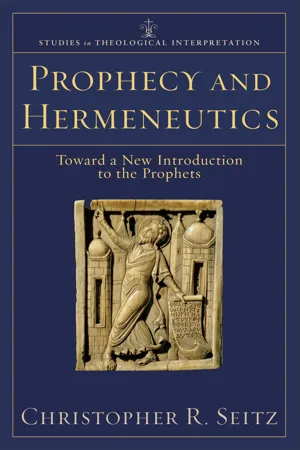
eBook - ePub
Prophecy and Hermeneutics (Studies in Theological Interpretation)
Toward a New Introduction to the Prophets
- 266 pages
- English
- ePUB (mobile friendly)
- Available on iOS & Android
eBook - ePub
Prophecy and Hermeneutics (Studies in Theological Interpretation)
Toward a New Introduction to the Prophets
About this book
A fresh wave of studies on the prophets has appeared in recent years. Old Testament scholar Christopher R. Seitz has written Prophecy and Hermeneutics as a way of revisiting, from the ground floor up, what gave rise to studies of the prophets in our modern period. In addition, Seitz clearly shows that a new conceptuality of prophecy, hermeneutics, history, and time is needed--one that is appropriate to current views on Isaiah and the Twelve. Scholars, students, professors, and theological libraries will find this an essential foundational resource.
Information
1
WHAT IS AN INTRODUCTION TO THE PROPHETS?
WHAT IS AN INTRODUCTION TO THE PROPHETS?
What is an introduction to the prophets? What do books that purport to tell us something about Israel’s prophets do? At one level, one can see that the matter entails both a literary question of genre and a sociological question of function. Introductions to the prophets could be accounts that simply try to tell a general reader something about a phenomenon that occurs, in this instance, within ancient Israel and whose sources for our knowledge are the Bible and other materials from this same ancient environment. Such a general reader would expect an introduction to provide them basic information about a phenomenon that is unusual or foreign, and the fact that this phenomenon occurs within a literature whose traditional purpose has been religious edification or instruction is largely incidental. Such accounts do exist. Their genre would make them suitable in an encyclopedia or as a general resource book.
Another possibility is that an introduction to the prophets is meant to serve a particular function. Here we might be speaking of something like a textbook, to be used within a classroom, aimed toward this or that curricular requirement. And of course there is quite likely an overlap of genre in something like an introduction. Basic information and the requirement, or hope, of fitting into a curriculum are probably kindred concerns.
If one goes to a library and looks up books that go by the title “Introduction to the Prophets,” and others like it, one discovers that this combination of loose genre classification and functional requirement has conspired to create a discrete and sizable section. If one opens a book in this section, moreover, one can begin to get a feel for methods of approach, organizational patterns, and certain basic other features, to which a good number of the volumes clearly conform.
There is of course another way to answer the question asked in the chapter title. This other way also keeps firmly in view matters of genre and function, but it is more a question in the history of ideas: where did such a genre come from, to what uses has it been put, and how does it relate to other genres and other uses? If one opened an introduction to the prophets and it turned out to be an account of the way the prophets had been read in the church and synagogue—a history of the interpretation of the prophets—one would of course realize that there is a distinctly historical dimension to what we might mean by the genre and function of an introduction to the prophets.
The matter is being put this way because for the last two hundred years or so, in spite of manifold changes in the way one might ask and answer the question—and so construct a volume along these lines—the genre “introduction to the prophets,” and similar such works, has both matured and developed certain predictable forms. This is particularly true at the level of organization. The prophets are treated as historical figures, and this leads to the necessity of placing them in a temporally appropriate sequence, as a baseline consideration organizationally, whatever might then also be said about them. This also would constitute the creative and novel element in a book that in turn leads a publisher to say, “This is publishable, and I recognize what it is. It will work in this market, which expects X when it sees the title X, and it will do it with a special contribution or with special clarity and so forth.”
In this opening chapter, my purpose in the first instance is to offer an uncomplicated and uncontroversial answer to the question: where did separate treatments of the prophets of Israel come from? The reasons for such an inquiry, however, need to be in place. Two factors in particular are relevant here. Only when we comprehend them will our interest in returning to the origin of focused accounts of the prophets, with their own integrity, be clear.
First, changes are occurring in the way in which the prophetic books are being approached that are likely in turn to call into question the organizational scheme widely adopted in the genre of the modern period. This is already happening in some recent accounts.1 The reason for needing a reconsideration of the genre of introduction when it comes to the prophetic books as a whole is tied up with changes in approach to two specific prophetic books in particular—or more accurately, one book and one book collection (a factor that indicates that the matter was perhaps too tidy to begin with). The book of Isaiah had, over time, come to be regarded as a composite book, and this necessitated slotting it organizationally at three separate points in time for the purpose of the standard introduction. Recent work on the book of Isaiah indicates, to varying degrees, a lack of firm conviction about the propriety of this way of thinking about the book as altogether adequate—or even a firm resolve that it is mistaken and must be left off for good. In the history of ideas, resistance to dividing Isaiah was felt early on, but what is now being registered is not a simple notion that one Isaiah authored the entire book, but that the tidiness of a threefold (or more) division is less convincing and that the book needs some account that will deal with its present final form.
However one approaches the matter and however the issue is finally resolved (if such a thing happens), it has clear ramifications for the way in which an introduction organizes the material. Yet here one notes a time lag in adjusting the genre of introductions, or a resistance to change borne of factors not entirely obvious or logical. The genre of introduction has a firm hold on the market, in the form in which it has traditionally functioned. It is entirely possible to finesse the matter and have it both ways, as it were: treat Isaiah as three for the purposes of a historically genetic model and outline, but then comment on it as one when all the history settles down and a sixty-six-chapter canonical Isaiah results. Indeed, this might be a salutary and defensible adjustment.2 But other factors must be thought through as well, and I wish to indicate these shortly.
Potentially more incorrigible for the genre of introduction, as traditionally constructed, is a factor going in the opposite direction to what is happening in Isaiah. This makes the matter of finessing things more complicated. The Minor Prophets comprise twelve individual witnesses, and almost from the beginning of the analysis of the prophets with which we are here concerned, these twelve were taken as twelve and not as one composite work. Here was the basic prophetic stuff at its length and breadth, poised for twelvefold reassembling according to historical (genetic) considerations. The basic organizational structure of the introduction was conceived and took hold.
Newer work on the Twelve is concerned, among other things, to show that the Twelve is a single coordinated work as well as a composite collection—now no longer random or requiring a basic historical retrofitting—of twelve coordinated witnesses. Yet in large measure, as in the case of the book of Isaiah, the genre of introduction has resisted change—even in the face of what might well be a major question mark hanging over it. This can be said without impugning the logic and defensibility of the traditional structure of an introduction or insisting upon its dismantling; work on the Twelve as a whole hardly disputes the historical character of the material and its gradual development into the form in which we now have it. Perhaps the question can most fairly be put as one of proper balance and proportion: how does the coherence of the witness as a whole also require an inquiry at the very basic level assumed by an introduction? If the logic of the whole is granted as crucial, then can the legitimacy of taking the witness apart and reassigning it, in parts and in whole, along a chronological organizational grid still be so obvious? What is an introduction to the prophets? In David Petersen’s recent treatment, one sees an adjustment in the organizational structure that takes account of the kinds of changes in the prophets noted with Isaiah and the Twelve. But this seems to be a formal adjustment only, without any real engagement with the history of the genre that, to my mind, is now called for. It may well be that we are seeing a kind of tentativeness here, borne of uneasiness about the ways in which such an approach to the prophets is properly to be appreciated as historical.
This then brings us to the second factor. The genre of an introduction to the prophets did not drop from the sky. It was engendered by a wide variety of factors, theological concerns, and affiliated developments. What we may be witnessing, in the light of newer developments in the interpretation of Israelite prophecy just noted, is an alteration of the genre of the introduction that degenerates into specious or disconnected, local adjustments—adjustments that fail to take into account the wider implications of what is going on. Treatments of the prophets in the form we are discussing emerged in conscious relationship to other factors and justified their existence and their utility within a specific environment of affiliated concerns. In the present work I will seek to demonstrate the correlation between new models of interpreting the prophets and the wider implications of this for theological reflection more broadly and for the character of biblical studies as an inherently affiliated discipline. These were the terms on which it was originally conceived, especially in the area of the prophets.
The ramifications of this extend beyond the area of basic theological affiliation and well into the conceptual apparatus of hermeneutics more generally. How do the prophets prophesy, and how do we understand what is meant by fulfillment and accordance? This latter feature takes us into the ambitious realm of time and providentiality and questions of the proper way in which to understand prophecy in the Old Testament and the relationship to it expressed in the New Testament. What we will see is that, while these were originally questions that came with an obviousness and immediacy when the historical approach of the modern period began its work, over time they lost both their moral urgency and the self-evidence of the need to integrate them into any robust account of the matter.
There is a further, lower-flying matter to account for here as well. I noted at the outset the way in which questions of genre are at once questions of function. Interest in the prophets was not just intellectually and morally connected to a wide range of other questions—theological, historical, and philosophical in character—whose indispensability was everywhere granted. This connective tissue existed at the level of basic delivery systems, which were conceived to make the connections explicit and assure, as best they could, that the logic of the whole enterprise of theological inquiry was coherent and capable of intellectual justification. I speak here only of the requirement of intellectual consistency, such as is necessary in any properly comprehensive account of a thing. Academic organization of this wider account of affairs was undertaken so that the various subdisciplines were in obvious relationship to one another. If the subspecialties over time become specialties, then the genres around which they are organized and which they in turn generate for their extension in time will become detached from one another. The extension of these differentiated genres (within the larger categories of introduction, history of Israel, and biblical theology) in new contexts will over time operate, as it were, on something like autopilot. This is what makes them resist change when new factors come into play, as is happening in the case of the prophetic literature at present. At such times it is necessary to return to the original hothouse in which such genres were first conceived in order to be sure we grasp their character as historical realities.
Part 1 to follow will tackle this matter in some detail, especially in the light of recent work on the Minor Prophets. This recent work presses one to account for the logic and durability of a model of interpreting the prophets that has maintained its basic character for quite a long time. Once one tries to integrate this new work—representing as it does certain fundamentally different understandings of prophecy—it becomes possible to detect a new way of thinking about prophecy that strikes at the very root of inherited models. What I hope to show is that the integrated character of prophecy, as was required in early historical accounts, is once again necessary, but for a fresh set of reasons and with very different consequences. I go back to the emergence of prophecy as its own special field of study because that specialness was still in distinct relationship to other matters—including especially comprehensive theological accounts of history. I shall argue that these theological accounts of history, precisely because of the zeal with which they were generated and because of the character of what counted for the sort of history they were seeking, ceased being able to understand the unique species of history that the Bible—and especially the prophets—was itself generating. Precisely the prophets were seen to occupy a special place, due to the historicality they manifested, and so interest in them grew in special proportion. Contributing to this was a sense that, of the various alternative parts of the Old Testament, seen as historical literature, the prophets in particular displayed far fewer problems. Much of this was only the illusion of perspective, as we shall see, for the problems would soon emerge in the prophetic materials as well, with a force commensurate with the strangeness of the literature, which had in fact always been there.
Part 1 will form the backbone of the treatment of prophecy in this book. It will examine in greater detail where study of the prophets came from and how such study will of necessity change if newer accounts of the status of the canonical form are allowed to register their full impact. That, at any rate, will constitute the thesis being pursued. I will not seek to give a full account of what might be called a canonical reading of the Minor Prophets as a whole, though I will give indication of what is at stake hermeneutically in the shift toward a newer canonical reading for figural interpretation of Christian Scripture. Part 2 will provide fuller treatments of such a canonical reading of the Twelve, again with the hermeneutical implications forming our major area of concern.
At this juncture, in order to provide a general introduction to the main materials to follow, I will address, along the lines just described and in brief fashion, the question: what is an introduction to the prophets?
The Prophets as an Affiliated Concern—Times and Authors
The name Wellhausen is conveniently associated in the history of ideas with a dramatically new account of the Pentateuch, but in point of fact, by his own admission, the idea was not really his own and was long in coming (in the work of Vatke, Graf, Reuss). Wellhausen organized and rhetorically performed the new account in a particularly compelling way, and that is why we remember him.
The same could be said—in much more modest terms and for different reasons—of the name Gabler, who in 1787 found himself giving an inaugural address that would mark a new era in the history of biblical interpretation. Gabler was indebted to a history of ideas and to far greater figures ahead of him in that history (Spinoza, Simon, Ernesti, Semler, Eichhorn), so in many ways his Altdorf address has achieved a proportion that is artificial. But it is a convenient marker, and the content of the address classifies in a compact way some of the reigning assumptions of the period. For my purpose here, the distinction he called attention to and argued for—between biblical and dogmatic theology, between true and pure/ideal theology—had the effect of cutting the larger enterprise in half, parceling out the chores to be done and consolidating the biblical side of things under one roof.
Initially, anyway, under this one roof, individual efforts at biblical theology were undertaken in an affiliative manner. The Testaments were treated in their entirety and then together, by one and the same interpreter.3 Two things at least marked the new biblical-theology emphasis, seen from the perspective of an earlier history of ideas. Time (or, more accurately, times) becomes an organizing concern as a matter of interest unto itself, with its own special significance. Time comes into its own—what will be called now with relish and fresh urgency “history”—as the interpreter comes under the obligation of understanding the biblical authors and the writings associated with them as belonging to discrete and particularized periods. Ti...
Table of contents
- Cover Page
- Title Page
- Copyright Page
- Table of Contents
- Preface: Explanation and Orientation
- Introduction: Prophecy Reconfigured
- 1. What Is an Introduction to the Prophets?
- Part 1: The Overreach of History—Figuring the Prophets Out
- Part 2: Time in Association—Reading the Twelve
- Conclusion
Trusted by 375,005 students
Access to over 1.5 million titles for a fair monthly price.
Study more efficiently using our study tools.
Frequently asked questions
Yes, you can cancel anytime from the Subscription tab in your account settings on the Perlego website. Your subscription will stay active until the end of your current billing period. Learn how to cancel your subscription
No, books cannot be downloaded as external files, such as PDFs, for use outside of Perlego. However, you can download books within the Perlego app for offline reading on mobile or tablet. Learn how to download books offline
Perlego offers two plans: Essential and Complete
- Essential is ideal for learners and professionals who enjoy exploring a wide range of subjects. Access the Essential Library with 800,000+ trusted titles and best-sellers across business, personal growth, and the humanities. Includes unlimited reading time and Standard Read Aloud voice.
- Complete: Perfect for advanced learners and researchers needing full, unrestricted access. Unlock 1.5M+ books across hundreds of subjects, including academic and specialized titles. The Complete Plan also includes advanced features like Premium Read Aloud and Research Assistant.
We are an online textbook subscription service, where you can get access to an entire online library for less than the price of a single book per month. With over 1.5 million books across 990+ topics, we’ve got you covered! Learn about our mission
Look out for the read-aloud symbol on your next book to see if you can listen to it. The read-aloud tool reads text aloud for you, highlighting the text as it is being read. You can pause it, speed it up and slow it down. Learn more about Read Aloud
Yes! You can use the Perlego app on both iOS and Android devices to read anytime, anywhere — even offline. Perfect for commutes or when you’re on the go.
Please note we cannot support devices running on iOS 13 and Android 7 or earlier. Learn more about using the app
Please note we cannot support devices running on iOS 13 and Android 7 or earlier. Learn more about using the app
Yes, you can access Prophecy and Hermeneutics (Studies in Theological Interpretation) by Christopher R. Seitz, Bartholomew, Craig G., Green, Joel, Seitz, Christopher, Craig G. Bartholomew,Joel Green,Christopher Seitz in PDF and/or ePUB format, as well as other popular books in Theology & Religion & Biblical Criticism & Interpretation. We have over 1.5 million books available in our catalogue for you to explore.