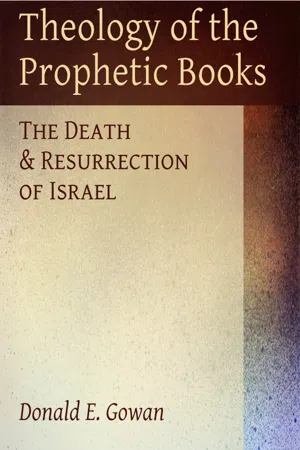
Donald Gowan offers a unified reading of the prophetic books, showing that each has a distinctive contribution to make to a central theme. These books--Isaiah through Malachi--respond to three key moments in Israel's history: the end of the Northern Kingdom in 722 BCE, the end of the Southern Kingdom in 587 BCE, and the beginning of the restoration from the Babylonian exile in 538 BCE. Gowan traces the theme of death and resurrection throughout these accounts, finding a symbolic message of particular significance to Christian interpreters of the Bible.
- English
- ePUB (mobile friendly)
- Available on iOS & Android
eBook - ePub
About this book
Information
Topic
Theology & ReligionSubtopic
Biblical Studies1
THE PROPHETS AS THEOLOGIANS
This is a study of a unique group of books that came into existence because of the destruction of the kingdoms of Israel and Judah and the beginning of the restoration of Judeans to their homeland. They are works of theology, in that they claim to be able to explain what Yahweh, God of Israel and Judah, was doing in the midst of those events, and this book focuses exclusively on that theological explanation. It thus differs from most books on the Old Testament prophets. It does not deal with the general phenomenon of “prophecy,” so will devote little attention to the psychology of prophetism or to the roles played by the prophets in their society, subjects that have been extensively discussed in recent literature.1 This study confines itself to the messages of the canonical prophets (formerly called writing prophets): Isaiah, Jeremiah, Ezekiel, and the Book of the Twelve.2 Their messages have, of course, been expounded many times over, and yet there is a way of looking at this corpus of literature which has not been overworked, and indeed has not been recognized as the unifying factor that explains why this collection of books was made. A brief survey of the ways the prophets have been understood should be useful to the reader as a way of locating what this book attempts to do, in comparison with the long history of interpretation.
1.1 Approaches to the Prophets
In postexilic Judaism the term “prophet” came to be used eventually of any inspired person. The origins of this usage may be found already in the Old Testament, where Abraham (Gen. 20:7) and Moses (Deut. 34:10) are so designated. In the New Testament, John the Baptist (Matt. 21:26) and Jesus (Matt. 21:11) are called prophets, so it is clear that by the New Testament period the term had come to be used in ways not necessarily defined by those books we now call the canonical prophets. John Barton has provided an extensive study of the various uses of the concept of prophet in this period.3 The canonical prophets themselves had been cast in the roles of martyrs, in keeping with the need for examples of faithfulness in the midst of suffering brought about by the persecutions of both Jews and Christians (cf. Matt. 5:12; 13:57; 23:30–31, 37; Acts 7:52; Rom. 11:3; 1 Thess. 2:15; James 5:10; Rev. 16:6). The noncanonical work Lives of the Prophets (first century C.E.) would more accurately have been called “deaths of the prophets,” for it considered them all to have been martyrs, and the legendary material which it adds to what is known from the Bible deals mostly with their deaths.
Through much of Christian history, the prophetic books have been read primarily as sources of predictions of the coming of Christ, and of the eschaton. In contrast, Judaism has understood the prophets to be teachers of the Torah.4 The historical and biographical interests that came to dominate nineteenth-century biblical scholarship led to a greater interest in the prophets as individuals, and efforts began to reconstruct the backgrounds, religious experiences, and distinctive theologies of each of them. The traditional understanding of prophets as people inspired by God tended to be transmuted into a picture of them as great, creative religious thinkers. The opinions of influential German scholars such as Ewald, Wellhausen, and Duhm have tended to be echoed in scholarship as a whole throughout the nineteenth and much of the twentieth century, and their definition of “prophet” has widely influenced the way prophets are viewed in the church, as well. To “prophesy” is still regularly used to mean “predict the future,” but to be “prophetic” now means to take a lonely stance for truth and justice, against popular opinion. This corresponds with the scholarly understanding of the canonical prophets as the virtual creators of ethical monotheism, lonely individualists who stood for spiritual religion and against organized religion’s ritualistic observances, which were devoid of concern for justice. Thinking of the prophets as individualists led to the effort to learn as much about their lives as possible. The Old Testament shows little interest in that subject, so the efforts to reconstruct their biographies inevitably led to a considerable exercise of the imagination. For example, the location of Amos’s home, Tekoa, on the edge of the Judean wilderness, and his reference to himself as a herdsman, could produce a rather romantic picture of one whose religious experience had been shaped by the severity of life in the desert. The fact is, we do not know whether Amos spent any time in the Judean wilderness, let alone whether he had any religious experiences there.
This biographical interest took a new turn early in the twentieth century, when Gustav Hölscher and others began to emphasize the psychological aspects of prophetic experience, as they are recorded in the accounts of visions and other paranormal phenomena, and eventually a full account of the “ecstatic personality” was produced by Johannes Lindblom.5 Some have tried to confine these phenomena to the kind of prophet mentioned in the books of Samuel and Kings, claiming they were not important aspects of canonical prophecy, but Amos, Isaiah, Ezekiel, and others do claim to have seen visions, and it seems most likely that Israelites identified people as nebi’im, “prophets,” because they were known to have had ecstatic experiences of this kind.
By the middle of the twentieth century, a reaction to the claim that the prophets rejected ritual in favor of a spiritual religion had set in. Numerous studies showed that the prophets all used cultic materials extensively, mostly in positive ways, and some even concluded that many, if not all, the canonical prophets were in fact employed at the Israelite sanctuaries.6 That theory has gained few adherents, but the study of the use of cultic forms showed at least that the prophets were well acquainted with the language of worship of their people, and by no means were starting afresh with a new vocabulary and new concepts.7
This move away from seeing them as individuals largely isolated from their community took another form in the writings of those who stressed the centrality of the covenant in the life of Israel. Even though the word “covenant” seldom appears in the prophetic books earlier than Jeremiah and Ezekiel, other forms associated with the covenant were identified, and the picture of prophets filling a formal office in Israel, carrying out God’s covenant lawsuit against his people, was created. Thus their oracles of judgment were claimed not to be original creations, after all, but part of Israel’s worship.8 Recent studies of the history of the covenant have questioned whether the covenant concept in Israel was even as early as the period of the prophets, and although that seems to be hyperskeptical, the evidence to support the idea that they were “covenant-officials” is largely lacking.9
Another possible source for the prophets’ teaching was located in the wisdom literature. Attention was drawn to the presence of certain genres, vocabulary, and ideas typical of the wisdom books, especially in Amos, Isaiah, and Habakkuk.10 For example, Hans Walter Wolff’s commentary on Amos takes the position that his thought was profoundly influenced by his “intellectual home,” which was tribal wisdom. Further studies showed that wisdom influence is widespread throughout the Old Testament, so it seems better to think of the prophets as using both wisdom and cultic materials known to everyone, without assuming that gave them a special relationship to either aspect of Israel’s institutional life.
Late in the twentieth century, efforts were made to shed additional light on the roles Israelite prophets may have played in their society by comparing them with figures in other, better-known cultures who are thought to have been similar to the Old Testament characters.11 Comparisons with the texts produced by oracle givers at the ancient Syrian city of Mari have been of interest, although they are dated long before the prophetic period in Israel. The efforts to interpret the roles of Israelite prophets by studying the activities of shamans in contemporary cultures runs the danger of circular reasoning, however, for the criteria for choosing individuals from other cultures must be drawn from one’s preconceptions of what the Old Testament prophets were really like.12
Contemporary studies have thus moved significantly away from the earlier picture of the prophets as highly creative individuals, who produced something truly new.13 These trends may lead to the extreme represented by these sentences from Lester Grabbe’s book: “The contents of the prophetic books are certainly not unique in the Bible.” “The differences between the pre-classical seer, the classical prophet, the postexilic prophet, and the apocalyptic visionary dwindle at most to matters of degree rather than kind.”14 At another extreme, a study of the Old Testament uses of the word nabi’, traditionally translated “prophet,” has suggested that Amos and the others associated with the “prophetic books” were probably never called by that title in the postexilic period, and it was given to them only much later.15 What then remains of those noble figures, martyrs, mystics, reformers, heroes of the faith, that earlier readers thought they had found in their books?
The fact is that there is not enough evidence about the biographies of the prophets or about the social setting of the words in these books to make any of the reconstructions just cited demonstrable. A great deal of extrapolation has been used in every case, and that explains why such a wide variety of pictures of who the prophets really were is possible. These efforts were probably inevitable, for the nineteenth and early twentieth centuries had a strong historical and biographical interest. The search for the historical Jesus was accompanied by these searches for the historical prophets. Late-twentieth-century scholarship has been strongly influenced by materialist approaches to history, with religion itself to be accounted for by social and political factors, and so the study of the prophets has now been made to conform with those interests. But the variety of results is not due solely to presuppositions; it is also, and primarily, due to the scarcity of evidence of the kind being sought. Israel clearly had little or no interest in the kinds of questions being asked by modern readers, for they preserved very little evidence of the sort needed to answer these questions. We know nothing about Obadiah and Habakkuk except their names, and only the name and place of residence of Nahum. We know Amos’s hometown, occupation, and one incident from his life, and that is more than we know about the other minor prophets. There is more information about Isaiah, Jeremiah, and Ezekiel, but not enough to write the life story of any of them. Jeremiah’s book does contain a lengthy series of stories about his later years, but the chapter on Jeremiah in this book will claim that was not an early effort at biography. The incidents from the lives of the prophets which are contained in the canonical books quite clearly have been preserved because they have within them a message from God to Israel, and not because the prophets lived such interesting lives.16 This book will follow Israel’s lead, and will claim that our inability to reconstruct biography or social location is not a serious defect. These efforts to get at the “historical Amos (or Isaiah, etc.)” certainly involve questions of great interest to us, and we cannot avoid asking them, but since the lives, religious experiences, and social status of those responsible for these books seem to have been of little or no interest to the Israelites who collected and produced the final editions of the material, this book will not attempt to get beyond what we have, written in the prophetic books, and will take them as Israel’s testimony to what the prophets meant to them, a subject of sufficient interest in its own right.
1.2 Ways of Reading the Prophetic Books
The prophets have been compared with shamans, with Nostradamus, with one’s favorite reformer, or one’s favorite evangelist, et al., but the books ascribed to them have no truly close parallels anywhere else in literature. The uniqueness of this collection will provide a starting point for our work in the theology of the books, but before moving in that direction some reflection on scholarly approaches to the books themselves will be helpful. For centuries the prophets were thought of as authors, so they were designated writing prophets to distinguish them from Nathan, Elijah, and the others in the books of Samuel and Kings. With the application of form criticism to these books, the homiletical nature of their words was noticed, and they were recognized to have been preachers whose work was originally oral in form, set in writing later (cf. Jeremiah 36). Whether the written forms were composed by themselves or by disciples, or even later by scribes dependent on oral tradition remains an unanswerable question. Once the interval between production of the words orally and their setting down in writing had been acknowledged, with the possibility that the prophet did not do any of the writing, then another possibility emerged: Perhaps the prophet himself did not say everything in the book asc...
Table of contents
- Cover
- Half title
- Title
- Copyright
- Dedication
- Contents
- Abbreviations
- 1. The Prophets as Theologians
- Part One Death: 722 and 587 B.C.E.
- Part Two Resurrection: 538 B.C.E. and the Postexilic Period
- Notes
- Index of Scripture and Other Ancient Writings
- Index of Names and Subjects
Trusted by 375,005 students
Access to over 1.5 million titles for a fair monthly price.
Study more efficiently using our study tools.
Frequently asked questions
Yes, you can cancel anytime from the Subscription tab in your account settings on the Perlego website. Your subscription will stay active until the end of your current billing period. Learn how to cancel your subscription
No, books cannot be downloaded as external files, such as PDFs, for use outside of Perlego. However, you can download books within the Perlego app for offline reading on mobile or tablet. Learn how to download books offline
Perlego offers two plans: Essential and Complete
- Essential is ideal for learners and professionals who enjoy exploring a wide range of subjects. Access the Essential Library with 800,000+ trusted titles and best-sellers across business, personal growth, and the humanities. Includes unlimited reading time and Standard Read Aloud voice.
- Complete: Perfect for advanced learners and researchers needing full, unrestricted access. Unlock 1.5M+ books across hundreds of subjects, including academic and specialized titles. The Complete Plan also includes advanced features like Premium Read Aloud and Research Assistant.
We are an online textbook subscription service, where you can get access to an entire online library for less than the price of a single book per month. With over 1.5 million books across 990+ topics, we’ve got you covered! Learn about our mission
Look out for the read-aloud symbol on your next book to see if you can listen to it. The read-aloud tool reads text aloud for you, highlighting the text as it is being read. You can pause it, speed it up and slow it down. Learn more about Read Aloud
Yes! You can use the Perlego app on both iOS and Android devices to read anytime, anywhere — even offline. Perfect for commutes or when you’re on the go.
Please note we cannot support devices running on iOS 13 and Android 7 or earlier. Learn more about using the app
Please note we cannot support devices running on iOS 13 and Android 7 or earlier. Learn more about using the app
Yes, you can access Theology of the Prophetic Books by Donald E. Gowan in PDF and/or ePUB format, as well as other popular books in Theology & Religion & Biblical Studies. We have over 1.5 million books available in our catalogue for you to explore.